Driver and Passenger Front Airbags
As a supplement to the seat belts, the vehicle is equipped with driver and passenger side front airbags.
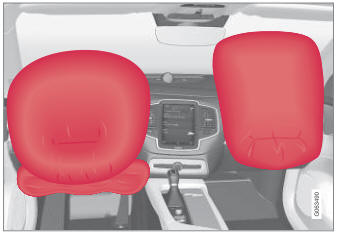
Driver and passenger front airbags.
In a frontal collision, the airbags help protect the driver's and passenger's head, neck, face and chest and the driver's knees and legs.
A collision of sufficient force will trigger the sensors and one or more airbags will inflate. The airbag helps cushion the initial impact of the collision for the occupant. The airbag fabric deflates immediately upon contact during a collision. A small amount of powder will also be released from the airbag. This may appear to be smoke and is normal. The entire process, from inflation to deflation of the airbag, occurs within tenths of a second.
Front Airbag System
The front airbag system includes gas generators surrounded by the airbags, and deceleration sensors that activate the gas generators, causing the airbags to be inflated with nitrogen gas.
As the movement of the seats' occupants compresses the airbags, some of the gas is expelled at a controlled rate to provide better cushioning. The belt tensioners minimize slack in the seat belts and are activated for occu- pants wearing their seat belts. The entire process, from inflation to deflation of the airbag, occurs within tenths of a second.
The location of the front airbags is indicated by SRS AIRBAG embossed on the steering wheel pad and above the glove compartment, and by decals on both sun visors and on the front and far right side of the dash.
The driver's front airbag is folded and located in the steering wheel hub.
The knee airbag is folded on the underside of the dashboard on the driver's side. The text AIRBAG is embossed on the panel.
The passenger's front airbag is folded behind a panel located above the glove compartment.
- The airbags in the vehicle are designed to be a SUPPLEMENT to-not a replacement for-the three-point seat belts. For maximum protection, wear seat belts at all times. Be aware that no system can prevent all possible injuries that may occur in an accident.
- Never ride with your hands on the steering wheel hub/airbag cover.
- Front airbags are designed to help prevent serious injury. Deployment occurs very quickly and with considerable force. During normal deployment and depending on variables such as seating position, one may experience abrasions, bruises, swelling, or other injuries as a result of deployment of one or both of the airbags.
- When installing any accessory equipment, make sure that the front airbag system is not damaged. Any interference with the system may cause a malfunction.
Front Airbag Deployment
- The front airbags are designed to deploy during certain frontal or front-angular collisions, impacts, or decelerations, depending on the crash severity, angle, speed and object impacted. The airbags may also deploy in certain non-frontal collisions where rapid deceleration occurs.
- The airbag system's sensors, which trigger the front airbags, are designed to determine if the collision is powerful enough to activate the belt tensioners and/or the airbags.
However, not all frontal collisions activate the front airbags.
- If the collision involves a nonrigid object (e.g., a snow drift or bush), or a rigid, fixed object at a low speed, the front airbags will not necessarily deploy.
- Front airbags do not normally deploy in a side impact collision, in a collision from the rear or in a rollover situation.
- The amount of damage to the bodywork does not reliably indicate if the airbags should have deployed or not.
- Front airbags deploy only once during a crash. In a collision where deployment occurs, the airbags and seat belt pretensioners activate. A small amount of noise is produced and a small amount of powder is released. The release of the powder may appear as smoke. This is a normal characteristic and does not indicate fire.
- Volvo's front airbags use special sensors that are integrated with the front seat buckles. The point at which the airbag deploys is determined by whether or not the seat belt is being used, as well as the severity of the collision.
- Collisions may occur where only one of the airbags deploys. If the impact is less severe, but severe enough to present a clear injury risk, the airbags are triggered at partial capacity. If the impact is more severe, the airbags are triggered at full capacity.
Should you have questions about any component in the SRS system, please contact a trained and qualified Volvo service technician or Volvo customer support:
In the United States
Volvo Car USA, LLC
Customer Care Center
1 Volvo Drive
P.O. Box 914
Rockleigh, New Jersey 07647
1-800-458-1552
www.volvocars.com/us
In Canada
Volvo Car Canada Ltd.
Customer Care Center
9130 Leslie Street, Suite 101
Richmond Hill, Ontario L4B 0B9
1-800-663-8255
www.volvocars.com/ca
Airbag Decals
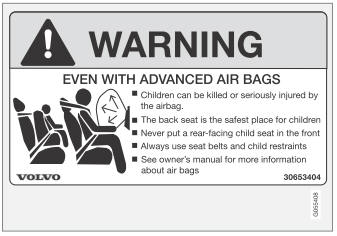
Airbag decal on the outside of both sun visors.
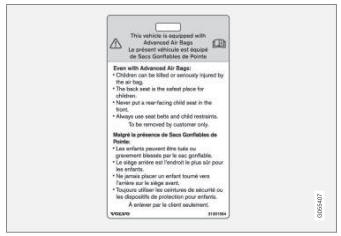
Passenger's side airbag decal.
- Children must never be allowed in the front passenger's seat.
- Occupants in the front passenger's seat must never sit on the edge of the seat, sit leaning toward the instrument panel or otherwise sit out of position.
- The occupant's back must be as upright as comfort allows and be against the seat back with the seat belt properly fastened.
- Feet must be on the floor, e.g., not on the dash, seat or out of the window.
Test yourself
A quick Volvo XC90 quiz: every answer comes with an explanation and a link to the manual page.