Airbag frontali lato guidatore/passeggero
As a supplement to the seat belts, the vehicle is equipped with driver and passenger side front airbags.
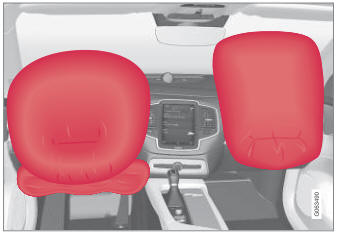
Airbag frontali lato guidatore/passeggero.
In a frontal collision, the airbags help protect the driver's and passenger's head, neck, face and chest and the driver's knees and legs.
Un urto di forza sufficientemente elevata attiverà i sensori e uno o più airbag si gonfieranno. L'airbag aiuta ad attutire l'impatto iniziale per il passeggero. Subito dopo il gonfiaggio, l'airbag si sgonfia. Una piccola quantità di polvere viene anche rilasciata dall'airbag. Questo può sembrare fumo ed è normale. L'intero processo, dal gonfiaggio allo sgonfiamento dell'airbag, avviene in frazioni di secondo.
Sistema airbag frontali
The front airbag system includes gas generators surrounded by the airbags, and deceleration sensors that activate the gas generators, causing the airbags to be inflated with nitrogen gas.
As the movement of the seats' occupants compresses the airbags, some of the gas is expelled at a controlled rate to provide better cushioning. The belt tensioners minimize slack in the seat belts and are activated for occu- pants wearing their seat belts. The entire process, from inflation to deflation of the airbag, occurs within tenths of a second.
La posizione degli airbag frontali è indicata dalla scritta airbag SRS in rilievo sul coprivolante e sopra il vano portaoggetti, e da adesivi su entrambi i parasole e sul lato anteriore e destro estremo del cruscotto.
L'airbag frontale lato guida è ripiegato e si trova nel mozzo del volante.
L'airbag per le ginocchia è ripiegato sul lato inferiore del cruscotto lato guida. La scritta AIRBAG è in rilievo sul pannello.
L'airbag frontale lato passeggero è ripiegato dietro un pannello situato sopra il vano portaoggetti.
- The airbags in the vehicle are designed to be a SUPPLEMENT to-not a replacement for-the three-point seat belts. For maximum protection, wear seat belts at all times. Be aware that no system can prevent all possible injuries that may occur in an accident.
- Non viaggiare mai con le mani appoggiate sul coprivolante/modulo airbag.
- Gli airbag frontali sono progettati per prevenire lesioni gravi. Il gonfiaggio avviene molto rapidamente e con notevole forza. Durante il normale gonfiaggio, e a seconda di variabili come la posizione di seduta, si possono subire abrasioni, contusioni, gonfiori o altre lesioni a causa del gonfiaggio di uno o entrambi gli airbag.
- Quando si installano accessori, assicurarsi che il sistema airbag frontale non venga danneggiato. Qualsiasi interferenza nel sistema può causare un malfunzionamento.
Attivazione dell'airbag frontale
- The front airbags are designed to deploy during certain frontal or front-angular collisions, impacts, or decelerations, depending on the crash severity, angle, speed and object impacted. The airbags may also deploy in certain non-frontal collisions where rapid deceleration occurs.
- The airbag system's sensors, which trigger the front airbags, are designed to determine if the collision is powerful enough to activate the belt tensioners and/or the airbags.
Tuttavia, non tutti gli urti frontali attivano gli airbag frontali.
- If the collision involves a nonrigid object (e.g., a snow drift or bush), or a rigid, fixed object at a low speed, the front airbags will not necessarily deploy.
- Front airbags do not normally deploy in a side impact collision, in a collision from the rear or in a rollover situation.
- The amount of damage to the bodywork does not reliably indicate if the airbags should have deployed or not.
- Gli airbag frontali si attivano una sola volta durante un incidente. In un urto in cui avviene l'attivazione, gli airbag e i pretensionatori delle cinture si attivano. Si sente un leggero rumore e viene rilasciata una piccola quantità di polvere. La polvere rilasciata può sembrare fumo. Questa è una caratteristica normale e non indica un incendio.
- Volvo's front airbags use special sensors that are integrated with the front seat buckles. The point at which the airbag deploys is determined by whether or not the seat belt is being used, as well as the severity of the collision.
- Gli urti possono verificarsi quando si attiva solo uno degli airbag. Se l'impatto è meno grave, ma sufficiente a presentare un chiaro rischio di lesioni, gli airbag si attivano a capacità parziale. Se l'impatto è più grave, gli airbag si attivano a piena capacità.
Should you have questions about any component in the SRS system, please contact a trained and qualified Volvo service technician or Volvo customer support:
Negli Stati Uniti
Volvo Car USA, LLC
Centro assistenza clienti
1 Volvo Drive
P.O. Box 914
Rockleigh, New Jersey 07647
1-800-458-1552
www.volvocars.com/us
In Canada
Volvo Car Canada Ltd.
Centro assistenza clienti
9130 Leslie Street, Suite 101
Richmond Hill, Ontario L4B 0B9
1-800-663-8255
www.volvocars.com/ca
Etichette degli airbag
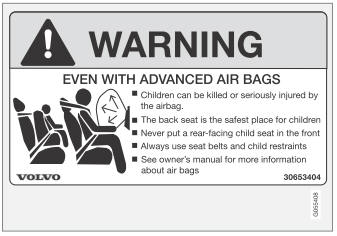
L'etichetta dell'airbag si trova all'esterno di entrambe le alette parasole.
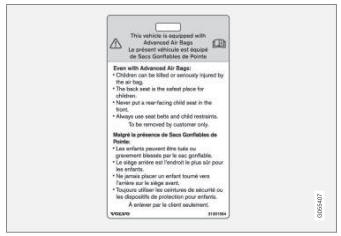
Etichetta dell'airbag laterale lato passeggero.
- I bambini non devono mai sedere sul sedile anteriore lato passeggero.
- Occupants in the front passenger's seat must never sit on the edge of the seat, sit leaning toward the instrument panel or otherwise sit out of position.
- The occupant's back must be as upright as comfort allows and be against the seat back with the seat belt properly fastened.
- Feet must be on the floor, e.g., not on the dash, seat or out of the window.
Mettiti alla prova
Un breve quiz sulla Volvo XC90: ogni risposta ha una spiegazione e un link alla pagina del manuale.