Tire Sidewall Designations
The following information can be found on the tire sidewall.
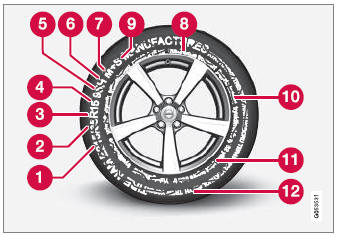
Federal law mandates that tire manufacturers place standardized information on the sidewall of all tires (see the illustration).
The vehicle has been certified with specific wheel and tire combinations.
The following information is shown on the tire sidewall:
Tire designation:
- 215: The width of the tire (in millimeters) from sidewall edge to sidewall edge. The larger the number, the wider the tire.
- 65: The ratio of the tire's height to its width in percent.
- R: Radial tire (the designation RF and the
 symbol indicate that the vehicle is equipped with optional self-supporting run flat tires1.
- 15: The diameter of the wheel rim (in inches).
- 95: The tire's load index. In this example, a load index of 95 equals a maximum load of 1521 lbs (690 kg).
- H: The tire's speed rating, or the maximum speed at which the tire is designed to be driven for extended periods of time, carrying a permissible load for the vehicle, and with correct inflation pressure. For example, H indicates a speed rating of 210 km/h.
- M+S or M/S = Mud and Snow, B = All Terrain, AS = All Season
- DOT. Tire Identification Number (TIN): This begins with the letters "DOT" and indicates that the tire meets all federal standards. The next two numbers are the factory code where the tire was manufactured, the next two are the tire size code and the last four numbers represent the week and year the tire was made. For example, 0717 means that the tire was manufactured during week 7 of 2017. The numbers in between are marketing codes used at the manufacturer's discretion. This information helps a tire manufacturer identify a tire for safety recall purposes.
- Construction and materials used in tires: Indicates the number of plies or the number of layers of rubber-coated fabric in the tire tread and sidewall. Tire manufacturers also must indicate the ply materials in the tire and the sidewall, which include steel, nylon, polyester, and others.
- Maximum load: Indicates the maximum load in pounds and kilograms that can be carried by the tire. Refer to the vehicle's tire information placard located on the B-pillar for the correct tire pressure for your vehicle.
- Tread wear, traction and temperature.
- Maximum permissible inflation pressure: The greatest amount of air pressure that should ever be put in the tire. This limit is set by the tire manufacturer.
Speed Symbol
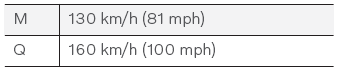
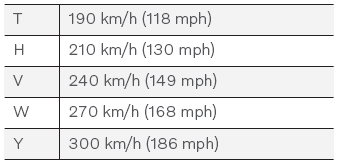
A tire's Speed Symbol (SS) indicates the maximum speed for which the tire has been certified and should be at least equivalent to the vehicle's top speed.
Winter tires, with or without studs, are exceptions and may use a lower SS. When winter tires are installed, the vehicle may not be driven faster than the tires' SS.
The vehicle's speed should always be determined by the posted speed limit and traffic and road conditions, not the tire's SS.
The following table shows the maximum permissible speed for each SS.
- The wheel and tire sizes for your Volvo are specified to meet stringent stability and handling requirements. Unapproved wheel/tire size combinations can negatively affect your vehicle's stability and handling.
- Any damage caused by installation of unapproved wheel/tire size combinations will not be covered by your new vehicle warranty. Volvo assumes no responsibility for death, injury, or expenses that may result from such installations.
1 Self-supporting run flat tires may not be available on all models.
Test yourself
A quick Volvo XC90 quiz: every answer comes with an explanation and a link to the manual page.