Sistema di ritenuta con cintura di sicurezza
AVVERTENZA
- Per la massima protezione offerta dal sistema di ritenuta, le cinture di sicurezza devono sempre essere utilizzate ogni volta che il veicolo è in movimento.
- Le cinture di sicurezza sono più efficaci quando gli schienali dei sedili sono in posizione verticale.
- I bambini di età pari o inferiore a 12 anni devono sempre essere trattenuti correttamente sul sedile posteriore. Non permettere mai ai bambini di viaggiare sul sedile anteriore del passeggero. Se un bambino di età superiore a 12 anni deve sedere sul sedile anteriore, deve essere correttamente allacciato con la cintura e il sedile deve essere spostato il più possibile indietro.
- Never wear the shoulder belt under your arm or behind your back. An incorrect shoulder belt position may cause serious injury in a crash. The shoulder belt should be positioned across the middle of your shoulder and over your collarbone.
- Never fasten the seat belt over fragile objects. In the event of a sudden stop or impact, the seat belt may damage them.
- Avoid using twisted seat belts. A twisted belt cannot perform its function properly. In a collision it may even cut into you. Make sure the belt webbing is flat and not twisted.
- Fare attenzione a non danneggiare la cintura o il meccanismo. Se la cintura o il meccanismo sono danneggiati, sostituirli.
AVVERTENZA
Seat belts are designed to fit the bony structure of the body and should be worn low across the hips or pelvis, chest and shoulders, where applicable; wearing the lap portion of the belt across the abdominal area should be avoided.
Seat belts should be adjusted as closely as possible to fit comfortably, to provide the protection for which they were designed.
Belt slack significantly reduces the protection provided to the occupant. Take care to avoid contaminating the belt webbing with polishes, oils and chemicals, especially battery acid.
Cleaning can be safely performed using mild soap and water. The belt should be replaced if the webbing becomes worn, contaminated or damaged.
The entire assembly must be replaced after it has been subjected to a severe impact, even if damage to the assembly is not apparent. Belts must not be worn with twisted webbing. Each seat belt assembly must be used by one occupant only; it is dangerous to fasten the belt around a child being carried on a passenger's lap.
AVVERTENZA
- No modifications or additions should be made by the user that would prevent the seat belt adjusting devices from working to remove slack or prevent the seat belt assembly from being adjusted to remove slack.
- When fastening the seat belt, be careful not to fasten the seat belt buckle of another seat. This is very dangerous, and you cannot be properly protected by the seat belt.
- Do not unfasten the seat belt, or fasten and unfasten the seat belt several times while driving. This may result in loss of control and a fatal accident, serious injury or property damage.
- When fastening the seat belt, make sure the seat belt does not pass over hard objects or it may easily break.
- Assicurarsi che la fibbia sia agganciata. La cintura di sicurezza potrebbe non essere fissata in modo sicuro.
Front Seat Belt Warning
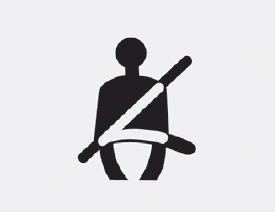
As a reminder, the front seat belt warning lights will illuminate for approximately 6 seconds each time you turn the ignition key ON, regardless of whether the belt is fastened.
If you do not fasten your seat belt and you are driving at a speed below 20 km/h, the warning indicator will remain on until the belt is fastened.
If you do not fasten your seat belt and you are driving at a speed above 20 km/h, the seat belt warning chime will sound for approximately 100 seconds and the corresponding warning light will flash.
If you unfasten your seat belt while driving below 20 km/h, the unbuckled seat belt warning light will remain on until the seat belt is fastened.
AVVERTENZA
Riding in an incorrect position adversely affects the front seat belt warning system. It is important for the driver to instruct the passenger to sit correctly in accordance with the instructions in this manual.
AVVISO
Front passenger seat belt warning (if equipped)
- La spia della cintura di sicurezza del passeggero anteriore si trova al centro del pannello strumenti.
- While the front passenger seat is unoccupied, the seat belt warning light will flash or illuminate for 6 seconds.
- L'avviso della cintura di sicurezza del passeggero anteriore può attivarsi quando un bagaglio viene posizionato sul sedile del passeggero anteriore.
Rear Passenger Seat Belt Unbuckled Warning
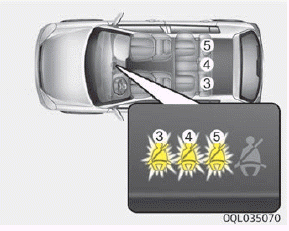
As a reminder, the rear seat belt warning lights will illuminate for approximately 6 seconds each time the ignition is turned ON, regardless of whether the belt is fastened.
Then, the corresponding rear seat unbuckled belt warning light will remain on for approximately 35 seconds if any of the following occurs:
- You start the engine when the rear belt is not fastened.
- You drive at a speed above 9 km/h when the rear belt is not fastened.
- The rear belt is unfastened while driving below 20 km/h.
If the rear seat belt is fastened, the warning light will turn off immediately. If the rear seat belt is unfastened when driving at a speed above 20 km/h, the corresponding unbuckled seat belt indicator will flash and a warning chime will sound for 35 seconds.
However, if the rear passenger's knee/shoulder belt is connected and disconnected twice within 9 seconds after the belt is fastened, the corresponding seat belt warning light will not operate.
Cintura a due punti / a tre punti
Height Adjustment (Front Seat, if equipped)
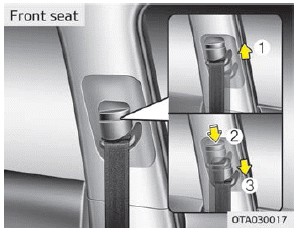
You can adjust the height of the shoulder belt anchor to one of 3 positions for maximum comfort and safety. The height of the adjustable seat belt should not be too close to the neck. The shoulder portion should be adjusted so that it lies across the chest and midway over the shoulder, close to the door, not the neck.
Per regolare l'altezza della cintura di sicurezza, premere il pulsante di rilascio, quindi abbassare o sollevare il regolatore in posizione.
To raise the height adjuster, pull it upward (1). To lower it, press it (3) while pressing the height adjustment button (2). Release the button to lock the anchor in position. Try to move the height adjuster to make sure it is locked in position.
Cinture di sicurezza allacciate in modo non corretto possono causare gravi lesioni in caso di incidente.
AVVERTENZA
- Make sure the shoulder belt anchor is locked in the appropriate height position. Never position the shoulder belt across the neck or face.
- Failure to replace seat belts promptly after an accident may leave you with damaged seat belts that will not provide protection in the event of another collision, leading to personal injury or death. Replace your seat belts as soon as possible after an accident.
Per allacciare la cintura di sicurezza:
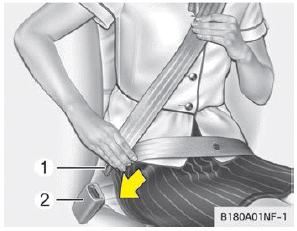
Per allacciare la cintura di sicurezza, estrarre la cinghia dal retrattore e inserire la linguetta metallica (1) nella fibbia (2). Si sentirà un "clic" quando la linguetta si blocca nella fibbia.
La cintura di sicurezza si regola automaticamente alla lunghezza corretta solo dopo che la parte addominale è stata regolata manualmente, in modo che aderisca saldamente alle cosce. Se si si inclina in avanti lentamente e dolcemente, la cintura si estende e consente di muoversi. In caso di frenata brusca o urto, tuttavia, la cintura si blocca in posizione. Si blocca anche se si tenta di inclinarsi in avanti troppo rapidamente.
AVVISO
Se non è possibile estrarre la cintura di sicurezza dall'avvolgitore, tirare la cintura con decisione e poi rilasciarla. In seguito sarà possibile estrarre la cintura con movimento regolare.
AVVERTENZA
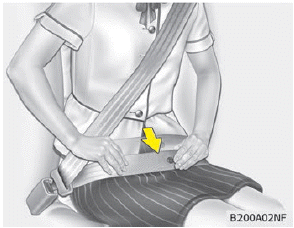
Posizionare la parte addominale della cintura il più in basso possibile e aderente sulle cosce, non sulla vita. Se la cintura addominale è posizionata troppo in alto sulla vita, può aumentare il rischio di lesioni in caso di collisione. Nessuna delle due mani deve trovarsi sotto o sopra la cintura. Piuttosto, deve passare sotto l'altra, come mostrato nell'illustrazione.
Non allacciare mai la cintura di sicurezza sotto il braccio più vicino alla portiera.
Cintura di sicurezza posteriore centrale:

Tenere sempre la piastra (1) e la fibbia (2) bloccate. Tirare la linguetta metallica (3) e inserirla (3) nella fibbia (4). Si sentirà un "clic" quando la linguetta si blocca nella fibbia. Assicurarsi che la cintura non sia attorcigliata.
Quando si utilizza la cintura di sicurezza centrale posteriore, deve essere utilizzata la fibbia contrassegnata con «CENTER».
Per slacciare la cintura di sicurezza:
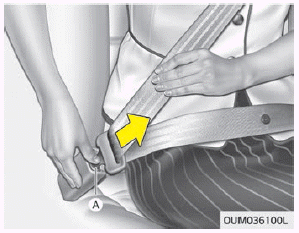
Per slacciare la cintura di sicurezza, premere il pulsante di sblocco (A) sulla fibbia. Quando viene rilasciata, la cintura deve rientrare automaticamente nel retrattore.
Se ciò non accade, controllare che la cintura non sia attorcigliata, quindi riprovare.
Cintura addominale
Per allacciare la cintura di sicurezza:
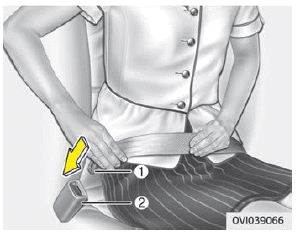
Per allacciare la cintura di sicurezza statica a due punti, inserire la linguetta metallica (1) nella fibbia (2). Si sentirà un "clic" quando la linguetta si blocca nella fibbia. Assicurarsi che la cintura sia bloccata correttamente e che non sia attorcigliata.
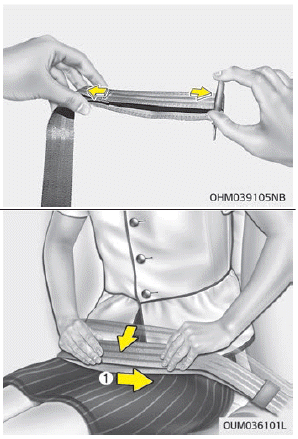
Con la cintura di sicurezza statica a 2 punti, la lunghezza deve essere regolata manualmente in modo che aderisca saldamente al corpo. Fissare la cintura e tirare l'estremità libera per stringerla.
La cintura deve essere posizionata il più in basso possibile, sulle cosce (1), non sulla vita. Se la cintura è troppo alta, può aumentare il rischio di lesioni in caso di incidente.
Quando si utilizza la cintura di sicurezza centrale posteriore, deve essere utilizzata la fibbia contrassegnata con «CENTER».
Per slacciare la cintura di sicurezza:
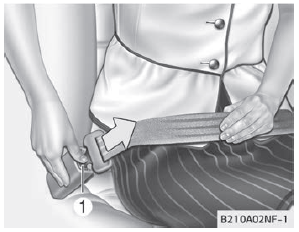
Per rilasciare la cintura, premere il pulsante (1) sulla fibbia.
AVVERTENZA
Il meccanismo di aggancio della cintura centrale è diverso da quello delle cinture a tre punti dei sedili posteriori. Quando si allacciano le cinture dei sedili posteriori o la cintura addominale centrale, assicurarsi di inserirle nella fibbia corretta per la massima protezione del sistema di ritenuta e per garantirne il corretto funzionamento.
Riposizionamento della cintura di sicurezza posteriore

Le fibbie delle cinture posteriori possono essere riposte nella tasca tra lo schienale e il cuscino dei sedili posteriori quando non sono in uso.
Mettiti alla prova
Un breve quiz sulla Kia Picanto JA: ogni risposta ha una spiegazione e un link alla pagina del manuale.