Ziehen
The function of the tires is to carry loads, provide traction on r oad surfaces, reduce vibrations and protect the wheels from wear. The tires significantly influence the vehicle's driving characteristics. The type, dimensions, tire pressure and speed rating have a considerable impact on how the vehicle performs.
Your vehicle is equipped with tires according to the vehicle's tire information placard on the B-pillar (the structural member at the side of the vehicle, at the rear of the driver's door opening).
The tires have good road holding characteristics and offer good handling on dry and wet surfaces. It should be noted however that the tires have been developed to give these features on snow/ice-free surfaces.
Most models are equipped with "all-season" tires, which provide a somewhat higher degree of roadholding on slippery road surfaces than tires without the "all-season" rating. However, Volvo recommends using snow tires on all four wheels for good roadholding on icy or snow-covered roads.
When replacing tires, be sure that the new tires are the same size designation, type (radial) and preferably from the same manufacturer, on all four wheels. Otherwise there is a risk of altering the vehicle's roadholding and handling characteristics.
Empfohlene Reifen
On delivery, the car is equipped with Volvo original tires that have the VOL1 marking on the side of the tires. These tires have been designed specifically for your vehicle. It is therefore important when replacing tires that the new tires have this same marking to help maintain the vehicle's driving characteristics, comfort and fuel consumption.
Neue Reifen
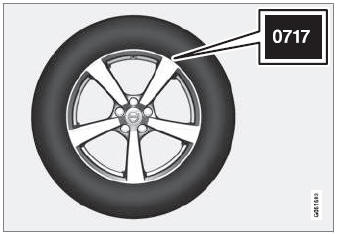
Reifen sind verderbliche Waren. Nach einigen Jahren beginnen sie zu verhärten, und ihre Hafteigenschaften verschlechtern sich allmählich. Ersetzen Sie Reifen immer durch möglichst frische Reifen. Dies ist besonders wichtig für Winterreifen. Auf der Seitenwand des Reifens ist eine Zahlenreihe eingeprägt. Die letzten vier Ziffern dieser Reihe sind das DOT-Kennzeichen (Department of Transportation) und geben die Woche und das Jahr der Herstellung des Reifens an. Der Reifen in der Abbildung hat als letzte vier Ziffern 0717, was bedeutet, dass er in der 7. Woche des Jahres 2017 hergestellt wurde.
Reifenalter
Tires degrade over time, even when they are not being used. It is recommended that tires generally be replaced after 6 years of normal service. Heat caused by hot climates, frequent high loading conditions or Ultra Violet (U.V.) exposure can accelerate the aging process. The temporary spare 2 should also be replaced at 6-year intervals, even if it has never been used. A tire with e.g., visible cracks or discoloration should be replaced immediately.
Reifenwirtschaftlichkeit
- Achten Sie auf den richtigen Reifendruck.
- Vermeiden Sie schnelles Anfahren, starkes Bremsen und scharfes Kurvenfahren.
- Der Reifenverschleiß steigt mit der Geschwindigkeit.
- Eine korrekte Spureinstellung der Vorderräder ist sehr wichtig.
- Unwuchtige Räder verschlechtern die Reifenwirtschaftlichkeit und den Fahrkomfort.
- Reifen sollten während ihrer gesamten Lebensdauer dieselbe Laufrichtung beibehalten.
- When replacing tires, the tires with the most tread should be mounted on the rear wheels to reduce the chance of oversteer during hard braking.
- Stöße durch Bordsteine oder Schlaglöcher können Reifen und/oder Räder dauerhaft beschädigen.
Reifenrotation
Ihr Fahrzeug hat keine vorgeschriebene Reifenrotation. Fahrstil, Reifendruck, Klima und Straßenverhältnisse beeinflussen, wie schnell die Reifen altern und Verschleißerscheinungen zeigen. Das Einhalten des richtigen Reifendrucks trägt dazu bei, dass sich der Profilverschleiß gleichmäßig verteilt.
Um zu verhindern, dass sich unterschiedliche Profiltiefen und Verschleißbilder an den Reifen bilden, sollten die Vorder- und Hinterräder getauscht werden, d. h. die Vorderreifen nach hinten und die Hinterreifen nach vorne. Idealerweise sollte die erste Reifenrotation nach ca. 5000 km (ca. 3100 Meilen) erfolgen und danach in Intervallen von 10.000 km (ca. 6200 Meilen).
If you have any questions regarding tread depth, Volvo recommends consulting an authorized Volvo workshop. If significant differences in wear (> 1 mm difference in tread depth) between the tires have already occurred, the least worn tires should always be mounted on the rear wheels. A front-wheel skid (understeer) is usually easier to control than a rear-wheel skid (oversteer). If the front wheels skid, the vehicle will continue in a straight line instead of the rear wheels skidding to the side, which could cause you to completely lose control of the vehicle. It is therefore important that the rear wheels never lose grip before the front wheels.
Lagerung von Rädern und Reifen
When storing complete wheels (tires mounted on rims), they should be suspended off the floor or placed on their sides on the floor. Tires not mounted on rims should be stored on their sides or standing upright, but should not be suspended.
- The wheel and tire sizes for your Volvo are specified to meet stringent stability and handling requirements. Unapproved wheel/tire size combinations can negatively affect your vehicle's stability and handling.
- Any damage caused by installation of unapproved wheel/tire size combinations will not be covered by your new vehicle warranty. Volvo assumes no responsibility for death, injury, or expenses that may result from such installations.
1 Dies kann je nach Reifengröße variieren.
2 Nicht bei allen Modellen verfügbar.
Testen Sie sich
Ein kurzes Quiz zum Volvo XC90: Zu jeder Antwort gibt es eine Erklärung und einen Link zur Handbuchseite.