Specifications
* Certain specifications are also given in the text of the Chapter, and where compliance is mandatory they are highlighted in bold.
Tightening torques for threaded connections
Fastener tightening torques are given in the text of the Chapter and in some illustrations*.
*Torques shown in bold in the text must be observed exactly; torques not shown in bold are approximate only.
General information
(Refer also to the Chapter “Controls and Safe Driving Practices”).
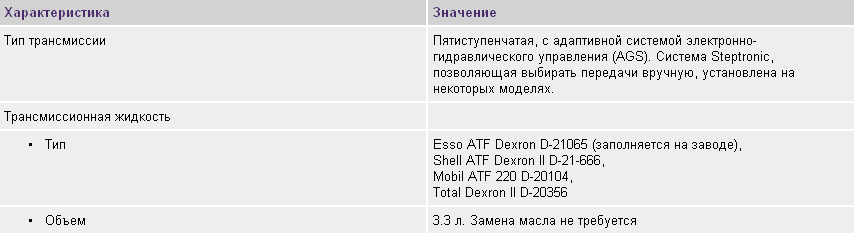
The vehicle may be equipped with a 5-speed automatic transmission. The automatic transmission has electronic-hydraulic shift control (the so-called “EH” control). This means the AT hydraulic system has an electronic control unit that selects the correct shift point depending on vehicle speed and engine load.
To adapt optimally to the driver's individual characteristics and driving conditions, the AT has an adaptive gear shift control system (AGS). When selecting a gear, the system takes into account various conditions, such as driving uphill or downhill, towing a trailer, driving on level ground or stop-and-go traffic, as well as the driver's driving style. The AGS analyzes accelerator pedal movement, vehicle speed, lateral acceleration (cornering) and braking deceleration.
Based on this information, the system determines the driver type and assigns one of four programs available in the control system. The programs are: the highly economical “XE” program, the “E” and “S” programs, and the sporty “XS” program. Drivers who prefer a distinctly sporty driving style set the mode selector to position “4”. On level roads, an additional winter driving program is also activated automatically, which improves traction and driving stability.
Steptronic: AGS system with manual shift gate
Some vehicle models are equipped with the Steptronic AT control system. It has a short shift gate with manual step shifting. This type of gear shifting is common in automobile and motorcycle racing.
In automatic mode, which has only the “D” position for forward driving, the five gears shift automatically using the adaptive control system. In the left gate, the driver selects gears manually. If the driver moves the selector from “D” to “M” in the left gate, the selected gear is held. If the driver pushes the selector forward toward “+”, the transmission shifts up; if toward “-”, it shifts down.
Compared with conventional manual shifting, Steptronic is more comfortable and prevents driving errors such as improper shifts and downshifting at high engine speed. When accelerating without manual intervention, the system automatically shifts up before engine speed drops. When accelerating with the kickdown pedal without using the selector, the transmission always shifts down to the lowest possible gear.
When the vehicle is moving without engine power, the Steptronic system automatically shifts to 3rd gear to provide the necessary engine braking when the engine is reconnected.
To evaluate AT operation and diagnose faults, appropriate experience and special tools are required. For this reason, this Manual describes only AT removal, shift linkage adjustment and fluid replacement.
Automatic transmission removal and installation
Since the removal and installation procedures for the manual transmission and the automatic transmission are similar, the latter are described in the Section “Manual Transmission and AT Removal and Installation”, with AT-specific features highlighted.
Test yourself
A quick BMW 1 quiz: every answer comes with an explanation and a link to the manual page.