Jacking Up and Towing
Jacking Up
When working under the vehicle, it must be supported on a lift or, if no lift is available, on two or four secure support stands.
Never work under the vehicle if it is not securely supported or is supported by only one jack. Danger to life!
1. Only lift an unladen vehicle on a level, hard surface.
2. Chock the wheels that remain on the ground to prevent the vehicle from moving. Do not rely on the parking brake, as it may be released when certain repair work is performed.
3. Position the support so that it is at the side, on the outside of the vehicle.
To prevent damage to the underbody, place a rubber or wooden pad between the stand and the vehicle.
Jacking and Lifting Points
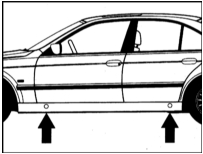
The jacking and lifting points for the vehicle jack and lift are the rubber pads on the lower side member, as shown by the arrows.
Position the vehicle jack so that its base rests fully on the surface and the jack head can engage the rectangular recess in the side member when it is turned.
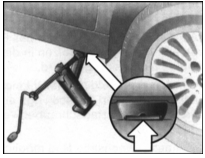
Turn the jack handle to raise the vehicle off the ground. Place the support stands under the vehicle.
Towing
The removable towing eyes are stored in the onboard tool kit and must be screwed into the corresponding locations in the front and rear bumpers before towing.
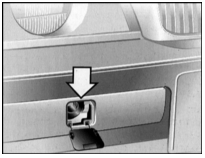
Front Towing Eye
Open the threaded hole. To do this, press the cover marked with an arrow. The cover is located on the right side of the front bumper.
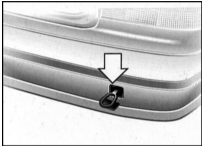
Rear Towing Eye
Open the threaded hole. To do this, press the cover marked with an arrow. The cover is located on the right side of the rear bumper.
TOWING RULES
1. Turn the ignition on to prevent the steering wheel from locking. This keeps the brake lights, horn, and windshield wipers operational.
2. Place the gear selector lever in Neutral. On vehicles with automatic transmission, set the selector to “N”.
3. Turn on the hazard warning lights on both the towed and towing vehicles.
4. The brake and power steering assist only operate with the engine running, so the brake pedal and steering wheel require considerable effort!
5. Use of a towing bar is recommended. When using a towing cable, there is a risk of one vehicle colliding with the other. The towing cable must be sufficiently elastic to protect both vehicles from dynamic shocks. For this purpose, a synthetic fiber towing cable or a cable with intermediate elastic elements is recommended.
Vehicles with Automatic Transmission
Selector lever position: “N”
Maximum towing speed: 70 km/h!
Maximum towing distance: 150 km!
If the AT is damaged: To tow at higher speeds or over longer distances, the drive wheels must be lifted off the ground. The reason is as follows. With the engine off, the AT pump does not operate, so there is no adequate lubrication.
When using a flatbed transporter: The vehicle may only be towed with the drive wheels lifted off the ground.
Starting the Engine by Towing
Starting the engine of a vehicle with an AT by towing is not possible.
The vehicle may only be started when the engine is cold, otherwise the catalytic converter may be damaged.
PROCEDURE
1. Turn the ignition on.
2. Depress the accelerator.
3. Engage 3rd gear, depress the clutch pedal and hold it.
4. Start towing or push the vehicle.
5. Slowly release the clutch.
Test yourself
A quick BMW 1 quiz: every answer comes with an explanation and a link to the manual page.