Automotive Chemicals, Oils and Lubricants
A wide range of chemicals, oils and lubricants required for routine maintenance and repair procedures is available on the market. This includes a broad range of chemical and petroleum products, from cleaning agents and solvents to oils, greases and aerosols for protecting the rubber and plastic components of the vehicle.
Cleaners
Fuel injection and throttle body cleaner is a powerful solvent for resins, deposits and carbon buildup. Most cleaners leave a dry lubricating film that does not harden or gum up over time. Because of this film, these cleaners are not recommended for cleaning electrical components.
Brake cleaner is used to remove grease and brake fluid residue from brake system components where absolute cleanliness is essential for proper operation. The cleaner leaves no residue and in many cases eliminates brake squeal caused by contamination of brake components.
Electrical contact cleaner removes oxide films, corrosion and deposits from contact surfaces without affecting electrical conductivity. It can also be used to clean spark plugs, carburetor jets, voltage regulators and other components where complete removal of oil and grease is required.
Moisture displacers are used to remove water and moisture from electrical components such as the alternator, voltage regulator, fuse block, electrical connectors, etc. Moisture displacers are generally non-conductive, non-corrosive and non-flammable.
Degreasers are super-strong solvents used to remove grease from the external surfaces of the engine and chassis components. They are supplied as aerosols or applied with a brush, and depending on the type, are rinsed off either with water or with a solvent.
Lubricating Fluids
Engine oils are specially formulated compounds for lubricating internal engine components. They usually contain a wide range of additives that prevent foaming and corrosion. Engine oils are available in different viscosity grades, from 5 to 80. The choice of oil grade is usually determined by climatic conditions and the requirements of the specific engine. Thin (light) oils are normally used in cold climates and under light engine loads. Heavy (viscous) oils are used in hot conditions and under high engine loads. Multigrade oils have the characteristics of both light and heavy oils and are usually designated from 5W-20 to 20W-50.
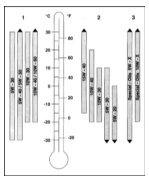
Engine oil viscosity chart 1 — BMW 525tds
2 — BMW 520i, 523i, 528i, 535i, 540i
3 — special engine oil grades for BMW petrol and diesel engines
Transmission fluid is designed for use in differentials, transmissions, and other components where resistance to high temperatures is required.
Chassis and wheel bearing grease is a heavy grease used in components subject to high loads and friction, such as wheel bearings, ball joints, tie rod ends, and driveshaft universal joints.
High-temperature wheel bearing grease is capable of withstanding the high temperatures generated in the wheel bearings of vehicles equipped with disc brakes. It usually contains molybdenum disulfide, which is a dry lubricant.
White grease (lithium-based) is a heavy grease applied to metal surfaces in contact with each other in areas where excessive moisture is a problem. It remains soft at both low and high temperatures and is not washed out or thinned by water.
Assembly lube is a special high-pressure lubricant, usually containing molybdenum, used to lubricate components subject to high loads (such as main and connecting rod bearings and camshaft lobes) before the first engine start after an engine overhaul.
Silicone lubricants are used to protect rubber, plastic, vinyl, and nylon components.
Graphite lubricants are used where oil cannot be used due to contamination problems (for example, in locks). Dry graphite lubricates metal parts well and protects them from moisture, acids, and other aggressive contaminants. The lubricant is electrically conductive and does not interfere with contact in components such as the ignition switch.
Molybdenum penetrating lubricants are used to help loosen seized fasteners and to lubricate fasteners to prevent future corrosion.
Heat transfer compound is electrically non-conductive and is used when installing electronic ignition modules that require intensive heat dissipation.
Sealants
RTV sealant is the most widely used gasket sealant. It is silicone-based, cures in air, provides sealing and bonding, is waterproof, fills surface imperfections, remains flexible, does not shrink or sag, is relatively easy to remove, and is used in addition to almost all gaskets in areas where temperatures do not exceed moderate values.
Anaerobic sealant, unlike RTV sealant, can be used not only in addition to gaskets but also to form them. It remains flexible, is resistant to solvents, and fills surface irregularities well. The main difference from RTV sealant is the curing conditions. While RTV sealant begins to cure after exposure to air, anaerobic sealant cures only in the absence of air. This means that this sealant cures only after the components are assembled and pressed tightly together.
Pipe and thread sealant is used to seal fittings of hydraulic, pneumatic, and vacuum lines. It is usually made from a PTFE compound and supplied as an aerosol, a brush-on liquid, or as tape (PTFE tape).
Chemicals
Anti-seize compound prevents seizing, corrosion, binding, and galling of fasteners. High-temperature anti-seize compounds are usually made from copper-based or graphite-based greases and are used on exhaust system and exhaust manifold fasteners.
Anaerobic thread locking compounds prevent fasteners from loosening spontaneously due to vibration and cure only after installation in the absence of air. Medium-strength thread locking compounds are used to secure small fasteners (nuts, bolts, screws) that may need to be loosened regularly later. High-strength compounds are usually used to lock large fasteners that are not loosened on a regular basis.
Oil additives are used to change the chemical properties of oil without changing its viscosity, with the aim of reducing internal friction in the engine. It should be noted that most manufacturers of engine oils warn against using any additives with them.
Fuel additives perform several functions at once, depending on their chemical composition. They usually contain solvents that help remove sludge and clean deposits from the internal surfaces and components of the fuel injection system and intake tract. In addition, this type of additive helps remove carbon deposits that form on combustion chamber walls. Some additives contain substances that lubricate upper cylinder head components (valve train, piston rings), while others help remove condensation from fuel tank walls.
Miscellaneous
Brake fluid is a specially developed fluid capable of withstanding the high temperatures and pressures generated in the brake system. Do not allow brake fluid to contact painted vehicle surfaces or exposed skin. Keep brake fluid in a tightly sealed container to prevent moisture (the fluid is highly hygroscopic) and dirt from entering it.
Body opening weatherstrip adhesive, as its name suggests, is used to bond weatherstrips for door, window, and trunk lid openings. It may also be used to secure interior trim components.
Underbody coating is a tar-like compound made from a petroleum base. It is used as a protective coating for metal surfaces to prevent corrosion. It also performs a soundproofing function in the passenger compartment.
Waxes and polishes are used to protect painted surfaces from environmental effects. Different types of paint may require different types of waxes and polishes. Some polishes contain abrasive or chemical additives designed to remove the outer layer of oxidation (dullness) from painted surfaces of older vehicles. Recently, various wax-free polishes containing many chemical additives, such as polymers or silicone-based substances, have become widely available on the market. Such polishes are usually easier to apply and last longer than conventional (wax) products.
Test yourself
A quick BMW 1 quiz: every answer comes with an explanation and a link to the manual page.