Tire Condition
Regularly check the tires for damage and foreign objects, paying attention to the degree of wear and tread depth.
Minimum Tread Depth
Tread depth must be at least 3 mm. If tread depth is less than 3 mm, there is a risk of hydroplaning at high speed, even on a very thin film of water on the road.
When the remaining tread depth is less than 4 mm, the suitability of winter tires for winter conditions is noticeably reduced. Therefore, for safety reasons, they must be replaced.
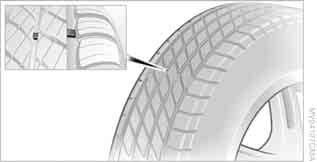
Tread wear indicators (see arrows) marked TWI (Tread Wear Indicator) are distributed around the circumference of the tyre on the sidewall. When the tread depth reaches 1.6 mm, these indicators signal that the legally prescribed wear limit of the tyre has been reached.
Tire Damage
Unusual vibrations while driving may indicate tyre damage or another vehicle defect. This may be the result of driving over an obstacle, for example a kerb. Any other unusual vehicle behaviour, such as sudden pulling to the left or right, should also be treated as a warning.
 In this case, have the wheels and tyres checked as soon as possible. Reduce speed immediately and drive to a BMW Service Centre, or have the vehicle towed there.
Damaged tires endanger the lives of the vehicle occupants and other road users.◄
Tire Age
Tyres age over time, so BMW recommends replacing all tyres, regardless of their actual wear, at least every six years. This also applies to the compact spare wheel.
The tire manufacturing date is shown on the marking:
DOT…1208 means that the tyre was manufactured in week 12 of 2008.
Test yourself
A quick BMW X3 quiz: every answer comes with an explanation and a link to the manual page.