Wheels and Tires
Tires
Every new GM vehicle has high-quality tires made by a leading tire manufacturer. See the warranty manual for information regarding the tire warranty and where to get service. For additional information refer to the tire manufacturer.
• Poorly maintained and improperly used tires are dangerous.
• Overloading the tires can cause overheating as a result of too much flexing.
There could be a blowout and a serious crash.
• Underinflated tires pose the same danger as overloaded tires. The resulting crash could cause serious injury.
Check all tires frequently to maintain the recommended pressure.
Tire pressure should be checked when the tires are cold.
• Overinflated tires are more likely to be cut, punctured, or broken by a sudden impact— such as when hitting a pothole. Keep tires at the recommended pressure.
• Worn or old tires can cause a crash. If the tread is badly worn, replace them.
• Replace any tires that have been damaged by impacts with potholes, curbs, etc.
• Improperly repaired tires can cause a crash. Only the dealer or an authorized tire service center should repair, replace, dismount, and mount the tires.
• Do not spin the tires in excess of 56 km/h on slippery surfaces such as snow, mud, ice, etc. Excessive spinning may cause the tires to explode.
All-Season Tires
This vehicle may come with all-season tires. These tires are designed to provide good overall performance on most road surfaces and weather conditions. Original equipment tires designed to GM's specific tire performance criteria have a TPC specification code molded onto the sidewall. Original equipment all-season tires can be identified by the last two characters of this TPC code, which will be “MS.” Consider installing winter tires on the vehicle if frequent driving on snow or ice-covered roads is expected. All-season tires provide adequate performance for most winter driving conditions, but they may not offer the same level of traction or performance as winter tires on snow or ice-covered roads.
Winter Tires
This vehicle was not, originally, equipped with winter tires. Winter tires are designed for increased traction on snow and ice-covered roads. Consider installing winter tires on the vehicle if frequent driving on snow or ice-covered roads is expected.
With winter tires, there may be decreased dry road traction, increased road noise, and shorter tread life. After changing to winter tires, be alert for changes in vehicle handling and braking.
If using winter tires:
• Use tires of the same brand and tread type on all four wheel positions.
• Use only radial ply tires of the same size, load range, and speed rating as the original equipment tires.
Winter tires with the same speed rating as the original equipment tires may not be available for H, V, W, Y, and ZR speed rated tires. If winter tires with a lower speed rating are chosen, never exceed the tire's maximum speed capability.
Summer Tires
This vehicle may come with high performance summer tires. These tires have a special tread and compound that are optimized for maximum dry and wet road performance. This special tread and compound will decrease performance in cold climates, and on ice and snow. We recommend installing winter tires on the vehicle if frequent driving in cold temperatures or on snow or ice covered roads is expected.
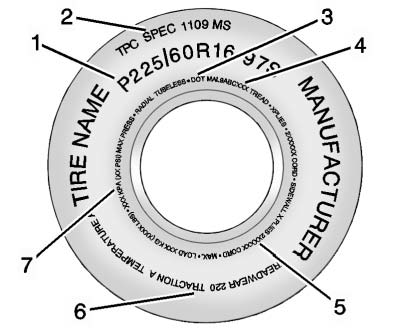
Tire Sidewall Labeling
Useful information about a tire is molded into its sidewall. The examples show a typical passenger vehicle tire and a compact spare tire sidewall.
Test yourself
A quick Chevrolet Equinox quiz: every answer comes with an explanation and a link to the manual page.