Young Child Safety
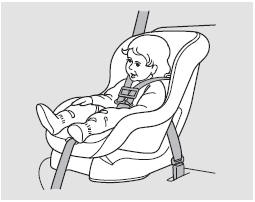
Types of Child Restraints
A child aged one year or older who meets the minimum height and weight requirements may be moved from a rear-facing child restraint to a forward-facing child restraint. Observe local regulations and follow the instructions for using the child restraint.
Many experts recommend using rear-facing child restraints until the child reaches the age of two, provided the child's height and weight are suitable for this type of restraint.
Of the wide variety of child restraint systems, we recommend choosing those equipped with a five-point harness system (see illustration).
We also recommend keeping young children in child restraint systems for as long as possible, provided that their height and weight allow it.
For a list of child restraints recommended for use in European countries, refer to page 56.
Installing Child Restraint Systems
We strongly recommend installing child restraint systems in which the child faces forward on the rear seat rather than the front seat of the vehicle.
If your vehicle is equipped with a front passenger airbag, installing a forward-facing child restraint system on the front seat may be dangerous.
If the front passenger seat is positioned too close to the instrument panel, or if the child's head moves sharply forward in a frontal collision, the deploying airbag may cause serious injury or even death to the child.
If it is necessary to install a forward-facing child restraint system on the front passenger seat, move the seat fully rearward, and make sure the child restraint system is securely fastened to the front passenger seat and that the child is properly and securely restrained in the child restraint system.
Do not install a forward-facing child restraint system on the front passenger seat. In a collision, the rapidly inflating airbag can kill or seriously injure the child.
If it is necessary to install a child restraint system on the front passenger seat, move the seat as far as possible from the instrument panel and properly secure the child restraint system installed on it.
When purchasing a child restraint system, you may choose either a standard child restraint system or a special child restraint system that is secured using the lower anchorages and the top tether strap.
A standard child restraint system should be secured to the vehicle seat using the vehicle seat belt.
A child restraint system designed for attachment using lower anchorages is secured with the brackets (anchors) provided at all rear seating positions.
Child restraint systems compatible with lower anchorages are simple to install, and the possibility of incorrect installation is minimized. Therefore, if your vehicle is equipped with lower anchorages for installing child restraint systems, we recommend purchasing a special child restraint system compatible with them.
When selecting such a child restraint system, we recommend giving preference to systems with rigid rather than flexible attachments.
Child restraint systems with flexible attachments are not supplied to EU countries.
If the vehicle does not have lower anchorages, a special child restraint system can be installed in the standard way, using the vehicle seat belt.
Regardless of the type of child restraint system, the three requirements below must be met to ensure child protection:
1. The child restraint system must comply with safety standards. In most European countries, child restraint systems must meet the requirements of UN ECE Regulation No. 44.
Check for the special certification mark on the product itself and on its packaging. The vehicle manufacturer is not responsible for damage caused by defects in recommended child restraint systems.
Test yourself
A quick Honda CR-V quiz: every answer comes with an explanation and a link to the manual page.