Body Electrical System
Description and Operation
In this manual: Body Electrical System
8steps
~48min
2/5difficulty
Done 0 of 8
Description
LKAS (Lane Keeping Assist System): The system is designed to help recognize the lane ahead and provide a lane departure warning when the vehicle begins to drift out of its lane, using the camera image and vehicle signal information. Typical operating conditions of the LKAS controller. Note that the operating conditions are adapted to customer requirements.- Vehicle speed within 60 km/h – 200 km/h
- Lane markings are clearly visible.
- Driver does not overload the system by applying excessive torque to the steering wheel.
- Turn signals (including hazard warning signals) are off.
- Lane width from 2.7 m to 4.2 m.
- Lane curvature greater than 250 m.
- Absolute lateral acceleration of the vehicle < 2.5 m/s2.
- Driver's hands on the steering wheel.
- Vehicle does not exceed the lane boundaries by more than 0.3 m.
- Absolute steering wheel angle < specified value (for example, 90 degrees)
- Maximum allowable application time of maximum torque is not exceeded. (90 seconds)
- Reverse or city mode EPS is not activated.
- No system malfunctions are present.
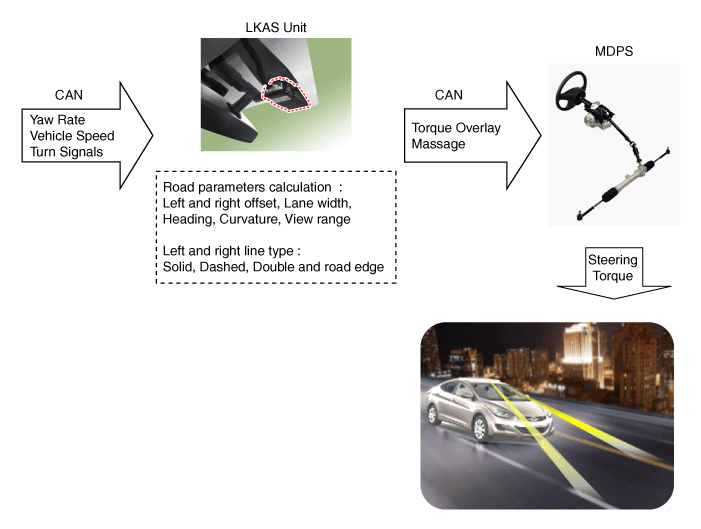
- Lane Keeping Assist System (LKAS): The system is designed to help recognize the lane ahead and provide a lane departure warning when the vehicle begins to drift out of its lane, using the camera image and vehicle signal information.
- High Beam Assist (HBA): Detects headlights and taillights of vehicles ahead and turns the high beams on/off.

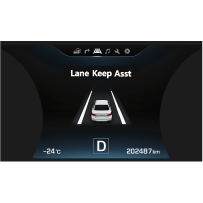
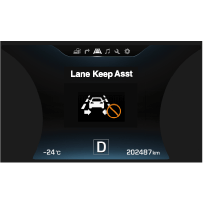
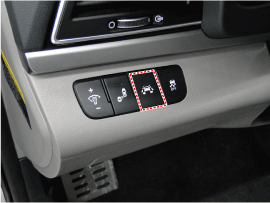
- Press the LKAS switch to turn on the LKAS indicator on the instrument cluster and the lane departure warning system status display in the center of the instrument cluster. The various LDWS states are shown in the following table.
Lane not detected Lane detected and LKAS is on LKAS canceled 

Right-side departure Left-side departure LKAS canceled 

- High Beam Assist (Multifunction Switch Auto/High Beam Position)
Description Show Status in Cluster Notes Illuminates in the cluster when HBA is on. 
Vehicle speed of 45 km/h and above - When the LKAS switch is pressed, LKAS is turned on while the LDWS indicator is illuminated. When the LKAS switch is pressed again, LKAS is turned off and the indicator goes off.
- High Beam Assist Switch: The automatic high beam control system is activated if the lighting switch on the multifunction switch is set to AUTO and the lighting switch is set to high beam (pressed).
A. If the lighting switch is not set to AUTO or high beam, the automatic high beam control system is deactivated. 
- Visual warning: A warning is displayed in the instrument cluster.
- Audible warning: A warning sound is emitted from the speakers connected to the instrument cluster or, if an external amplifier is present, from the speakers connected to the external amplifier.
|

Test yourself
A quick Hyundai Elantra AD quiz: every answer comes with an explanation and a link to the manual page.
Was this page helpful?