Braking System
EBD (Electronic Brakeforce Distribution) Description and Operation
In this manual: Braking System
~1min read
Description
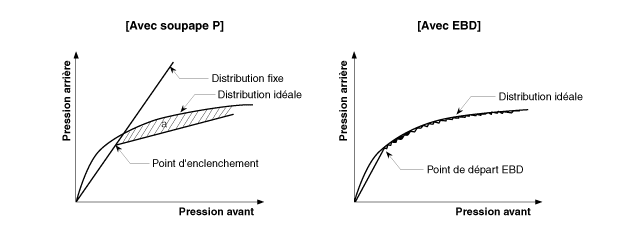
The EBD (Electronic Brakeforce Distribution) system, which is a component of the ABS system, has a rear wheel grip control function. It uses the latest ABS hardware and monitors rear wheel slip in the partial braking zone. Braking force is optimally regulated and controlled electronically, eliminating the need for a proportioning valve. A mechanical proportioning valve cannot ideally distribute braking force to the rear wheels and cannot provide flexible braking force distribution proportional to vehicle load or increased weight. Furthermore, in the event of a malfunction, the driver cannot tell whether it is faulty or not. The EBD, controlled by the ABS control module, continuously calculates the slip speed of each wheel and checks that the rear wheel brake pressure does not exceed the front wheel brake pressure. In the event of a failure, the EBD warning lamp (parking brake signal) illuminates. ADVANTAGES- Improved basic brake system.
- Compensation for different friction coefficients.
- Removal of Proportioning Valve.
- Malfunction indication by warning lamp.
Test yourself
A quick Hyundai i20 quiz: every answer comes with an explanation and a link to the manual page.
Was this page helpful?