Four-Wheel Drive (4WD) System
Direct Electro-Hydraulic Coupling Description and Operation
In this manual: Four-Wheel Drive (4WD) System
6steps
~36min
2/5difficulty
Done 0 of 6
Description
The 4WD ECU processes signals from various sensors and determines the current road and driving conditions. The ECU then uses this information to precisely control the multi-plate 4WD clutch and smoothly adjust the amount of torque transmitted to the rear wheels. 4WD Transfer Mode Selection- AUTO MODE:
- When driving in 4WD AUTO mode, the vehicle operates similarly to conventional four-wheel drive vehicles under normal driving conditions. However, if the system determines that there is a need for 4WD, engine power is distributed to all four wheels automatically without driver intervention.
- When driving on normal roads and paved surfaces, the vehicle moves similarly to conventional four-wheel drive vehicles.
- LOCK MODE:
- This mode is used for climbing or descending steep slopes, off-road driving, driving on sand and muddy roads, etc., to maximize traction.
- This mode automatically begins to disengage at speeds above 30 km/h and switches to 4WD AUTO mode at speeds above 40 km/h. If the vehicle speed drops below 30 km/h, however, the transfer mode switches back to 4WD LOCK mode.
- Cruise (Auto Mode) - Power is mainly transmitted to the front wheels.
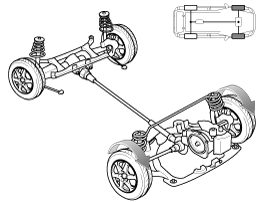
- Cornering (Auto Mode) - Adjusts the amount of power to the rear wheels depending on the turning radius and cornering speed.
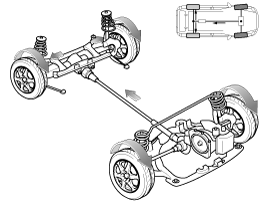
- Wheel Slip (Automatic Mode) - If one or both front wheels lose traction, the system transfers the corresponding amount of power to the rear wheels depending on the amount of slip on the front wheels.
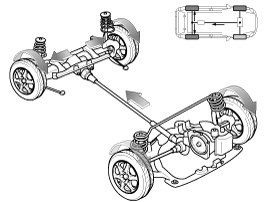
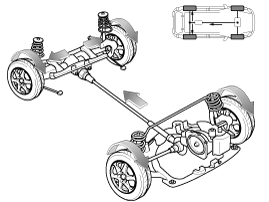
- Lock Mode - Maximizes off-road performance (active only at speeds below 40 km/h).
Test yourself
A quick Hyundai Kona quiz: every answer comes with an explanation and a link to the manual page.
Was this page helpful?