Forward Collision-Avoidance Assist Limitations
The Forward Collision-Avoidance Assist system may not operate normally or may operate unexpectedly if:
- The front view camera or front radar is blocked, covered, or damaged by snow, water, or dirt.
- The temperature near the front view camera is very hot or cold.
- The camera lens is covered or blocked by window tint, the windshield is damaged, or sticky material (sticker, bug, etc.) is on the glass.
- Moisture is not removed or freezes on the windshield.
- Washer fluid is sprayed continuously, or the wipers are on.
- Driving in heavy rain or snow, or in dense fog.
- Sunlight blocks the field of view of the front view camera.
- Sunlight, street lights, or lights from an oncoming vehicle are reflected on a wet road surface, such as a puddle on the road.
- An object is placed on the instrument panel.
- Your vehicle is being towed.
- The surroundings are very bright or very dark (night, tunnel, etc.).
- The brightness changes suddenly, for example when entering or exiting a tunnel.
- The outside brightness is low, and the headlights of the vehicle ahead are off or not bright.
- The vehicle, pedestrian, or cyclist ahead is partially visible.
- The vehicle ahead is a bus, heavy truck, truck with an unusual shape, trailer, etc.
- The vehicle ahead does not have taillights, or the taillights are located in an unusual position.
- In low light conditions, the taillights of the vehicle ahead are off or not bright.
- The rear of the vehicle ahead is small, or the vehicle does not appear normal, for example when your vehicle is tilted, overturned, or the side of your vehicle is visible.
- The ground clearance of the vehicle ahead is too low or too high.
- A vehicle, pedestrian, or cyclist suddenly cuts in front of you.
- The bumper is damaged or the front radar is misaligned due to an impact to the front bumper.
- The temperature near the front radar is very hot or cold.
- Nearby material that reflects very well to the front radar, such as guardrails, a closely parked vehicle, etc.
- The vehicle ahead is made of a material that does not reflect the front radar well.
- The vehicle ahead is detected late.
- The vehicle ahead is suddenly blocked by an obstacle.
- The vehicle ahead suddenly changes lanes or decelerates.
- Your vehicle changes lanes at low speed in front of a vehicle ahead.
- The vehicle ahead is covered with snow.
- You are leaving or entering an alley.
- You are on a curve or roundabout and the vehicle ahead is not detected.
- You are constantly driving in a circle.
- The vehicle ahead has an unusual shape.
- The vehicle ahead is driving uphill or downhill.
- Only a part of the vehicle, pedestrian, or cyclist is detected. For example, if the pedestrian is leaning or not walking straight.
- The pedestrian or cyclist wears clothing or equipment that makes them difficult to detect.
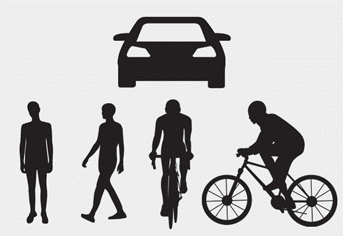
The illustration above shows that the front view camera and front radar are able to detect a vehicle, pedestrian, and cyclist.
- The pedestrian or cyclist ahead is moving very fast.
- The pedestrian or cyclist ahead is short.
- The pedestrian or cyclist ahead has limited mobility.
- The path of the pedestrian or cyclist ahead is moving at an angle to the path of your vehicle.
- There is a group of pedestrians or cyclists in front of your vehicle.
- The pedestrian or cyclist wears clothing that blends easily into the background, making them difficult to detect.
- The pedestrian or cyclist is difficult to distinguish from similarly shaped structures in the surroundings.
- You are driving past a pedestrian, cyclist, road sign, or other structures near an intersection.
- You are driving through steam, smoke, or shadows.
- You are driving through a tunnel or under an iron bridge.
- You are driving across a large open area with few vehicles or structures (for example, a desert, a meadow, or an empty suburb).
- You are driving in a parking lot.
- You are passing through a toll gate, construction site, unpaved road, partially paved road, uneven road, speed bumps, etc.
- You are driving on roads with railway tracks or other embedded metal objects.
- You are driving on a sloped road or a winding road.
- You are driving along a roadside with trees or street lights.
- You are driving on a narrow road where trees or grass are overgrown.
- You are driving in an area with strong radio wave or electrical interference.
- Your vehicle is moving unstably or vibrating excessively.
- The height of your vehicle is lowered or raised due to heavy loads, incorrect tire pressure, etc.
WARNING
- Driving on Curves
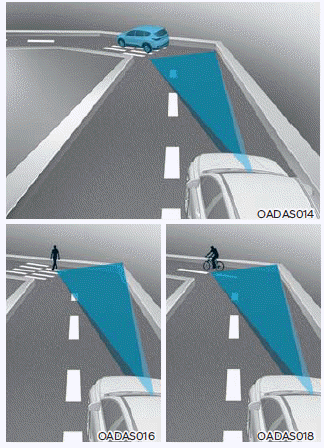
Forward Collision-Avoidance Assist may not detect other vehicles, pedestrians, or cyclists ahead of you when driving through a curve, and may not activate the warning or brake the vehicle when necessary.
When driving through a curve, always keep a safe distance from other vehicles on the road. Reduce your vehicle speed or steer the vehicle as necessary.
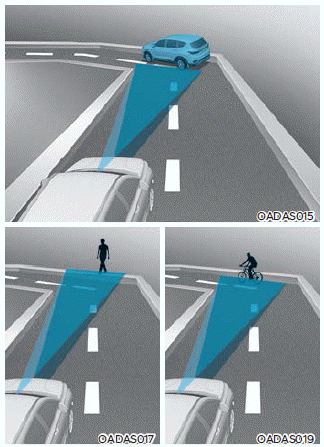
If a vehicle, pedestrian, or cyclist is detected in an adjacent lane or outside the driving lane when driving through a curve, Forward Collision-Avoidance Assist may warn you and may brake the vehicle even when it is not necessary.
Always check road conditions, and if necessary, take appropriate measures to drive carefully.
Driving on Hills
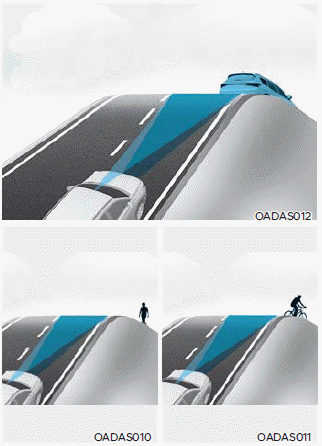
Forward Collision-Avoidance Assist may not detect other vehicles, pedestrians, or cyclists ahead of you when driving uphill or downhill.
This may result in unnecessary warnings or braking assistance, or no warnings or braking assistance when needed.
In addition, your vehicle's speed may decrease rapidly when a vehicle, pedestrian, or cyclist suddenly appears ahead. Always maintain a safe distance from other vehicles on the road. Adjust your vehicle speed or drive your vehicle according to road conditions.
Lane Change Assist
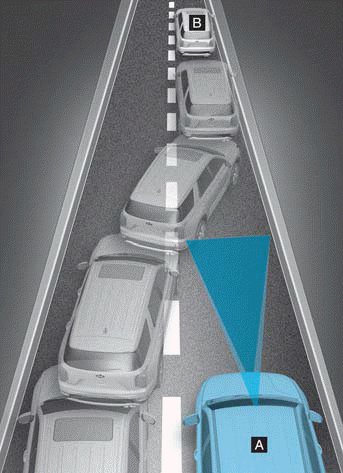
A: Your vehicle,
B: Vehicle changing lanes
When a vehicle enters your lane from an adjacent lane, it cannot be detected by the sensor until it is within the sensor's detection zone. Forward Collision-Avoidance Assist may not immediately detect a vehicle that changes lanes suddenly.
Always maintain a safe distance from the vehicle ahead. Adjust your vehicle speed or drive your vehicle according to road conditions.
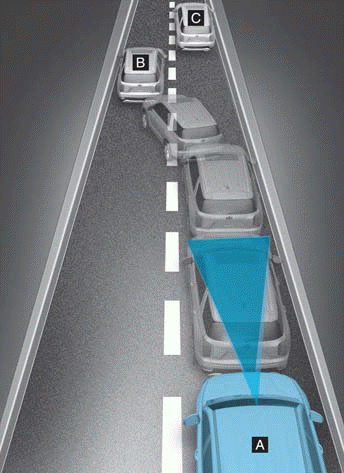
A: Your vehicle,
B: Vehicle leaving the lane,
C: Another vehicle in your lane
When the vehicle ahead moves out of the lane, Forward Collision-Avoidance Assist may not immediately detect another vehicle in your lane.
Always maintain a safe distance from the vehicle ahead. Adjust your vehicle speed or drive your vehicle according to road conditions.
Vehicle Detection
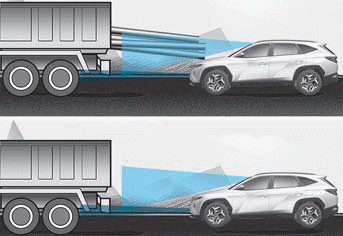
Forward Collision-Avoidance Assist may not be able to detect all potential hazards, for example, if the vehicle ahead is carrying a load that extends beyond the rear of the vehicle, or if the vehicle ahead is higher than your vehicle. Always maintain a safe distance from the vehicle ahead. Adjust your vehicle speed or drive your vehicle according to road conditions.
WARNING
- When towing a trailer or another vehicle, turn off Forward Collision-Avoidance Assist.
- Forward Collision-Avoidance Assist may detect objects that are similar in shape or characteristics to vehicles, pedestrians, and cyclists.
- Forward Collision-Avoidance Assist may not detect bicycles, motorcycles, or smaller objects on wheels, such as luggage carts, shopping carts, or strollers.
- Forward Collision-Avoidance Assist may not operate normally if there is interference from strong electromagnetic waves.
- Forward Collision-Avoidance Assist may not operate correctly for 15 seconds after starting the vehicle or while the front view camera is initializing.
Test yourself
A quick Hyundai Tucson LM quiz: every answer comes with an explanation and a link to the manual page.