Rücksitzeinstellung
Headrest
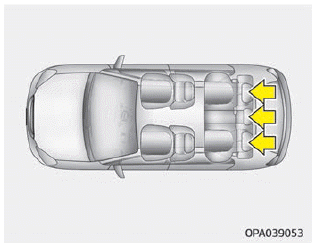
The rear seats are equipped with headrests to improve comfort and safety for occupants.
Die Kopfstütze bietet nicht nur Komfort für Fahrer und Beifahrer, sondern sie stützt auch den Kopf und den Nacken im Fall einer Kollision ab.
WARNING
- For maximum effectiveness in the event of an accident, the headrest should be adjusted so that the center of the headrest is level with the center of gravity of the front passenger's head. In general, the center of gravity of the head of most people is approximately at the level of the upper eye corner. Also adjust the headrest so that it is as close as possible to your head. For this reason, do not use an additional cushion that increases the distance between your back and the seatback.
- Do not drive the vehicle if the headrests have been removed. In the event of an accident, this may result in serious injury to the occupant. When used correctly, headrests provide protection against neck injuries.
Einstellung der Höhe
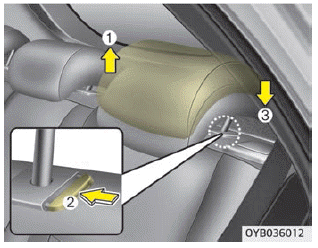
To move the headrest to a higher position, pull it up to the desired position (1). To move the headrest to a lower position, press the release button (2) on the headrest guide, hold the button down, and press the headrest down to the desired position (3).
Removal and Installation
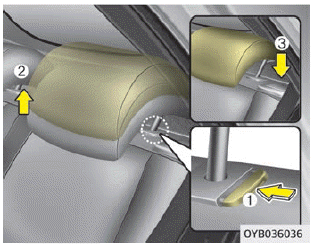
To remove the headrest, pull the headrest up to the stop. Then press the release button (1) and simultaneously pull the headrest further up (2). To install a headrest, hold the release button (1) down and slide the headrest posts (3) into the openings. Then adjust the height accordingly.
WARNING
Make sure the headrest locks into position after adjustment to properly protect the vehicle occupants.
Folding Rear Seat
Die Rücksitzlehnen können umgeklappt werden, um den Transport längerer Gegenstände zu erleichtern oder um die Ladekapazität des Fahrzeugs zu vergrößern.
WARNING
The folding rear seatbacks allow you to transport longer items that otherwise could not be accommodated.
Never allow passengers to ride on folded seatbacks. This is not a proper seating position, and no seat belts are provided for this use. Riding in this way could result in serious or fatal injury in an accident or sudden braking. If items are transported on folded seats, they must not be higher than the front seats. Otherwise, the cargo could slide forward during sudden braking and cause injury or damage.
Die Hinteren Rückenlehnen können nach vorn geklappt werden, um Zugang zum Laderaum und zusätzlichen Laderaum zu gewinnen.
- To raise the seatback, lift it up, then press it into position until it locks audibly.
- Wenn Sie die Rückenlehne wieder in die aufrechte Stellung klappen, Richten Sie die hinteren Sicherheitsgurte so aus, dass sie von den Fondsinsassen genutzt werden können.
WARNING
Do not fold the rear seat if the driver's seat position cannot be properly adjusted for body size after folding the rear seat. Sudden braking or a collision could cause injury.
WARNING
- When folding or returning the seatback, move the front seats fully forward. Do not use force if there is not enough space to fold the seatback. Otherwise you may damage the headrest or seat.
- Before using the seat belt, remove the seat belt from the holder. If you pull on the seat belt while it is still in the buckle, the seat belt or holder may be damaged.
- Use the seat belt buckle only when no occupants are seated in the rear seat or when the seatback must be folded.
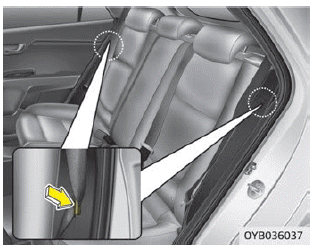
Rücksitzlehne umklappen:
1. When folding the rear seatback, push the seat belt buckle into the pocket between the rear seatback and the seat cushion. Make sure that both seat belts do not become entangled with the luggage or cargo. Then route the seat belt through the two openings on both sides.
2. Return the front seatback to an upright position and, if necessary, slide the front seat forward.
3. Slide the headrest down to the lowest position.
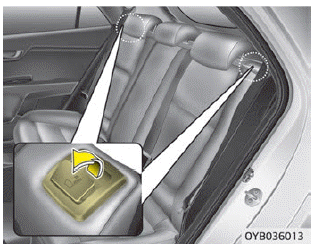
4. Ziehen Sie am Freigabehebel und klappen Sie die Rücksitzlehne nach vorn und fest nach unten.
Folding Rear Seat
1. To use the rear seat again, lift it up and pull it back. Pull firmly on the seatback until it locks with a click. Make sure the seatback is locked in position. When returning the seatback upright, always make sure it is locked by pressing firmly on the top of the seatback. If you cannot see the red line on the underside of the folding lever, the seatback is correctly locked.
2. Return the rear seat belt to its proper position.
3. Wenn die Sitzlehne richtig eingebaut ist, prüfen Sie den Hebel zum Umlegen der Rücksitzlehne erneut.
WARNING
Sitz aufrichten
To return the seatback to its upright position, hold the seatback and lower it slowly. If you return the seatback without holding it, it could swing forward and cause injury.
WARNING
Fold the rear seatback only after the driver's seat has been correctly adjusted to the driver's body size. Otherwise, injury may occur in a sudden stop or collision.
WARNING
When returning the seatback to the upright position:
Make sure that neither the seat belt webbing nor the buckle is damaged. Make sure the seat belt webbing and buckle are not pinched or crushed in the rear seat. Make sure the rear seatback is correctly locked in the upright position by pressing firmly on the top of the seatback. Otherwise, cargo could enter the vehicle interior in an accident or sudden stop and cause serious or even fatal injury.
WARNING
Damage to the rear seat belt
When folding the rear seatback, push the seat belt buckle between the seatback and the seat cushion. This prevents the buckle from being damaged by the rear seatback.
WARNING
Hintere Sicherheitsgurte
When returning the rear seatback to the upright position, do not forget to return the rear seat belts to their correct position.
WARNING
Cargo
Cargo must always be secured to prevent it from being thrown around the vehicle in a collision and causing injury to occupants. Do not place any objects on the rear seats, as they cannot be properly secured and may injure occupants in the front seats in a collision.
WARNING
Vehicle loaded
The engine must be switched off and the automatic/dual-clutch transmission placed in Park (P), or the manual transmission placed in 1st gear, when loading or unloading the vehicle. The parking brake must be applied. Otherwise the vehicle could move unintentionally or be placed in a different position.
Test yourself
A quick Kia Stonic quiz: every answer comes with an explanation and a link to the manual page.