Seats
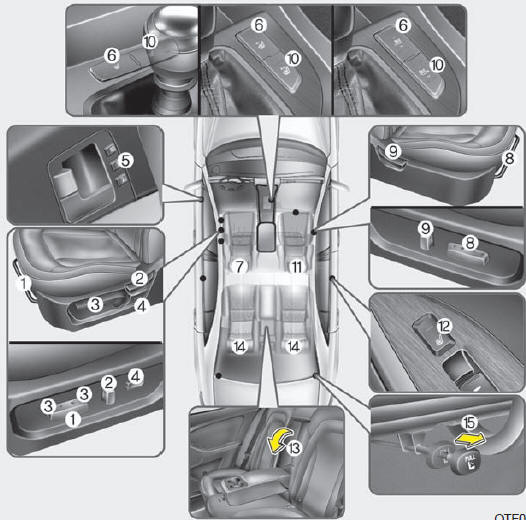
Driver's Seat
(1) Seat Forward/Backward Adjustment
(2) Seatback Recline (3) Seat Height Adjustment (4) Lumbar Support
(5) Driver's Seat Memory Position*
(6) Seat Heater Switch* (7) Headrest Adjustment
Front Passenger Seat
(8) Seat Forward/Backward Adjustment
(9) Seatback Recline (10) Seat Heater Switch* (11) Headrest Adjustment
Rear Seat
(12) Seat Heater Switch* (13) Armrest
(14) Headrest Adjustment (15) Seatback Folding Lever
*: if equipped
WARNING - Loose ItemsLoose items at the driver's feet can interfere with pedal operation and may cause an accident. Never place anything under the front seats.
WARNING - Returning the Seatback to UprightTo return the seatback to the upright position, hold the seatback and raise it slowly, making sure no one is nearby. If you do not hold the seatback, it may spring forward and injure someone by striking them.
WARNING - Driver Responsibility for the Front PassengerRiding in a vehicle with the seatback folded down can cause serious injury or death in an accident. If the seatback is folded down during a crash, the occupant's hips may slide under the lap belt, placing enormous force on the exposed abdomen. This can cause serious or fatal internal injuries. The driver must advise the passenger before keeping the seatback reclined while the vehicle is moving.
WARNINGDo not use a cushion to reduce friction between the seat and the occupant. The occupant's hips could slide under the lap belt in an accident or sudden stop. Serious or fatal injury could result because the seat belt cannot function properly.
WARNING - Driver's Seat- Never adjust the seat while the vehicle is moving.
You could lose control and cause an accident resulting in death, serious injury, or property damage.
Once the seat is adjusted, make sure it is securely locked in place by trying to slide it forward or backward without using the lever. A sudden or unexpected movement of the driver's seat may cause loss of vehicle control and an accident.
WARNING- Do not adjust the seat while the seat belt is fastened. Moving the seat cushion forward could cause strong pressure on the abdomen.
- Use extreme caution when moving the seat to avoid pinching your fingers or an object in the seat mechanism.
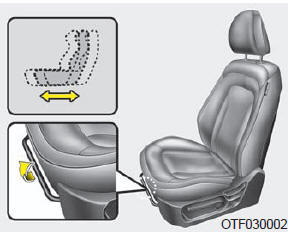
Front Seat Adjustment
Forward or Backward Sliding
To move the seat forward or backward:
- Lift and hold the seat slide lever.
- Slide the seat to the desired position.
- Release the lever and make sure the seat is locked in position.
Adjust the seat before driving.
Make sure it is securely locked in position by trying to move it forward and backward without using the lever. If the seat moves, it is not locked properly.
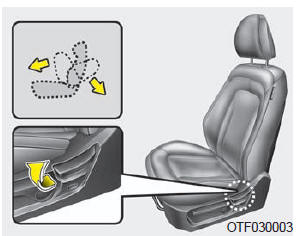
Seatback Angle
To recline the seatback:
- Lean forward slightly and lift the seatback recline lever.
- Slowly lean back against the seatback to adjust its position.
- Release the lever and make sure the seatback locks in position (the lever MUST return to its original position for the seatback to lock).
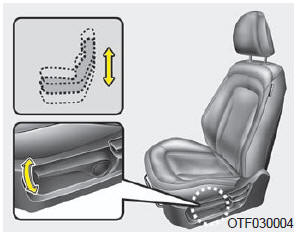
Seat Height
To change the seat height, move the lever up or down.
- To lower the seat, pump the lever repeatedly downward.
- To raise the seat, pump the lever repeatedly upward.
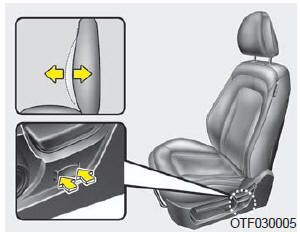
Lumbar Support (Driver's Seat)
Press the front part of the switch to increase support, or the rear part to decrease it.
Automatic Adjustment (if equipped)
The front seat can be adjusted using the control switch on the outer side of the seat cushion. Adjust the seat to the correct position before driving, so that you can properly operate the steering wheel, pedals and dashboard switches.
WARNINGThe power seat can be adjusted even when the ignition switch is in the OFF position.
Therefore, never leave children unattended in the vehicle.
WARNING The power seat is driven by an electric motor.
Stop operating the switch once the adjustment is complete. Excessive use may damage the electrical equipment.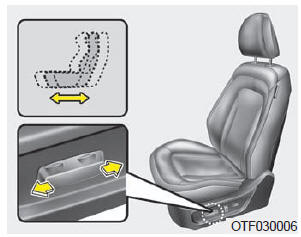
Forward or rearward position
Push the switch forward or rearward to move the seat to the desired position. Release the switch once the seat is in the correct position.
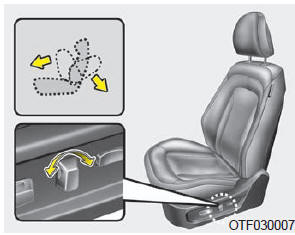
Seatback Angle
Push the switch forward or rearward to adjust the seatback to the desired angle. Release the switch once the seatback is in the correct position.
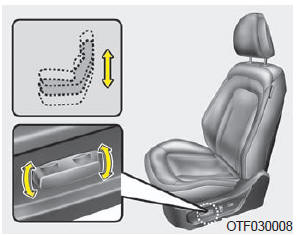
Seat cushion height (driver's seat)
Use the front of the switch to raise or lower the front of the seat cushion. Use the rear of the switch to raise or lower the rear of the seat cushion. Release the switch once the cushion is in the correct position.
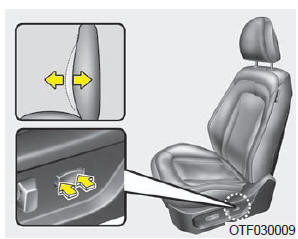
Lumbar support (driver's seat, if equipped)
The lumbar support is adjusted by pressing the lumbar support switch on the side of the driver's seat. Press the front of the switch to increase support, or the rear of the switch to decrease it.
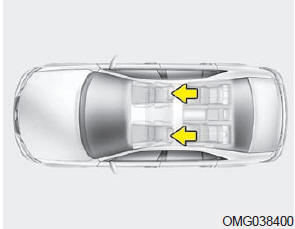
Head restraint
The driver's and front passenger's seats are equipped with head restraints for the safety and comfort of the occupants.
In addition to improving the comfort of the driver and front passenger, the head restraint also helps protect the head and neck in a collision.
WARNING- To ensure maximum effectiveness in an accident, the head restraint should be adjusted so that its center is at the level of the center of gravity of the occupant's head. In general, the center of gravity of most people's head is at the same height as their eyes. Also adjust the head restraint as close as possible to your head. For this reason, using a cushion that pushes the body away from the seatback is not recommended.
- Do not drive the vehicle without the head restraints in place, as passengers could suffer serious injuries in an accident. When properly adjusted, head restraints can help protect against neck injuries.
- Do not adjust the head restraint height while the vehicle is moving.
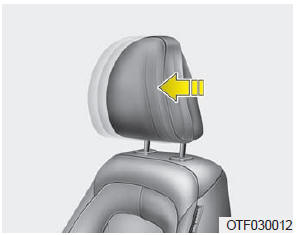
Forward or rearward adjustment
The head restraint can be adjusted forward in 3 positions by pulling it forward to the desired locking position. To return the head restraint fully to the rear, pull it fully forward and then release it.
Adjust the head restraint so that it properly supports your head and neck.
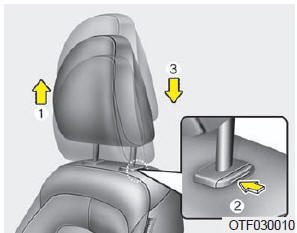
Height adjustment
To raise the head restraint, pull it up to the desired position (1). To lower it, press and hold the release button (2) and lower the head restraint to the desired position (3).
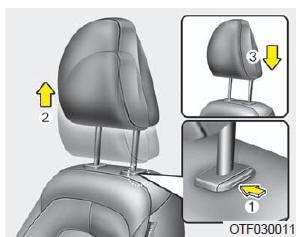
Removal
To remove the head restraint, raise it as high as possible, then press and hold the release button (1) while continuing to pull the head restraint up (2).
To reinstall the head restraint, insert the posts (3) of the head restraint into the holes while pressing the release button (1). Then adjust it to the appropriate height.
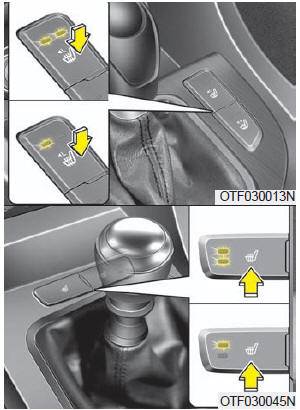
Seat heater (if equipped)
The seat heaters warm the front seats in cold weather. With the engine running, press either switch to heat the driver's seat or the front passenger's seat.
In mild weather, or if you do not want to use the seat heater, keep the switches in the off position.
- The seat temperature changes as follows each time the button is pressed:
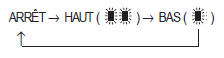
- By default, the seat heater is off each time the ignition is switched on.
NOTICE
When the seat heater is on, the seat heater circuit turns on or off depending on the seat temperature.
CAUTION- When cleaning the seats, do not use organic solvents such as thinner, benzene, alcohol or gasoline. You could damage the surface of the seat heater or the seats.
- To prevent overheating while the seat heater is operating, do not place objects on the seat that block heat, such as blankets, cushions or seat covers.
- Do not place heavy or sharp objects on a seat equipped with a seat heater. You could damage the seat heater elements.
Occupants should be very careful when using the seat heaters, as there is a risk of overheating or burns. Occupants must be able to feel if the seat becomes too hot and be able to turn the seat heater off. The seat heater can cause burns even at low temperatures if used for long periods. The driver must take extreme care with the following types of occupants:
- Infants, children, elderly or disabled persons, or outpatients
- Persons with sensitive skin or skin that burns easily.
- Fatigued persons.
- Persons under the influence of alcohol.
- Persons taking medication that causes drowsiness (sleeping pills, cold tablets, etc.).
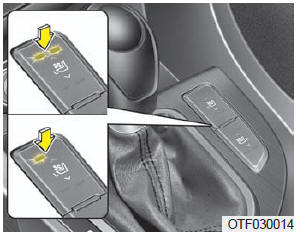
Climate-controlled seat (if equipped)
The climate-controlled seat cools or heats the driver's seat in hot or cold weather by blowing air through the small vent holes in the surface of the seat cushion and backrest. When the engine is running, press the rear part of the switch to cool the driver's seat, or the front part of the switch to heat it.
If seat ventilation for the driver's seat is not needed, keep the switch in the OFF position.
- Each press of the switch sets the cooler in the following sequence:
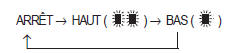
- The driver's seat climate control is always turned OFF when the ignition switch is turned off.
- The climate-controlled seat is equipped with an additional cooling/heating system.
The climate-controlled seat operates when the air conditioning system is on.
Using the ventilated seat for an extended period while the air conditioning system is off may cause the ventilated seat to malfunction.Passengers should be very careful when using the climate-controlled seat for heating, as there is a risk of overheating or burns. Occupants must be able to feel if the seat becomes too hot and be able to turn the seat heater off. The driver must use extreme caution with the following types of passengers:
- Infants, children, elderly or disabled persons, or outpatients
- Persons with sensitive skin or skin that burns easily.
- Fatigued persons.
- Persons under the influence of alcohol.
- Persons taking medication that causes drowsiness (sleeping pills, cold tablets, etc.).
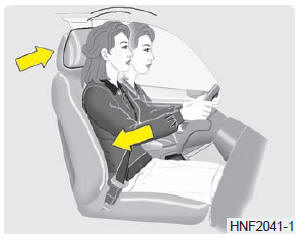
Active head restraint
The active head restraint is designed to move forward and up in a rear impact. It helps prevent the heads of the driver and front passenger from moving rearward, helping to minimize the risk of neck injury.
WARNINGA gap may form between the seat and the head restraint release button when you sit on the seat, or when you push or pull the seat. Be careful not to pinch your fingers, etc. in this gap.
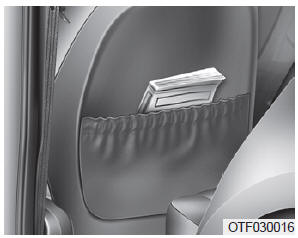
Seatback pocket (if equipped)
The front passenger seatback is equipped with a storage pocket.
WARNING - Seatback PocketsDo not place any heavy or sharp objects in the pockets. In an accident, they could become projectiles and injure passengers.
WARNINGTo ensure proper operation of the occupant detection system, do not place items weighing more than 1 kg (2.2 lb) in the front passenger seatback pocket.
Rear seat adjustment
Folding down the rear seatback
The rear seatbacks can be folded down to make it easier to transport long items or to increase cargo space.
WARNINGThe folding rear seatbacks allow you to transport items that would normally be too long for the cargo area.
Never allow anyone to sit on a folded-down seatback while the vehicle is moving, as it is not a proper seat and the seat belt cannot be used. An accident or sudden stop could result in serious or fatal injury. Items carried on a folded-down seatback should not be higher than the front seatback. Otherwise, items could slide forward and cause injury or damage in a sudden stop.
To fold down the rear seatback:
- Adjust the front seatback to an upright position and, if necessary, slide the front seat forward.
- Lower the rear head restraints to their lowest position.
- Open the luggage compartment.
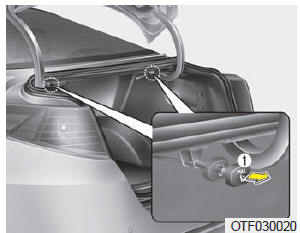
- Pull the release lever (1).
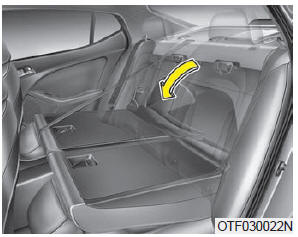
- Firmly fold the seatback forward.
- To use the rear seat, raise the seatback and latch it firmly in place.
- Return the rear seat belt to its proper position.
NOTICE
If the seat belt locks when the seatback is folded down, pull on the locked seat belt and then release it.
WARNINGWhen raising the seatback after folding it down: be careful not to damage the seat belt webbing or buckle.
Do not let the webbing or buckle get caught or pinched in the seat. Make sure the seatback is securely latched in place by pushing on the top of the seatback.
Otherwise, in an accident or sudden stop, the seatback could fold down, and cargo could be thrown into the passenger compartment, causing serious or fatal injury.
CAUTION - Rear Seat BeltsWhen raising the rear seatbacks, remember to return the seat belts to their proper position.
WARNING - LuggageLuggage should always be secured to prevent it from becoming a projectile in an accident and injuring occupants.
Do not place any objects on the rear seats, as they cannot be secured firmly and could strike the occupants of the front seats in a collision.
WARNING - Loading LuggageMake sure the engine is off, the automatic transmission is in P (Park) or the manual transmission is in 1st or reverse (R), and the parking brake is firmly engaged when loading or unloading luggage.
Otherwise, the vehicle could start to roll if the gear selector is moved unintentionally.
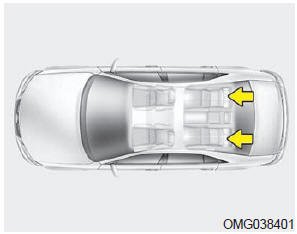
Head restraint
The rear seat(s) are equipped with head restraints in the outboard seating positions to ensure passenger safety and comfort.
The head restraint not only provides passenger comfort, but also helps protect the head and neck in an accident.
WARNING- To ensure maximum effectiveness in an accident, the head restraint should be adjusted so that its center is at the level of the center of gravity of the occupant's head. In general, the center of gravity of most people's head is at the same height as their eyes. Also adjust the head restraint as close as possible to your head. For this reason, using a cushion that pushes the body away from the seatback is not recommended.
- Do not drive the vehicle without the head restraints in place, as passengers could suffer serious injuries in an accident. When properly adjusted, head restraints can help protect against neck injuries.
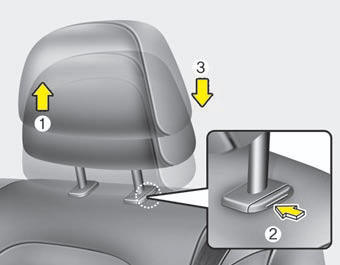
Height adjustment
To raise the head restraint, move it to the desired position (1). To lower it, press and hold the unlock button (2), then lower the head restraint to the desired level (3).
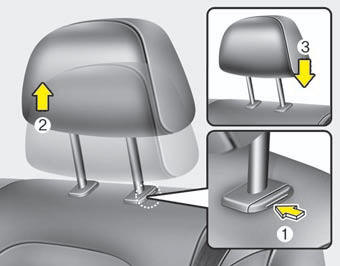
Removal
To remove the head restraint, raise it as high as possible, then press and hold the release button (1) while continuing to pull the head restraint up (2).
To reinstall the head restraint, insert the posts (3) of the head restraint into the holes while pressing the release button (1). Then adjust the height of the head restraint.
WARNINGAfter adjusting the head restraint, make sure it locks in position so that it properly protects the occupant.
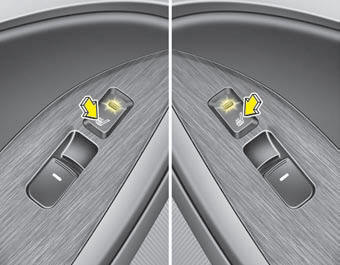
Seat heater (if equipped)
The seat heater warms the front seats in cold weather.
With the ignition switch in ON, press one of the switches to heat the seat.
In mild weather, or if you do not want to use the seat heater, keep the switches in the off position.
NOTICE
When the seat heater is on, the seat heater circuit turns on or off depending on the seat temperature.
CAUTION- When cleaning the seats, do not use organic solvents such as thinner, benzene, alcohol or gasoline. You could damage the surface of the seat heater or the seats.
- To prevent overheating while the seat heater is operating, do not place objects on the seat that block heat, such as blankets, cushions or seat covers.
- Do not place heavy or sharp objects on a seat equipped with a seat heater. You could damage the seat heater elements.
Occupants should be very careful when using the seat heaters, as there is a risk of overheating or burns. Occupants must be able to feel if the seat becomes too hot and be able to turn the seat heater off. The seat heater can cause burns even at low temperatures if used for long periods. The driver must take extreme care with the following types of occupants:
- Infants, children, elderly or disabled persons, or outpatients
- Persons with sensitive skin or skin that burns easily.
- Fatigued persons.
- Persons under the influence of alcohol.
- Persons taking medication that causes drowsiness (sleeping pills, cold tablets, etc.).
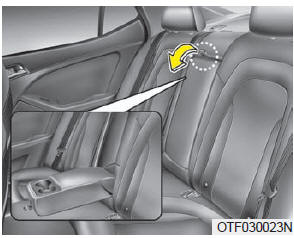
Armrest
To use the armrest, pull it out from the seatback.
Test yourself
A quick Kia Optima DL3 quiz: every answer comes with an explanation and a link to the manual page.