Child Restraint
Children should be seated in the rear seat, always in a restraint device, to minimize the risk of injury in the event of an accident, sudden stop or sharp maneuver. Statistics show that children are safer when properly restrained in a device in the rear seat than in the front seat. Older children should use the vehicle's seat belt.
You should know the specific requirements of your country. Child seats or restraint devices must be properly positioned and installed in the rear seat.
You should use a restraint device that complies with the safety standards of your country.
Child restraint systems are designed to securely hold a child seat in a vehicle seat using the lap belt or the lap portion of a three-point seat belt, or using a top tether and/or LATCH lower anchorages (if equipped).
Children can be injured or killed in an accident if their restraint device or seat is improperly installed. Use a seat for small children or infants.
Before purchasing a particular child restraint, make sure it is suitable for your vehicle and your child. Follow the manufacturer's instructions when installing the child restraint system.
WARNING- The child restraint must be installed in the rear seat. Never install it in the front seat. If an accident causes the airbag to deploy, an infant or small child in the seat could be seriously or fatally injured.
To reduce the risk of serious or fatal injury:
- Children of all ages are safest in the rear seat. A child seated in the front seat can be struck with force by a deploying airbag, causing serious or fatal injuries.
- Always follow the instructions provided by the child restraint manufacturer regarding installation and use.
- Always make sure the child seat is securely fastened and that your child is properly restrained in the seat.
- Never hold a child in your arms or on your lap. The violent forces of an accident will tear the child from your arms and throw them into the vehicle.
- Never place a seat belt over yourself and a child. In an accident, the force could crush the child and cause serious internal injuries.
- Never leave a child alone in the vehicle, even for a short time. The vehicle can heat up very quickly and cause serious injury to the child.
Even very young children can accidentally set a vehicle in motion, get caught in the windows or become trapped in the vehicle.
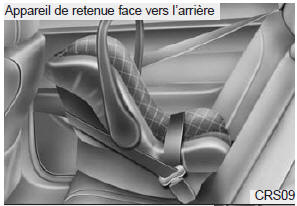
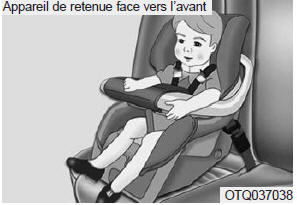
Using a Child Restraint
Small children and infants must use a child seat. It should be suitable for the child's size and weight and be installed according to the manufacturer's instructions.
For safety reasons, we recommend that a child restraint be used in the rear seats.
WARNINGNever place a rear-facing child seat in the front seat, as the deploying airbag could strike the seat and cause the child's death.
Because seat belts move freely under normal conditions and lock only in extreme or emergency conditions (emergency locking mode), you must manually set these belts to automatic locking mode to secure a child seat.
WARNING - Installing a Child Seat- A child may be injured or killed in a collision if the child seat is not securely anchored to the vehicle or if the child is not properly secured in the child seat. Before installing a child seat, read all instructions provided by the child seat manufacturer.
- If the seat belt does not operate as described in this section, have the system inspected immediately by an authorized Kia dealer.
- Failure to follow the instructions in this manual and those provided by the child seat manufacturer could increase the risk or severity of injury in an accident.
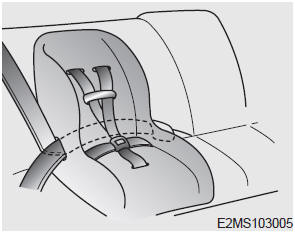
Setting a passenger seat belt to automatic locking mode
The automatic locking mode helps prevent normal child movement from loosening the seat belt, which would reduce the effectiveness of the restraint system.
Follow the steps below to make the restraint system secure.
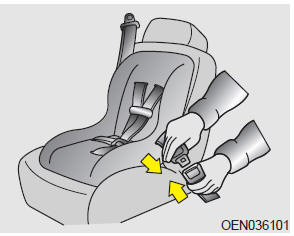
To install a child restraint on the left, right or center rear seat positions:
- Place the child restraint on the seat and route the seat belt around or through the child restraint, as indicated by the restraint manufacturer. Make sure the belt is not twisted.
- Insert the seat belt latch plate into the buckle, and listen for a distinct click.
Position the release button where it can be easily reached in an emergency.
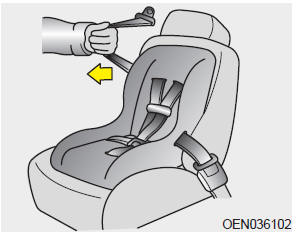
- Pull the shoulder belt out completely. Once it is extended, the seat belt retractor switches to automatic locking mode (child restraint).
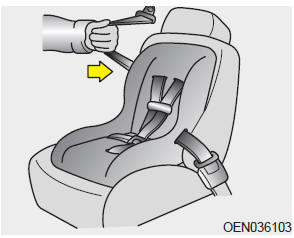
- Let the shoulder belt retract slowly and listen for a click or ratcheting sound. This indicates that the retractor is in automatic locking mode. If you hear no sound, repeat steps 3 and 4.
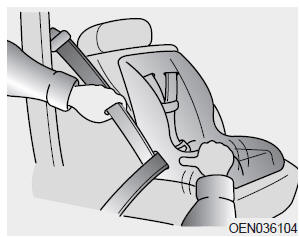
- Remove as much slack as possible by pressing down on the child restraint while feeding the shoulder belt back into the retractor.
- Push and pull on the child restraint to make sure the belt holds it firmly in place. If it does not, release the belt and repeat steps 2 to 6.
- Check again that the retractor is in automatic locking mode by trying to pull the belt out further. If it cannot be pulled out, the retractor is in automatic locking mode.
To remove the child restraint, press the buckle release button, pull the belt out of the child restraint and let the seat belt retract.
WARNING - Automatic Locking ModeThe three-point belt automatically returns to emergency locking mode once the belt has fully retracted.
You must therefore follow the seven steps above each time you install a child restraint.
If the retractor is not in automatic locking mode, the child restraint may move during a turn or sudden stop. A child can suffer serious or fatal injuries if the child restraint is not securely anchored to the vehicle.
When you let the seat belt retract completely, the retractor automatically switches from automatic locking mode back to emergency locking mode, for normal use by an adult.
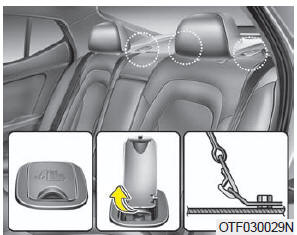
Installing a child seat using the lower anchorage (LATCH) system
The child seat tether anchors are located on the cargo area floor.
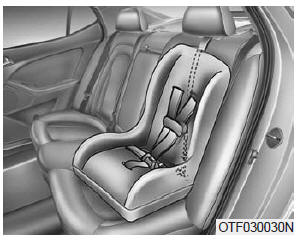
- Route the child seat tether straps over the top of the seatback.
If you use the tether anchorage system to install a child restraint on the rear seat, all unused seat belt latch plates must be buckled and the belts tightened behind the child restraint to prevent the child from reaching and holding loose belts. Unbuckled latch plates may allow the child to reach loose belts, creating a risk of strangulation, serious injury or even death of the child in the child restraint.
WARNING - Tether Strap- A child can be seriously injured or killed in a collision if the child restraint is not securely anchored. Always follow the installation and use instructions provided by the child restraint manufacturer.
- Never attach more than one child seat to a tether anchor or anchor point. The increased load could cause the tether or anchor point to fail, resulting in serious injury or death.
Make sure the child seat is securely anchored by pulling and pushing it in different directions. A poorly anchored seat will move or tip over, which can cause serious or fatal injuries.
WARNING - Child Seat Anchorage- Child seat anchors are designed to support only the loads imposed directly by a properly installed child seat. They must never be used for adult seat belts or harnesses, or to attach other items to the vehicle.
- The tether will not function properly if it is attached to a point other than the correct anchor point.
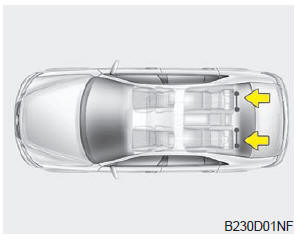
Attaching a child seat to the lower child seat anchors
Some child seat manufacturers produce seats labeled LATCH or LATCH-compatible. LATCH stands for "Lower Anchors and Tethers for Children". These seats have two rigid or flexible connectors that attach to two LATCH anchors located at specific positions in the vehicle. This type of child seat eliminates the need to use the vehicle seat belt to anchor the child seat on the rear seats.
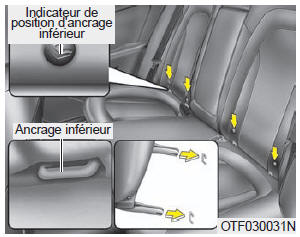
Child seat symbols are located on the left and right rear seatbacks, indicating the position of the lower child seat anchors.
WARNING- If you use the LATCH system to install a child seat on the rear seat, all unused seat belt latch plates must be buckled and the belts tightened behind the child seat to prevent the child from reaching and holding loose belts. Unbuckled latch plates may allow the child to reach loose belts, creating a risk of strangulation, serious injury or even death of the child in the child seat.
- Do not place anything around the lower anchors. Also make sure the seat belt is not caught in the lower anchors.
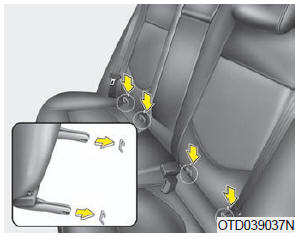
Your vehicle is equipped with LATCH anchors. The LATCH anchors are located in the left and right rear seating positions. Their locations are illustrated. There is no LATCH anchor in the center seating position.
The LATCH anchors are located between the backrest and the seat cushion of the left and right rear seats.
Follow the child seat manufacturer's instructions to properly install child seats with LATCH or LATCH-compatible attachments.
Once the LATCH child seat is installed, make sure it is securely attached to the LATCH anchors and tether hooks.
Test the child restraint before placing the child in it. Rock it from side to side. Try to pull it off the seat. Check that the anchors hold the seat firmly in place.
CAUTIONMake sure the rear seat belt webbing is not scratched or pinched by the buckle and the LATCH anchor during installation.
WARNINGIf the child seat is not anchored correctly, the risk of serious or fatal injury to the child increases greatly in the event of an accident.
WARNING - Lower LATCH AnchorsThe lower LATCH anchors may only be used in the left or right outboard seating positions.
Never attempt to anchor a LATCH child seat in the center rear seating position. You could damage the anchors, or the anchors may not withstand the impact of a collision.
Test yourself
A quick Kia Optima DL3 quiz: every answer comes with an explanation and a link to the manual page.