Removing the towing hook (Front) (if equipped)
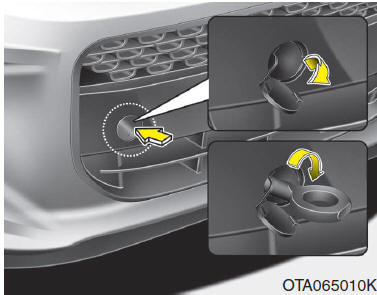
- Open the tailgate and remove the towing hook from the tool kit.
- Remove the hole cover by pressing its lower part on the front bumper.
- Install the towing hook by screwing it clockwise into the hole until it stops.
- After use, remove the towing hook and refit the cover.
Emergency towing
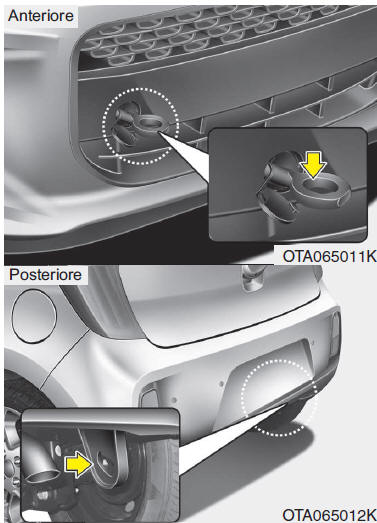
If the vehicle needs to be towed, it is recommended to contact an authorized Kia dealer or a roadside assistance service.
If a roadside assistance service is not available, in an emergency tow the vehicle with a cable or chain using the towing hook located on the front (or rear) underbody of the vehicle. Exercise extreme caution when towing the vehicle. One person must remain inside the vehicle to steer and operate the brakes.
Towing in this way may only be carried out on paved surfaces, for short distances and at low speed. In addition, the wheels, axles, drivetrain, steering and brakes must be in good condition.
- Do not attempt to tow the vehicle when the wheels are stuck in mud, sand or other situations in which the vehicle cannot free itself on its own.
- Avoid towing the vehicle with another vehicle that is lighter.
- The drivers of the two vehicles must communicate frequently with each other.
WARNING
- Attach a towing rope to the towing hook.
- Using a towing point other than the towing hooks to tow the vehicle may cause damage to the vehicle.
- Use only cables or chains specifically designed for towing vehicles. Securely attach the cable or chain to the towing hook.
- Before performing an emergency tow, check that the hook is not broken or damaged.
- Securely attach the cable or chain to the towing hook.
- Do not jerk the hook. Apply force gradually.
- To avoid damaging the hook, do not apply the pulling force sideways. Always pull lengthwise.
WARNING Exercise extreme caution when towing the vehicle.
- Avoid sudden starts or incorrect maneuvers that may place excessive stress on the emergency towing hooks and the cable or chain. The towing hook and the cable or chain may break, with serious risk of personal injury and damage to the vehicle.
- If the disabled vehicle cannot be moved, do not persist in attempting to tow it. Contact an authorized Kia dealer or a roadside assistance service.
- Tow keeping the cable as lengthwise as possible relative to the vehicle.
- Keep a safe distance from the vehicle during towing.
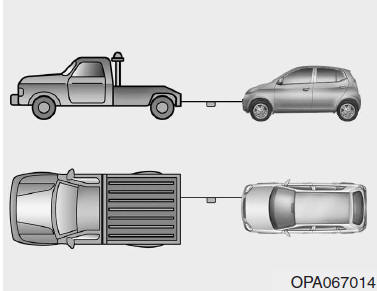
- Use a towing cable less than 5 m long. Attach a white or red cloth (approximately 30 cm wide) to the middle of the cable to improve its visibility.
- Drive carefully so that the cable does not slacken during towing.
Emergency towing precautions
- Turn the ignition switch to ACC so that the steering is not locked.
- Place the transmission in neutral (N).
- Release the parking brake.
- Press the brake pedal with more force than normal, as braking performance will be reduced.
- Since power steering will be inactive, greater effort will be required on the steering wheel.
- When driving downhill, the brakes may overheat, reducing braking performance. Stop often and let the brakes cool down.
WARNING - Automatic transmission
- Towing the vehicle with all four wheels on the ground may only be done from the front. Make sure the transmission is in neutral. Lock the steering wheel by turning the ignition switch to the ACC position.
One person must remain inside the towed vehicle to steer and operate the brakes.
- To prevent the risk of seriously damaging the automatic transmission, limit the speed to 15 km/h and tow for less than 1.5 km.
- Before towing, check the automatic transmission fluid level. If it is below the "HOT" range marked on the dipstick, add fluid. If topping up is not possible, use a tow truck.
Test yourself
A quick Kia Picanto JA quiz: every answer comes with an explanation and a link to the manual page.