Emergency Starting
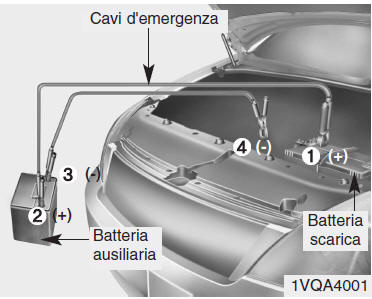
Connect the cables in the numerical order shown and disconnect them in reverse order.
Jump-starting with an auxiliary battery Jump-starting can be dangerous if performed incorrectly. To avoid injury or damage to the vehicle or battery, follow the procedure below. If in doubt, it is strongly recommended to contact a qualified technician or call roadside assistance to restart the vehicle.
WARNING Use only a 12-volt auxiliary power source.
Using a 24-volt power supply (such as two 12-volt batteries connected in series or a 24-volt engine-driven generator) may damage the 12-volt starter motor, the ignition system, and other electrical components. CAUTION - Battery Never attempt to check the battery electrolyte level, as this may cause the battery to rupture or explode, resulting in serious injury.CAUTION - Battery
- Keep sparks and open flames away from the battery. The battery produces hydrogen gas, which may explode if exposed to sparks or open flames.
If these instructions are not followed strictly, personal safety and vehicle integrity are seriously at risk! If in doubt, consult qualified personnel.
Car batteries contain sulfuric acid.
This is toxic and highly corrosive. When jump-starting, wear protective glasses and take care to prevent the acid from contacting your body, clothing, and the vehicle.Jump-starting procedure with an auxiliary battery
WARNING - AGM battery (if equipped)
- AGM (Absorbent Glass Mat) batteries are maintenance-free; for any work on the system, we recommend contacting an authorised Kia dealer.
To charge the AGM battery, use only fully automatic chargers designed specifically for AGM batteries.
If you want to use the ISG function, the battery sensor must be calibrated for approximately 4 hours with the ignition OFF.
- Make sure the auxiliary battery is 12 volts and that the negative terminal is connected to ground.
- If the auxiliary battery is in another vehicle, make sure the vehicles do not touch each other.
- Switch off all unnecessary electrical loads.
- Connect the jumper cables in the exact sequence shown in the figure. First connect one end of a cable to the positive terminal of the discharged battery (1), then connect the other end to the positive terminal of the auxiliary battery (2).
Keep the jumper cables away from any points other than the correct battery terminals or the correct ground. Do not lean over the battery when making connections.
WARNING - Jumper cables Do not connect the jumper cable directly from the negative terminal of the auxiliary battery to the negative terminal of the discharged battery. The discharged battery may overheat and rupture, allowing acid to escape.- Start the vehicle with the auxiliary battery and let it run at 2000 rpm, then start the vehicle with the discharged battery.
If the cause of the battery discharge is not evident, have the vehicle checked by an authorised Kia dealer.
Push-starting Do not push-start vehicles with manual transmission, as this may damage the evaporative emission control system.
Vehicles with automatic transmission cannot be push-started.
Follow the instructions in this section for jump-starting.
CAUTION Never tow a vehicle to start it, as the sudden jerk when the engine starts may cause a collision with the towing vehicle.Test yourself
A quick Kia Picanto JA quiz: every answer comes with an explanation and a link to the manual page.