Starting the Engine
WARNING
- Always wear appropriate footwear when operating your vehicle. Improper footwear (high heels, ski boots, etc.) may interfere with your ability to properly operate the brake and accelerator pedals.
- Do not start the vehicle with the accelerator pedal depressed. The vehicle may move and cause an accident.
- Wait until the engine idle speed is normal. The vehicle may move suddenly if the brake pedal is released when engine speed is high.
NOTICE
Kickdown Mechanism (if equipped)
If your vehicle is equipped with a kickdown mechanism in the accelerator pedal, it prevents you from accidentally operating at full throttle by requiring the driver to apply additional force to the accelerator pedal. However, if you press the pedal beyond approximately 80%, the vehicle may go to full throttle and the accelerator pedal will be easier to depress. This is not a malfunction but a normal condition.
Starting the Gasoline Engine
1. Carry the smart key or leave it inside the vehicle.
2. Make sure the parking brake is firmly applied.
3. Manual transaxle: Fully depress the clutch pedal and shift the transmission into Neutral. Keep the clutch pedal and brake pedal depressed while starting the engine. Automatic transaxle: Place the shift lever in P (Park). Fully depress the brake pedal. You can also start the engine when the shift lever is in N (Neutral).
4. Press the engine START/STOP button. Do not depress the accelerator pedal.
5. Do not wait for the engine to warm up while the vehicle is stationary. Start driving at moderate engine speed. Avoid rapid acceleration and deceleration.
Manual transaxle
- When starting the vehicle, keep the clutch and brake pedals depressed, check that the engine speed is within the permissible range, and place the shift lever in the required position.
- Release the parking brake, release the clutch pedal, depress the accelerator pedal, and move the vehicle off smoothly.
CAUTION
Do not turn the ignition key to the START position while the engine is running. This may damage the starter.
- Even if the Smart Key is inside the vehicle, the engine may not start if the Smart Key is too far from you.
- When the ENGINE START/STOP button is in ACC or higher and any door is opened, the system checks for the Smart Key. If the Smart Key is not in the vehicle, the "
 " or "
 " indicator will flash or the warning "Key Not In Vehicle" will appear on the LCD display. If all doors are closed, a chime will sound for 5 seconds. The indicator or warning will turn off when the vehicle moves. Always keep the Smart Key with you.
WARNING
The engine will start only when the smart key is inside the vehicle.
Never allow children or anyone unfamiliar with the vehicle to touch the ENGINE START/STOP button or related parts.
CAUTION
If the engine stalls while the vehicle is moving, do not attempt to shift the shift lever to P (Park). If traffic and road conditions permit, you may shift the lever to N (Neutral), while the vehicle is still moving, and press the ENGINE START/STOP button to attempt to restart the engine.
NOTICE
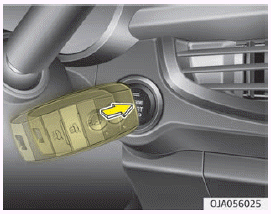
- If the battery is weak or the Smart Key is not functioning properly, you can start the engine by pressing the ENGINE START/STOP button with the Smart Key.
- When the brake switch fuse is blown, the engine will not start normally. Replace the fuse with a new one. If this is not possible, you can start the engine by pressing the ENGINE START/STOP button for up to 10 seconds while it is in the ACC position. The engine may start without depressing the brake pedal. However, for your safety, always depress the brake pedal before starting the engine.
CAUTION
Do not press the ENGINE START/STOP button for more than 10 seconds, except when the stop lamp fuse is blown.
Test yourself
A quick Kia Picanto JA quiz: every answer comes with an explanation and a link to the manual page.