Vehicle Loading
WARNING
Do not tow a trailer with this vehicle:
Towing a trailer with this vehicle is dangerous. The vehicle is not designed for towing, and the drivetrain could be adversely affected, which may damage the vehicle.
This section explains how to load the vehicle correctly so that the loaded vehicle weight stays within its rated limits. Loading the vehicle correctly helps achieve the best possible performance. Before loading the vehicle, become familiar with the following terms used to determine vehicle weight limits, based on the Vehicle Certification Label and the Tire and Loading Information Label:
WARNING
Overloaded vehicle:
Overloading a vehicle is dangerous. An overloaded vehicle can endanger passengers. Excessive weight on the suspension system can cause spring or shock absorber failure, brake failure, handling or steering problems, uneven tire wear, tire failure or other damage.
An overloaded vehicle is harder to drive and control. Stopping distance also increases. In case of severe overloading, the brakes may stop working altogether, especially on steep grades. The load a tire can carry depends on the tire size, its load range, and the corresponding inflation pressure.
Never overload the vehicle. Always comply with the vehicle weight limits shown on the Vehicle Certification Label and the Tire and Loading Information Label.
Base curb weight is the weight of the vehicle including a full tank of fuel and all standard equipment. It does not include passengers, cargo or optional equipment.
Vehicle curb weight is the weight of the new vehicle at delivery, including non-standard equipment.
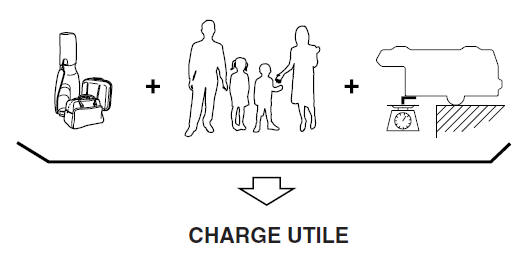
Payload is the combined weight of the cargo and passengers that the vehicle can carry. The maximum payload of your vehicle is shown on the Tire and Loading Information label located on the driver's door frame or door pillar. For the maximum payload, see "THE COMBINATION WEIGHT OF OCCUPANTS AND CARGO SHOULD NEVER EXCEED XXX kg or XXX lbs". The payload shown on the tire label is the maximum payload for the vehicle as built at the factory. If non-standard equipment has been installed on the vehicle, the weight of this equipment must be subtracted from the payload shown on the tire label to obtain an accurate result.
SAMPLE
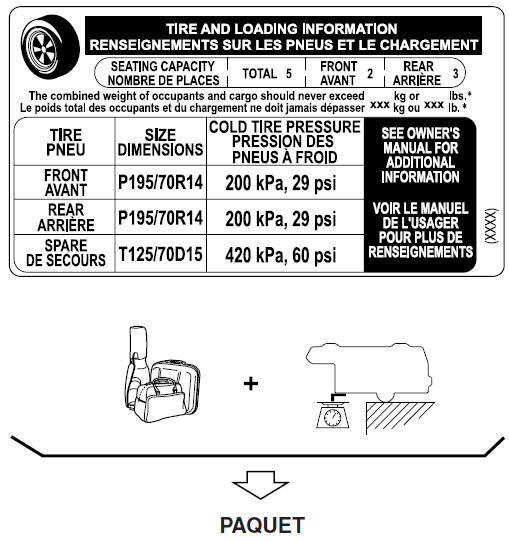
The added cargo weight includes all weight added to the base curb weight, including cargo and optional equipment.
The added cargo weight limit decreases as the number of occupants in the vehicle increases. The added cargo weight limit can be calculated by subtracting the total weight of the occupants in the vehicle from the "maximum combined weight of occupants and cargo" value shown on the tire label.
Examples: Based on one occupant weighing 68 kg (150 lbs), and a value of 385 kg (849 lbs) for the "maximum combined weight of occupants and cargo": The added cargo weight limit with one occupant is 385 kg (849 lbs) - 68 kg (150 lbs) = 317 kg (699 lbs). The added cargo weight limit with two occupants is 385 kg (849 lbs) - (68 × 2) kg ((150 × 2) lbs) = 249 kg (549 lbs). If the weight of the occupants increases, the added cargo weight limit decreases by the same amount.
GAWR (Gross Axle Weight) is the total weight placed on each axle (front and rear), including the curb weight of the vehicle and all payload.
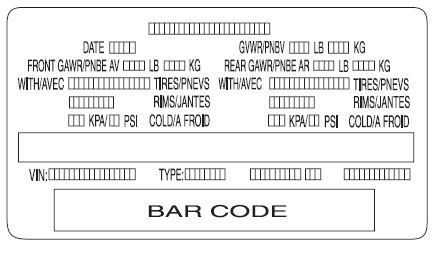
GAWR (Gross Axle Weight Rating) is the maximum permissible weight that a single axle (front or rear) can support. These figures are shown on the Safety Certification label located on the driver's door frame or door pillar. The total load carried by each axle must never exceed its GAWR.
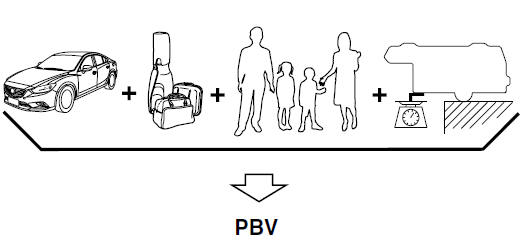
GVW (Gross Vehicle Weight) is the curb weight of the vehicle plus luggage and passengers.
GVWR (Gross Vehicle Weight Rating) is the maximum permissible weight of the fully loaded vehicle (including all options, equipment, passengers and cargo). The GVWR is shown on the Safety Certification label located on the driver's door frame or door pillar. The GVW must never exceed the GVWR.
SAMPLE
WARNING
Exceeding the axle weight ratings:
Exceeding the GAWR shown on the Safety Certification label is dangerous and may result in serious injury or death due to reduced vehicle handling and performance, engine and transmission operation, and/or structural damage, serious vehicle damage, or loss of vehicle control.
Always make sure not to exceed the GAWR.
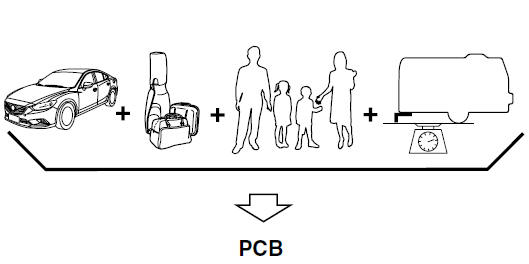
GCW (Gross Combined Weight) is the weight of the loaded vehicle (GVW).
GCWR (Gross Combined Weight Rating) is the maximum permissible weight of the vehicle, including all luggage and passengers, that the vehicle can carry without risk of damage. GCW must never exceed GCWR.
WARNING
Exceeding the GVWR or GAWR specifications:
Exceeding the GVWR or GAWR specified on the certification label is dangerous.
Exceeding the vehicle's weight ratings may cause a serious accident, personal injury or vehicle damage.
Do not use replacement tires with a load capacity lower than that of the original tires, as this may reduce the vehicle's GVWR and GAWR limits. Replacing the tires with tires that have a higher limit than the originals does not increase the GVWR and GAWR limits.
Never exceed the GVWR or GAWR values specified on the certification label.
Test yourself
A quick Mazda 6 quiz: every answer comes with an explanation and a link to the manual page.