Cruise control
General notes
CRUISE CONTROL maintains the vehicle speed at the value you have set. It brakes the vehicle automatically so that the set speed is not exceeded. On long, steep downhill sections, you must shift to a lower gear in good time, especially when the vehicle is loaded or towing a trailer. To do this, first select manual program M (vehicles with automatic transmission). This way you use the engine braking effect. In doing so, you relieve the braking system and avoid overheating and rapid brake wear.
Only activate CRUISE CONTROL if you can drive at a constant speed for some time. You can set any speed above 30 km/h.
Important safety notes
WARNINGOn slippery roads, do not downshift to brake the vehicle. The drive wheels may lose traction and the vehicle may skid.
WARNINGCRUISE CONTROL cannot take road or traffic conditions into account.
Always pay attention to traffic conditions, even when CRUISE CONTROL is activated.
CRUISE CONTROL is only a driving assistance system. You are responsible for the vehicle speed and for deciding when to brake.
WARNINGDo not use CRUISE CONTROL
- when traffic conditions do not allow driving at a constant speed (heavy traffic or winding roads, for example). Otherwise, you could cause an accident.
- on slippery roads. The driven wheels could lose grip when braking or accelerating, and your vehicle could skid.
- when visibility is poor (in fog, heavy rain or snowfall, for example).
CRUISE control lever
The CRUISE CONTROL lever lets you operate CRUISE CONTROL and variable SPEEDTRONIC.
The LIM indicator lamp built into the CRUISE CONTROL lever shows which system you have selected:
- LIM indicator lamp off: CRUISE CONTROL is selected
- LIM indicator lamp on: variable SPEEDTRONIC is selected
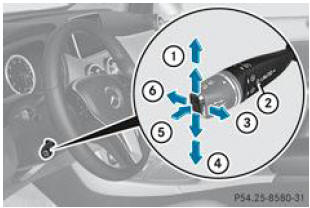
- Activating or increasing speed
- LIM indicator lamp
- Activation with current speed or last stored speed
- Setting or reducing speed
- Switching between CRUISE CONTROL and variable SPEEDTRONIC
- Deactivating CRUISE CONTROL
When you activate CRUISE CONTROL, the stored speed is shown on the multifunction display for 5 seconds. The segments of the multifunction display between the stored speed and the maximum speed are then lit.
Activation conditions
To activate CRUISE CONTROL, the following conditions must be met:
- The electric parking brake must be released.
- You are driving at more than 30 km/h.
- ESP® must be switched on but must not intervene.
- The selector lever must be in D (vehicles with automatic transmission).
- A gear must be engaged (vehicles with manual transmission).
- CRUISE CONTROL must be selected.
- Selecting CRUISE CONTROL: check whether the LIM 2 indicator lamp is off.
If it is off, CRUISE CONTROL is already selected.
If it is on, move the CRUISE CONTROL lever in direction 5.
The LIM 2 indicator lamp built into the CRUISE CONTROL lever goes off. CRUISE CONTROL is selected.
Storing, maintaining and resuming speed
Storing and maintaining the current speed
If the current speed is above 30 km/h, you can store it.
- Adjust the vehicle to the desired speed.
- Briefly move the CRUISE CONTROL lever up 1 or down 4.
- Release the accelerator pedal.
CRUISE CONTROL is activated. The vehicle maintains the speed automatically.
On uphill slopes, CRUISE CONTROL may not be able to maintain the stored speed. The stored speed is resumed as soon as the gradient decreases. On downhill slopes, CRUISE CONTROL maintains the speed by braking the vehicle automatically. Vehicles with manual transmission:- Always drive with sufficient but not excessive engine speed.
- Shift gears in good time.
- Where possible, do not downshift several gears at once.
Storing the current speed or recalling the last stored speed
WARNINGRecall the stored speed only if you know it and if traffic conditions permit.
Otherwise, inadvertent sudden acceleration or braking could endanger you or other people.
- Briefly pull the CRUISE CONTROL lever toward you 3.
- Take your foot off the accelerator pedal.
CRUISE CONTROL is activated and adopts the current vehicle speed if this is the first activation, or regulates the speed to the last stored value.
Adjusting the speed
- Push the CRUISE CONTROL lever up 1 to increase the speed or down 4 to decrease it.
- Hold the CRUISE CONTROL lever in this position until the desired speed is reached.
- Release the CRUISE CONTROL lever.
The new speed is stored.
- Adjusting the speed in increments of 1 km/h: briefly push the CRUISE CONTROL lever up 1 or down 4 up to the pressure point.
The last stored speed increases or decreases in increments of 1 km/h.
- Adjusting the speed in increments of 10 km/h: briefly push the CRUISE CONTROL lever up 1 or down 4 beyond the pressure point.
The last stored speed increases or decreases in increments of 10 km/h.
You cannot deactivate CRUISE CONTROL by pressing the accelerator pedal. If you accelerate temporarily, for example to overtake, CRUISE CONTROL resumes the last stored speed as soon as you release the accelerator pedal.Deactivating CRUISE CONTROL
You can switch off CRUISE CONTROL in several ways:
- Briefly push the CRUISE CONTROL lever forward 6.
- Brake.
- Briefly move the CRUISE CONTROL lever in direction 5.
Variable SPEEDTRONIC is selected. The LIM 2 indicator lamp built into the CRUISE CONTROL lever is lit.
CRUISE CONTROL switches off automatically when
- you apply the electric parking brake
- you are driving below 30 km/h
- ESP® intervenes or you switch it off
- you shift to neutral while driving or depress the clutch pedal for more than 6 seconds (vehicles with manual transmission)
- you engage a gear that is too low (vehicles with manual transmission), causing the engine speed to drop too far
- you shift the automatic transmission to N while driving (vehicles with automatic transmission)
A signal sounds when CRUISE CONTROL switches off. The message CRUISE CONTROL deactivated appears on the multifunction display for approximately 5 seconds.
The last stored speed is erased when you switch off the engine.
Test yourself
A quick Mercedes-Benz B-Class quiz: every answer comes with an explanation and a link to the manual page.