Towing and tow-starting. Important safety information. Installing/removing the towing eye
Towing and tow-starting a Mercedes E-Class (4th generation, W212, 2009–2016) requires special care and observance of numerous safety notes. This section explains the correct use of the towing eye, rope or bar in practical terms and gives useful tips to avoid damage to the vehicle and risks when towing.
Important Safety Notes
WARNINGSafety-related functions are restricted or unavailable if
- the engine is not running
- the brake system or power steering is faulty
- the power supply or the vehicle electrical system is faulty.
In these cases, use a towing bar. Before towing, make sure the steering is free to move.
WARNING
If the vehicle being towed or the towing vehicle is heavier than the permissible gross vehicle mass of your vehicle, you may- the towing eye may tear off
- the trailer may snake and even tip over.
When towing or being towed by another vehicle, its weight must not exceed the permissible gross vehicle mass of your vehicle.
Info

Information on the permissible gross vehicle mass of your vehicle can be found on the vehicle identification plate.
NOTE
When DISTRONIC PLUS or the HOLD function is switched on, the vehicle brakes automatically in certain situations.
To avoid damage to the vehicle, switch off DISTRONIC PLUS and the HOLD function in the following or similar situations:- when towing
- in car washes
Attach the tow rope or tow bar only to the towing eyes or, if fitted, to the towing hitch. Otherwise you may damage the vehicle.
When towing with a tow rope, observe the following points:
- Attach the tow rope to both vehicles on the same side wherever possible.
- Make sure the tow rope is not longer than legally permitted. Mark the centre of the tow rope, e.g. with a white cloth (30 x 30 cm). This allows other road users to recognise the towing situation.
- Attach the tow rope only to the towing eyes or, if fitted, to the towing hitch.
- While driving, watch the brake lights of the towing vehicle. Always keep a distance that prevents the tow rope from sagging.
- Do not use steel cables or chains for towing. Otherwise you may damage the vehicle.
Do not use the towing eye for recovery. This can damage the vehicle. If in doubt, recover the vehicle with a crane.
When towing or being towed, pull away slowly and smoothly. Otherwise excessive tensile forces may damage the vehicles.
When towing vehicles with KEYLESS-GO, use the key instead of the Start/Stop button. Otherwise, opening the driver or front passenger door may shift the automatic transmission to position P, which can damage the transmission.
You may tow the vehicle a maximum of 50 km. The towing speed must not exceed 50 km/h.
For towing distances over 50 km, the entire vehicle must be lifted and transported. When towing or being towed by another vehicle, its weight must not exceed the permissible gross vehicle mass of your vehicle.Hybrid vehicles: Be sure to read the supplementary "HYBRID" manual, which is part of the vehicle literature. Otherwise you may not recognise hazards, for example from high voltage.
When towing or being towed, observe the legal regulations in each country.It is better to transport the vehicle rather than tow it.
If the vehicle has transmission damage, have it transported on a flatbed truck or trailer.When towing, vehicles with automatic transmission must have the transmission in position N.
The battery must be connected and charged. Otherwise you will not be able to- do not turn the key in the ignition lock to position 2
- on vehicles with automatic transmission, do not move the transmission to position N.
If the battery is defective, the automatic transmission is locked in position P. To move the automatic transmission to position N, you must supply power to the vehicle electrical system as for jump-starting.
Have the vehicle transported on a flatbed truck or trailer.Info
Before towing, switch off the automatic locking. Otherwise you may lock yourself out while pushing or towing the vehicle.
Before towing, switch off the tow-away protection.
Attaching/removing the towing eye
Attaching the towing eye
WARNINGThe exhaust tailpipe can be very hot. Risk of burns when removing the rear cover!
Do not touch the exhaust tailpipe. Take particular care when removing the rear cover.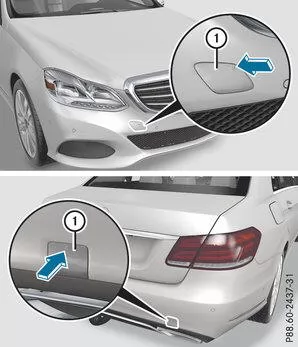
Towing eye covers (example: saloon)
Vehicles with towing hitch: To tow, fold out the ball neck and attach the towing device to it.The mounts for the screw-in towing eye are in the bumpers. On vehicles without a towing hitch, they are located at the front and rear under the covers. On vehicles with a towing hitch, they are located at the front under the cover.
 Take the towing eye from the onboard tool kit.
The cover press inward at the marking in the direction of the arrow.
The coverRemove from the opening.Screw the towing eye in to the right as far as it will go and tighten it.
Removing the towing eye
Loosen and unscrew the towing eye.The coverplace it against the bumper and press until it engages.
Place the towing eye in the onboard tool kit.The Mercedes E-Class W212 (model years 2009–2016) provides precise instructions and safety information for towing and being towed. The correct procedure for fitting the towing eye and using suitable towing equipment is essential to avoid damage.
Особенно для моделей с automatic transmission and 4MATIC, specific steps must be observed to protect the technology. Mercedes emphasises the high standard of safety and responsibility in every breakdown situation.
In this way, the E-Class remains an example of well-thought-out engineering and practical solutions on the road.
Test yourself
A quick Mercedes-Benz E-Class quiz: every answer comes with an explanation and a link to the manual page.