Flat tire. TIREFIT kit
The TIREFIT kit in the Mercedes-Benz E-Class (4th generation, W212, 2009–2016) allows you to seal small tire damage so that you can continue driving. This section describes how to use the system and warns about the limits of its effectiveness to avoid the risks of damaged tires.
Important Safety Notes
TIREFIT is a tire sealant.TIREFIT can seal puncture damage up to 4 mm, especially in the tire tread. You can use TIREFIT at outside temperatures of up to 20
 use.
WARNING
In the following cases, the tire sealant cannot provide sufficient emergency assistance because it cannot seal the tire:- For cuts or punctures in the tire that are larger than specified above.
- For damage to the wheel rim.
- If you have driven with very low tire pressure or with flat tires.
Do not continue driving! Contact a qualified workshop.
WARNING
The tire sealant is harmful to health and causes irritation. It must not come into contact with skin, eyes or clothing, or be swallowed. Do not inhale the vapors. Keep the tire sealant away from children. There is a risk of injury!If you have come into contact with the tire sealant, observe the following:
- Immediately rinse tire sealant off the skin with water.
- If tire sealant gets into your eyes, immediately rinse your eyes thoroughly with clean water.
- If tire sealant has been swallowed, rinse your mouth thoroughly at once and drink plenty of water. Do not induce vomiting and seek medical attention immediately!
- Change clothing that has become soiled with tire sealant immediately.
- If allergic reactions occur, seek medical attention immediately.
Once the tire inflator has cooled down, you can continue to use it.
Observe the manufacturer's safety information on the label of the tire inflator.
Using the TIREFIT kit
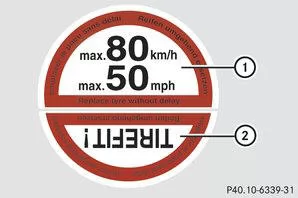
 Leave the foreign object, e.g. the screw or nail, in the tire.
Remove the tire sealant bottle, the enclosed TIREFIT label and the tire inflator from the storage compartment under the luggage compartment floor.
Stick the part of the TIREFIT label onto the instrument cluster in the driver's field of vision.
Stick the part of the TIREFIT label near the valve on the wheel of the defective tire.
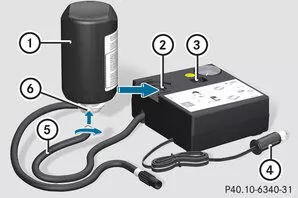
Pull the plug with cable and the hose
 out of the housing.
Screw the hoseonto the flange of the tire sealant bottle.
Insert the tire sealant bottlehead first into the recessof the tire inflator.
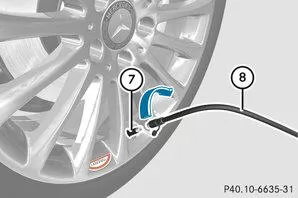
Turn the valve cap off the valve of the defective tire.
Attach the filler hose to the valve.
Pull the plugPlug it into a 12 V socket in your vehicle.
Turn the key in the ignition to position 1.
Press the on/off switch on the tire inflator to I.
First, the tire sealant is pumped into the tire. The pressure may briefly rise to approx. 500 kPa (5 bar, 73 psi) during this process.
Do not switch off the tire inflator during this phase!Let the tire inflator run for five minutes. The tire pressure must then have reached at least 180 kPa (1.8 bar, 26 psi).
If the tire pressure does not reach 180 kPa (1.8 bar, 26 psi) after five minutes, see "Tire pressure not reached".
If tire sealant has leaked out, let it dry. You can then peel it off like a film.If your clothing has been soiled with tire sealant, have it cleaned as soon as possible at a dry cleaner using perchloroethylene.
Tire pressure not reached
If the tire pressure does not reach 180 kPa (1.8 bar, 26 psi) after five minutes:Switch off the tire inflator.
Unscrew the filler hose from the valve of the defective tire.
Drive the vehicle very slowly forward or backward approx. 10 m.
Inflate the tire again.
After five minutes at most, the tire pressure must be at least 180 kPa (1.8 bar, 26 psi).
WARNING
If the specified tire pressure is not reached within the specified time, the tire is too severely damaged. The tire sealant cannot provide emergency repair in this case. Damaged tires and insufficient tire pressure can seriously impair braking and handling. There is a risk of accident!Do not continue driving. Contact a qualified workshop.
Tire pressure reached
WARNINGA tire temporarily sealed with tire sealant has impaired handling and is not suitable for higher speeds. There is a risk of accident!
Adjust your driving style accordingly and drive carefully. Do not exceed the maximum speed specified for a tire sealed with tire sealant.The maximum speed for a tire sealed with tire sealant is 80 km/h. The upper part of the TIREFIT label must be attached to the instrument cluster in the driver's field of vision.
NOTE
Residual tire sealant may run out of the filler hose after use. This may cause staining.
Therefore, place the filler hose in the plastic bag in which the TIREFIT kit was supplied.Environmental Note
Have the used tire sealant bottle disposed of properly, e.g. at a qualified workshop.If the tire pressure reaches 180 kPa (1.8 bar, 26 psi) after five minutes:
Switch off the tire inflator.Unscrew the filler hose from the valve of the defective tire.
Stow the tire sealant bottle, the tire inflator and the warning triangle.Drive off immediately.
After driving for about ten minutes, stop and check the tire pressure with the tire inflator.If the specified tire pressure is not reached after the short drive, the tire is too severely damaged. The tire sealant cannot provide emergency repair in this case. Damaged tires and insufficient tire pressure can seriously impair braking and handling. There is a risk of accident!
Do not continue driving. Contact a qualified workshop.Info

A label with the Mercedes-Benz Service24h telephone number can be found in your vehicle, e.g. on the B-pillar on the driver's side.
Correct the tire pressure if it is still at least 130 kPa (1.3 bar, 19 psi). For values, see fuel filler flap.
Increase tyre pressure: Switch on the tyre inflator compressor.
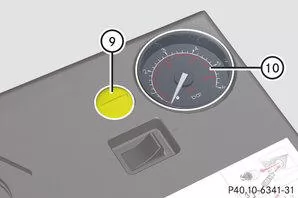
Reduce tyre pressure: Press the release button next to the pressure gauge
 press.
If the tyre pressure is correct, unscrew the inflation hose from the valve of the sealed tyre.
Screw the valve cap onto the valve of the sealed tyre.
Pull the tyre sealant bottle out of the tyre inflator compressor.
The inflation hose stays on the tyre sealant bottle.
Drive to the nearest qualified workshop and have the tyre replaced.
Have the tyre sealant bottle replaced at a qualified workshop as soon as possible.
Have the tyre sealant bottle replaced at a qualified workshop every four years.
The temporary spare wheel of the Mercedes E-Class W212 (model years 2009–2016) provides a proven solution for continuing your journey after a tyre puncture. It is stored space-saving and can be fitted quickly when needed. Observe the notes on maximum speed and driving with the temporary spare wheel at all times.
This equipment underlines the E-Class's high standards of practicality and safety.
Question: Why is the speed limited when the temporary spare wheel is fitted?
Answer: Because the temporary spare wheel is intended for limited use only and does not offer the same driving stability as a standard wheel.
Question: Where is the temporary spare wheel located in the vehicle?
Answer: In the storage compartment under the luggage compartment floor.
Test yourself
A quick Mercedes-Benz E-Class quiz: every answer comes with an explanation and a link to the manual page.