Jump-starting
The jump-starting section for the Mercedes E-Class (4th generation, W212, 2009–2016) provides precise instructions for the safe starting procedure with a discharged battery. It emphasizes the importance of the correct connection sequence for the cables and warns of typical hazards.
For jump starting, use only the jump-start terminal in the engine compartment, consisting of the positive terminal and ground point.WARNING
Battery acid is corrosive. Risk of injury!Avoid contact with skin, eyes or clothing. Do not breathe in battery gases. Do not lean over the battery. Keep children away from batteries. Rinse battery acid off immediately with plenty of clear water and seek medical attention without delay.
WARNING
When charging the battery and jump starting, explosive gas mixture may escape from the battery. There is a risk of explosion!Avoid fire, open flames, sparks and smoking at all times. Ensure adequate ventilation when charging the battery and when jump starting. Do not lean over a battery.
WARNING
When charging, a battery produces hydrogen gas. If you cause a short circuit or sparks occur, the hydrogen gas can ignite. Risk of explosion!- Always make sure that the positive terminal of a connected battery does not come into contact with vehicle parts.
- Never place metal objects or tools on a battery.
- When connecting and disconnecting the battery, be sure to follow the described sequence of battery terminals.
- When jump-starting, always make sure you only connect battery terminals with identical polarity.
- When jump-starting, be sure to follow the described sequence for connecting and disconnecting the jumper cables.
- Do not connect or disconnect the battery terminals while the engine is running.
A discharged battery can freeze at temperatures around freezing point. If you then jump start the vehicle or charge the battery, battery gas may escape. There is a risk of explosion!
Always allow a frozen battery to thaw before charging it or jump starting the vehicle.NOTE
Petrol engine vehicles: Avoid repeated and prolonged starting attempts. Otherwise, unburnt fuel can damage the catalytic converter.
Hybrid vehicles: Be sure to read the supplementary "HYBRID" manual, which is part of the vehicle literature. Otherwise you may not recognise hazards, for example from high voltage.
Do not start the vehicle using a fast charger. If the battery is discharged, another vehicle or an external battery with jump leads can provide a jump start. Observe the following points:- On some vehicles the battery is not accessible. If the battery of the other vehicle is not accessible, jump-start using an external battery or a jump-start device.
- Petrol engine vehicles: Only have a jump start given when the engine is cold and the exhaust system has cooled down.
- If the battery is frozen, do not attempt to start the engine. Let the battery thaw first.
- Only jump-start from batteries with a 12 V nominal voltage.
- Only use jump leads with sufficient cross-section and insulated clamps.
- If the battery is completely discharged, leave the donor battery connected for a few minutes before the starting attempt. This charges the flat battery slightly.
- Make sure the vehicles are not touching.
- the jump leads are undamaged.
- uninsulated parts of the clamps do not touch other metal parts while the jump leads are connected to the battery.
- the jump leads cannot touch parts that can move while the engine is running, e.g. the belt pulley or the fan.
 Firmly press the parking brake pedal.
Manual transmission: Fully depress the clutch pedal and select neutral.
Automatic transmission: Shift the transmission to position P.Switch off all electrical consumers, e.g. rear window heating, lights, etc.
Open the hood.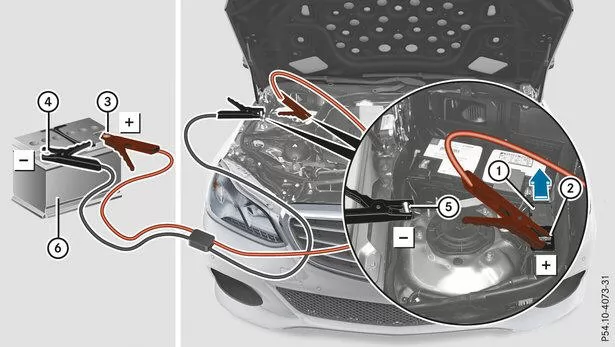
The item number indicates the charged battery of the other vehicle or a corresponding jump-start device.
The cover of the positive contact
 Slide in the direction of the arrow.
Connect the positive contacton your vehicle and the positive terminal of the donor batterywith the jump lead. Start with the positive contactof your vehicle.
On the donor vehicle, let the engine run at idle speed.Connect the negative terminal of the donor batteryand the ground point
 on your vehicle with the jump lead. Start with the donor battery°C.
Start the engine.Before disconnecting the jump leads, let the engines run for a few minutes.
First disconnect the jump leads from the ground pointand negative terminal, then from the positive contactand positive terminal. In each case, start at the contacts of your own vehicle.After removing the jump leads, close the coverof the positive contact.
Have the battery checked at a qualified workshop.Info

Jump starting is not normal operation.
Jump leads and further information on jump starting are available at any qualified workshop.
The Mercedes E-Class W212 (model years 2009–2016) provides detailed information on jump starting with jumper cables. The clear sequence of connections and observance of the safety notes prevent damage to the electrical system and increase safety during jump starting.
Mercedes combines practical technology with the highest safety standards to optimally support the driver, even in difficult situations.
This is why the E-Class remains an example of well-thought-out solutions down to the smallest detail.
Test yourself
A quick Mercedes-Benz E-Class quiz: every answer comes with an explanation and a link to the manual page.