ECO display. Brakes
The ECO display and the brake system of the Mercedes E-Class (4th generation, W212, 2009–2016) provide valuable support for an economical and safe driving style. The display gives feedback on driving behavior and helps optimize fuel consumption. At the same time, this chapter provides comprehensive information on how to use the brakes safely and efficiently to avoid wear.
ECO display
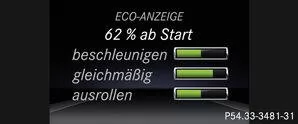
The ECO display gives you feedback on how economical your driving behavior is. It helps you achieve a consumption-optimized driving style under the given and selected conditions. Your driving style can significantly influence fuel consumption.
The ECO display consists of three bars:- accelerating
- steady
- coasting
The ECO display does not show actual fuel consumption. A fixed percentage value on the ECO display does not correspond to a fixed consumption value.
In addition to driving style, fuel consumption depends on many other factors, such as- Loading
- Tire pressure
- Cold start
- Route selection
- electrical loads switched on
Your driving style is rated in the following three categories:
- accelerating (rating of all acceleration processes)
- The bar fills: moderate acceleration, especially at higher speeds
- The bar empties: sporty acceleration
- steady (rating of driving behavior at all times)
- The bar fills: constant speed and avoiding unnecessary acceleration and deceleration
- The bar empties: speed fluctuations
- coasting (rating of all deceleration processes)
- The bar fills: anticipatory driving, keeping a safe distance and lifting off the accelerator early. The vehicle can coast without braking.
- The bar empties: frequent braking

To achieve higher values in the accelerating and steady categories,
- observe the gear shift recommendations
- drive in drive program E (vehicles with automatic transmission).
During longer journeys at constant speed, e.g. on the motorway, only the steady bar changes.
The ECO display totals driving behavior from the start of the journey to the end. Therefore, the bars change dynamically at the beginning of the journey. Changes become smaller over longer journey times. For more dynamic changes, perform a manual reset.
More information on the ECO display.
Brakes
Important Safety Notes
WARNINGIf you downshift on slippery road surfaces to increase engine braking, the drive wheels can lose grip. There is an increased risk of skidding and accidents!
Do not downshift on slippery road surfaces to increase engine braking.Downhill gradients
Do not keep your foot on the brake pedal while driving, e.g. riding the brake by applying constant light pressure. This causes excessive and premature wear of the brake pads.On long and steep downhill gradients, shift to a low gear early.
Pay particular attention to this when the vehicle is loaded and when towing a trailer.Info
This also applies when CRUISE CONTROL, SPEEDTRONIC or DISTRONIC PLUS is switched on.
This allows you to use engine braking and brake less to maintain speed. This relieves the brake system and prevents the brakes from overheating and wearing out too quickly.
High and low loads
WARNINGIf you keep your foot on the brake pedal while driving, the brake system can overheat. This lengthens the braking distance, and the brake system may even fail. There is a risk of an accident!
Never use the brake pedal as a footrest. Do not press the brake pedal and accelerator pedal at the same time while driving.NOTE

Continuous application of the brake pedal causes excessive and premature wear of the brake pads.
If you have subjected the brakes to heavy loads, do not stop the vehicle immediately. Continue driving for a short time. The brakes cool down faster due to the airflow.
If you only apply the brakes moderately, check their effectiveness from time to time. To do so, brake more firmly from a higher speed, taking traffic conditions into account. This will improve the brake grip.Wet road surface
If you drive for a long time in heavy rain without braking, the brakes may respond with a delay when you first brake. This can also occur after washing the vehicle or driving through deep water.You will then have to press the brake pedal harder. Keep a greater distance to the vehicle ahead.
After driving on a wet road and after washing the vehicle, brake noticeably, taking traffic conditions into account. This warms the brake discs, helps them dry faster and protects them from corrosion.Reduced braking effectiveness on salt-treated roads
When driving on roads treated with salt, a layer of salt can form on the brake discs and brake pads. This can considerably increase the braking distance.- To remove a possible layer of salt, brake occasionally, taking traffic conditions into account.
- When parking and when starting off again, apply the brake pedal carefully.
- Keep a particularly large safety distance to the vehicle ahead.
New brake pads
New or replaced brake pads and brake discs only reach optimum braking performance after several hundred kilometers. Compensate for the reduced braking effect by applying firmer pressure to the brake pedal.For safety reasons, Mercedes-Benz recommends having only brake pads approved by Mercedes-Benz, or brake pads of the same quality standard, installed in your vehicle. Brake pads that are not approved by Mercedes-Benz, or brake pads that do not meet the same quality standard, can impair the safety of your vehicle.
AMG High-Performance Ceramic Brake
The high-performance brake system is only installed on AMG vehicles.AMG brake systems are designed for high loads. As a result, noises may occur when braking. These depend on
- Vehicle speed
- braking force
- ambient conditions, such as temperature and humidity.
A generally valid mileage cannot therefore be specified. Brake wear is correspondingly higher with a sporty driving style. For further information, contact your Mercedes-Benz Service Center.
New or replaced brake pads and brake discs only reach optimum braking performance after several hundred kilometers. Compensate for the reduced braking performance by applying more pressure to the brake pedal. Be aware of this and adjust your driving and braking behavior accordingly during this break-in period.Excessive hard braking causes correspondingly high brake pad wear. Observe the brake pad wear warning lamp in the instrument cluster and pay attention to brake status messages in the multifunction display. Especially with a sporty driving style, the brake system should be serviced and checked regularly.
The ECO display and the braking behavior notes of the Mercedes E-Class W212 (model years 2009–2016) actively support the driver in a fuel-efficient and safe driving style. Fuel consumption can be reduced by accelerating deliberately, driving smoothly and coasting in good time.
In addition, tips on using the brakes on downhill stretches or on wet roads help protect the brake system and increase safety. In this way, the E-Class shows how well-considered technology and clear information work together.
Test yourself
A quick Mercedes-Benz E-Class quiz: every answer comes with an explanation and a link to the manual page.