Battery

In this manual: Battery
Air bags, seat belts and child restraints — 1Exterior front — 1Exterior rear — 1Passenger compartment — 1Instrument panel — 1Engine compartment check locations — 1Seats — 1Head restraints/headrests — 1Seat belts — 1Child safety — 1Child restraints — 1Supplemental Restraint System (SRS) — 1Instrument panel — 1Meters and gauges — 1Warning lights, indicator lights and audible reminders — 1Security systems (if so equipped) — 1Wiper and washer switch — 1Rear window defroster switch — 1Headlight and turn signal switch — 1Horn — 1Vehicle Dynamic Control (VDC) off switch — 1Power outlets — 1Storage — 1Windows — 1Interior lights — 1Keys — 1Doors — 1Remote keyless entry system (if so equipped) — 1NISSAN Intelligent Key (if so equipped) — 1Hood — 1Trunk lid — 1Fuel-filler door — 1Steering wheel — 1Sun visors — 1Mirrors — 1Control panel buttons - color screen with Navigation System (if so equipped) — 1RearView Monitor (if so equipped) — 1Vents — 1Heater and Air Conditioner (manual) — 1Servicing air conditioner — 1Audio system — 1NissanConnectSM Mobile Apps (if so equipped) — 1Car phone or CB radio — 1Bluetooth Hands-Free Phone System without Navigation System (Type A) (if so equipped) — 1Bluetooth Hands-Free Phone System without Navigation System (Type B) (if so equipped) — 1Bluetooth Hands-Free Phone System with Navigation System (if so equipped) — 1NISSAN Voice Recognition System (if so equipped) — 1Precautions when starting and driving — 1Ignition switch (if so equipped) — 1Push-button ignition switch (if so equipped) — 1Before starting the engine — 1Starting the engine (models without NISSAN Intelligent Key system) — 1Starting the engine (models with NISSAN Intelligent Key system) — 1Driving the vehicle — 1Parking brake — 1Cruise control (if so equipped) — 1Break-in schedule — 1Fuel efficient driving tips — 1Increasing fuel economy — 1Parking/parking on hills — 1Power steering — 1Brake system — 1Vehicle Dynamic Control (VDC) system (if so equipped) — 1Cold weather driving — 1Hazard warning flasher switch — 1Flat tire — 1Jump starting — 1Push starting — 1If your vehicle overheats — 1Towing your vehicle — 1Cleaning exterior — 1Cleaning interior — 1Corrosion protection — 1Maintenance precautions — 1Engine compartment check locations — 1Engine cooling system — 1Engine oil — 1Continuously Variable Transmission (CVT) fluid (if so equipped) — 14-speed automatic transmission fluid (ATF) (if so equipped) — 1Power steering fluid — 1Brake and clutch (if so equipped) fluid — 1Windshield-washer fluid — 1Battery — 1Variable voltage control system (if so equipped) — 1Drive belt — 1Spark plugs — 1Air cleaner — 1Windshield wiper blades — 1Brakes — 1Fuses — 1Battery replacement — 1Lights — 1Wheels and tires — 1Maintenance requirements — 1General maintenance — 1Explanation of scheduled maintenance items — 1Maintenance schedules — 1Standard maintenance — 1Maintenance under severe operating conditions — 1Recommended fluids/lubricants and capacities — 1Specifications — 1When traveling or registering in another country — 1Vehicle identification — 1Installing front license plate — 1Vehicle loading information — 1Towing a trailer — 1Uniform tire quality grading — 1Emission control system warranty — 1Reporting safety defects — 1Readiness for inspection/maintenance (I/M) test — 1Event Data Recorders (EDR) — 1Owner's Manual/Service Manual order information — 1
~2min read
  • Keep the battery surface clean and dry.

    Clean the battery with a solution of baking soda and water.

  • Make certain the terminal connections are clean and securely tightened.
  • If the vehicle is not to be used for 30 days or longer, disconnect the negative (-) battery terminal cable to prevent discharge.

NOTE:

Care should be taken to avoid situations that can lead to potential battery discharge and potential no-start conditions such as: 1. Installation or extended use of electronic accessories that consume battery power when the engine is not running (Phone chargers, GPS, DVD players, etc.).

2. Vehicle is not driven regularly and/or only driven short distances.

In these cases, the battery may need to be charged to maintain battery health.

WARNING

  • Do not expose the battery to flames, an electrical spark or a cigarette. Hydrogen gas generated by the battery is explosive.

    Explosive gases can cause blindness or injury. Do not allow battery fluid to contact your skin, eyes, fabrics or painted surfaces. Sulfuric acid can cause blindness or injury. After touching a battery or battery cap, do not touch or rub your eyes. Thoroughly wash your hands. If the acid contacts your eyes, skin or clothing, immediately flush with water for at least 15 minutes and seek medical attention.

  • Do not operate the vehicle if the fluid in the battery is low. Low battery fluid can cause a higher load on the battery which can generate heat, reduce battery life, and in some cases lead to an explosion.
  • When working on or near a battery, always wear suitable eye protection and remove all jewelry.
  • Battery posts, terminals and related accessories contain lead and lead compounds.

    Wash hands after handling.

  • Keep battery out of the reach of children.
  • Do not tip the battery. Keep the vent caps tight and the battery level.
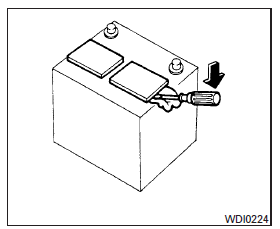
Battery

1. Remove the vent caps with a screwdriver as shown. Use a cloth to protect the battery case.

Battery

2. Check the fluid level in each cell. If it is necessary to add fluid, add only distilled water to bring the level up to the bottom of the filler opening. Do not overfill. Reinstall the vent caps.

Vehicles operated in high temperatures or under severe conditions require frequent checks of the battery fluid level.

Jump starting

If jump starting is necessary, refer to "Jump starting" in the "In case of emergency" section of this manual. If the engine does not start by jump starting, the battery may have to be replaced. It is recommended that you visit a NISSAN dealer for this service.