Fuses

In this manual: Fuses
Air bags, seat belts and child restraints — 1Exterior front — 1Exterior rear — 1Passenger compartment — 1Instrument panel — 1Engine compartment check locations — 1Seats — 1Head restraints/headrests — 1Seat belts — 1Child safety — 1Child restraints — 1Supplemental Restraint System (SRS) — 1Instrument panel — 1Meters and gauges — 1Warning lights, indicator lights and audible reminders — 1Security systems (if so equipped) — 1Wiper and washer switch — 1Rear window defroster switch — 1Headlight and turn signal switch — 1Horn — 1Vehicle Dynamic Control (VDC) off switch — 1Power outlets — 1Storage — 1Windows — 1Interior lights — 1Keys — 1Doors — 1Remote keyless entry system (if so equipped) — 1NISSAN Intelligent Key (if so equipped) — 1Hood — 1Trunk lid — 1Fuel-filler door — 1Steering wheel — 1Sun visors — 1Mirrors — 1Control panel buttons - color screen with Navigation System (if so equipped) — 1RearView Monitor (if so equipped) — 1Vents — 1Heater and Air Conditioner (manual) — 1Servicing air conditioner — 1Audio system — 1NissanConnectSM Mobile Apps (if so equipped) — 1Car phone or CB radio — 1Bluetooth Hands-Free Phone System without Navigation System (Type A) (if so equipped) — 1Bluetooth Hands-Free Phone System without Navigation System (Type B) (if so equipped) — 1Bluetooth Hands-Free Phone System with Navigation System (if so equipped) — 1NISSAN Voice Recognition System (if so equipped) — 1Precautions when starting and driving — 1Ignition switch (if so equipped) — 1Push-button ignition switch (if so equipped) — 1Before starting the engine — 1Starting the engine (models without NISSAN Intelligent Key system) — 1Starting the engine (models with NISSAN Intelligent Key system) — 1Driving the vehicle — 1Parking brake — 1Cruise control (if so equipped) — 1Break-in schedule — 1Fuel efficient driving tips — 1Increasing fuel economy — 1Parking/parking on hills — 1Power steering — 1Brake system — 1Vehicle Dynamic Control (VDC) system (if so equipped) — 1Cold weather driving — 1Hazard warning flasher switch — 1Flat tire — 1Jump starting — 1Push starting — 1If your vehicle overheats — 1Towing your vehicle — 1Cleaning exterior — 1Cleaning interior — 1Corrosion protection — 1Maintenance precautions — 1Engine compartment check locations — 1Engine cooling system — 1Engine oil — 1Continuously Variable Transmission (CVT) fluid (if so equipped) — 14-speed automatic transmission fluid (ATF) (if so equipped) — 1Power steering fluid — 1Brake and clutch (if so equipped) fluid — 1Windshield-washer fluid — 1Battery — 1Variable voltage control system (if so equipped) — 1Drive belt — 1Spark plugs — 1Air cleaner — 1Windshield wiper blades — 1Brakes — 1Fuses — 1Battery replacement — 1Lights — 1Wheels and tires — 1Maintenance requirements — 1General maintenance — 1Explanation of scheduled maintenance items — 1Maintenance schedules — 1Standard maintenance — 1Maintenance under severe operating conditions — 1Recommended fluids/lubricants and capacities — 1Specifications — 1When traveling or registering in another country — 1Vehicle identification — 1Installing front license plate — 1Vehicle loading information — 1Towing a trailer — 1Uniform tire quality grading — 1Emission control system warranty — 1Reporting safety defects — 1Readiness for inspection/maintenance (I/M) test — 1Event Data Recorders (EDR) — 1Owner's Manual/Service Manual order information — 1
~2min read
Fuses

If any electrical equipment does not operate, check for an open fuse.

Fuses are used in the passenger compartment.

Spare fuses are provided and can be found in the passenger compartment fuse box.

When installing a fuse make sure the fuse is installed in the fuse box securely.

Engine compartment
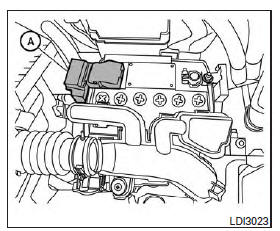
Engine compartment

WARNING

Never use a fuse of a higher or lower amperage rating than specified on the fuse box cover. This could damage the electrical system or electronic control units or cause a fire.

Fusible links

If any electrical equipment does not operate and the fuses are in good condition, check the fusible links A in the holder. If any of the fusible links are melted, replace only with Genuine NISSAN parts.

For checking and replacing the fusible links, it is recommended that you visit a NISSAN dealer.

Passenger compartment
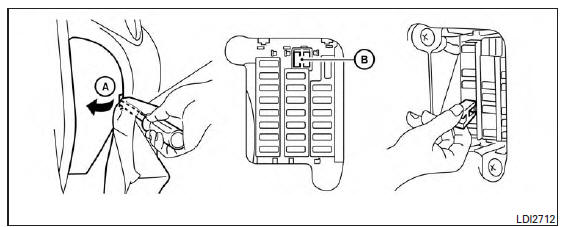
Passenger compartment

WARNING

Never use a fuse of a higher or lower amperage rating than specified on the fuse box cover. This could damage the electrical system or cause a fire.

If any electrical equipment does not operate, check for an open fuse.

NOTE:

The fuse box is located on the driver's side of the instrument panel.

1. Be sure the ignition switch and the headlight switch are OFF.

2. Remove the fuse box cover A with a suitable tool. Use a cloth to avoid damaging the trim.

3. Locate the fuse that needs to be replaced.

4. Remove the fuse with the fuse puller B .
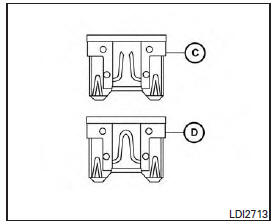
Passenger compartment

5. If the fuse is open C , replace it with an equivalent good fuse D .

6. Push the fuse box cover to install.

If a new fuse also opens, have the electrical system checked and repaired. It is recommended that you visit a NISSAN dealer for this service.

Extended storage switch
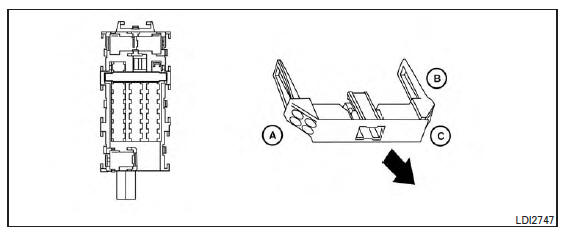
Extended storage switch

If any electrical equipment does not operate, remove the extended storage switch and check for an open fuse.

NOTE:

The extended storage switch is used for long term vehicle storage. Even if the extended storage switch is broken it is not necessary to replace it. Replace only the open fuse in the switch with a new fuse.

How to replace the extended storage switch: 1. To remove the extended storage switch, be sure the ignition switch is in the OFF or LOCK position.

2. Be sure the headlight switch is in the OFF position.

3. Remove the fuse box cover.

4. Pinch the locking tabs A and B found on each side of the storage switch.

5. Pull the storage switch straight out from the fuse box C .