Body Electrical System
Description and Operation
In this manual: Body Electrical System
22steps
~132min
4/5difficulty
Done 0 of 22
Description
The memorized seat position can be recalled using the IMS switch. The IMS switch controls the optimal seat position set by the driver. For safety, recall is prohibited while driving, and related movement stops during an emergency stop. The main functions are as follows.- Manual Operation: Motor operation using the manual seat switch.
- The seat position is changed by the motor when a signal is input with the manual seat switch (slide, recline, front height tilt, rear height adjustment).
- Memory Function: Stores and recalls data for two drivers using the IMS switch.
- Memory seat and outside mirror positions for the optimal driving position are set by the driver based on CAN data (IMS>DDM) with the IMS switch.
- Recall based on CAN data received from the IMS switch control.
- Linked Movement On/Off
- Linked movement on/off function depending on the engine ON/OFF status.
- Using MS IN data transmission
- Start condition: When the power is in ACC mode.
- Operating conditions: engine off.
- Storing and recalling the mirror position using the memory switch
- Description of the System
A. IMS switch input signals are received by the Power Seat Module (PSM). B. After receiving input from the IMS switch, the PSM sends information to the DDM and ADM through the CAN communication line. C. After receiving information from the PSM, the DDM and ADM store and recall it. - Storing and recalling operation is performed when the following conditions are met:
A. ON B. Transmission selected in P (Park) C. Vehicle speed is "0 km/h" based on information transmitted from the BCM via the CAN bus. - Save Mirror Position
A. Move the driver and passenger side mirrors to the desired position. B. Press the SET switch on the IMS switches. C. Press switch 1 or 2 within the specified time. D. Mirror positions are stored in IMS switches 1 or 2 for the DDM and ADM.
- Description of the System
Operation
Recall Movement- The buzzer sounds once and the mirror automatically adjusts to the stored position when CAN data is received from the IMS.
- CAN data that is not stored in memory is not used for recall.
- The finally received CAN data for recall takes priority when other CAN data is received during recall movement.
- The seat stops recall when CAN data received by pressing button 1 or 2 is received during recall.
- The seat stops recall when stored CAN data is received by pressing the SET button during recall.
Press the SET button again to save the stop position.
- Automatic stop when the seat reaches the virtual limit position during recall.
- Do not start the engine if the difference between the stored recall position and the current position is less than 4 pulses.
- IGN2 OFF (except for 30 seconds after opening or closing a door.)
- Vehicle speed above 3 km/h
- When the switch is operated manually
- Operation Timing Chart
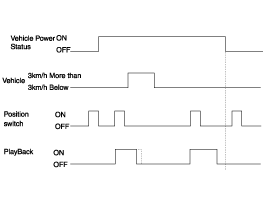
- Engine operation must be delayed by 100±10 ms to prevent overlap of the starting circuit when starting the engine. The priority in this case is: Slide > Seatback Adjustment > Front Seat Height Adjustment > Rear Seat Height Adjustment. Operation Timing Chart.
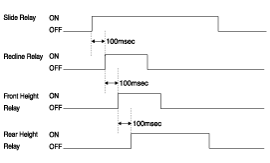
- Reverse movement when exiting and forward movement when entering (applies to slide only).
- Operation starts with the engine off.
- Movement to the target position in ACC ON
- Prohibited Operation Conditions
A. Vehicle speed 3 km/h B. Power seats, when operated by the manual control switch. C. Driver Settings Menu (USM) is off, D. Passenger actions when a recall command is received - Virtual Limit Conditions and Setting Positions: Set an arbitrary virtual limit using any of the methods below, since there is no independent limit switch restricting slide movement, and the seatback and front/rear height adjustment motors:
- Slide call: When no slide motor pulse input (mechanical end stop) is detected for 2 seconds after 6 or more pulses during any operation started by the manual switch or memory recall, stop the motor immediately and set the position 6 pulses ahead of that position as the limit in the direction of movement (same for setting the opposite limit).
Set Position Virtual Limit Setting Conditions Virtual Limit Setting Positions Slide 2 seconds, 6 pulses 6 pulses from the limited position Seatback Adjustment (Recline) 2 seconds, 155 pulses 155 pulses from the limited position Front Tilt 1 second, 6 pulses 6 pulses from the limited position Rear Height Adjustment 1.5 seconds, 6 pulses 6 pulses from the limited position
? Pulse: A waveform unit used to measure motor rotation. - After setting the virtual limit, do not perform any memory operations. Move the seat away from the limit position to prevent engine damage due to mechanical lock.
- Update the end position if the pulse is normally output at this position by memory operation with the limit set.
- Slide call: When no slide motor pulse input (mechanical end stop) is detected for 2 seconds after 6 or more pulses during any operation started by the manual switch or memory recall, stop the motor immediately and set the position 6 pulses ahead of that position as the limit in the direction of movement (same for setting the opposite limit).
- Virtual Limit Setting Procedure
- Slide: To set the virtual limit, move the seat forward to the end stop and hold for 2 seconds, then move it backward to the end stop and hold for 2 seconds.
- Recliner Adjustment (Reclining): To set the virtual limit, move the seatback forward to the end stop and hold for 2 seconds, then move it backward to the end stop and hold for 2 seconds.
- Front Tilt: To set the virtual limit, move the seat up to the end stop and hold for 1 second, then move it down to the end stop and hold for 1 second.
- Rear Height Adjustment: To set the virtual limit, move the seat up to the end stop and hold for 1.5 seconds, then move it down to the end stop and hold for 1.5 seconds.
Test yourself
A quick Hyundai Sonata LF quiz: every answer comes with an explanation and a link to the manual page.
Was this page helpful?