RCTA (Rear Cross-Traffic Collision-Avoidance Assist)
Operating Conditions

To operate:
Enter the User Settings mode (Driver Assistance) and select RCTA (Rear Cross-Traffic Alert) on the LCD display (refer to the LCD Display section in Chapter 3 for more details). The system will turn on and stand by for activation. The system is activated when the vehicle speed is below 10 km/h and the shift lever is in the R (Reverse) position.
NOTICE
The RCTA (Rear Cross-Traffic Alert) detection range is approximately 1 ft (0.5 m) to 65 ft (20 m). A vehicle will be detected if its speed is 2.5 mph (4 km/h) to 36 km/h within the detection range. However, the detection range may vary under different conditions. Always pay attention to your surroundings.
Warning Type
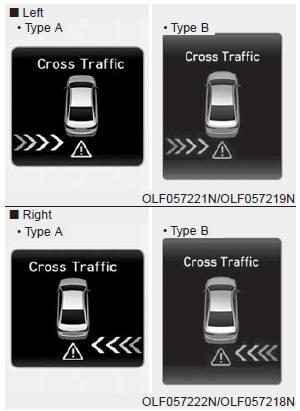
If a vehicle detected by the radar approaches your vehicle, a warning chime will sound, the indicator on the outside rearview mirror will flash, and a message will appear on the LCD display.
WARNING
- The warning indicator on the outside rearview mirror illuminates whenever the system detects a vehicle behind. To avoid accidents, do not focus only on the warning indicator and neglect what is around the vehicle.
- Drive safely even if the vehicle is equipped with the Blind-Spot Detection (BSD) system and Rear Cross-Traffic Alert (RCTA). Do not rely solely on the system; check your surroundings before changing lanes or reversing. The system may not alert the driver under some conditions, so always check your surroundings while driving.
- The Blind-Spot Detection (BSD) and Rear Cross-Traffic Alert (RCTA) systems do not replace proper and safe driving practices. Always drive safely and use caution when changing lanes or reversing. The Blind-Spot Detection (BSD) system may not detect every object next to the vehicle.
Information
- If the detected vehicle is outside the detection zone of your vehicle, slowly steer the vehicle away from the detected object; the warning will be canceled.
- The system may malfunction due to other factors or circumstances. Always pay attention to your surroundings.
- If the left or right side bumper of your vehicle is covered by a barrier or other vehicles, the sensitivity of the system may decrease.
NOTICE
- The system may malfunction if the bumper has been replaced or if repair work has been performed near the radar.
- The detection zone varies depending on the road width. If the road is narrow, the system may detect other vehicles in the adjacent lane. Also, if the road is very wide, the system may not detect other vehicles.
- The system may be deactivated due to strong electromagnetic waves.
Malfunction
The outside rearview mirror may not warn the driver if:
- The outside rearview mirror housing is damaged or covered with debris.
- The sensor window is blocked with debris.
- The windows are heavily tinted.
DRIVER ATTENTION
The driver should be cautious in the following situations, as the system may not detect other vehicles or objects under certain circumstances.
- Curvy roads, toll gates, etc.
- The area around the radar is contaminated with rain, snow, dirt, etc.
- The rear bumper near the radar is covered or blocked by a foreign object, such as a sticker, bumper guard, bicycle carrier, etc.
- The rear bumper is damaged or the radar is misaligned.
- The vehicle height is changed, for example, when the trunk is loaded with heavy items, low tire pressure, etc.
- Bad weather, such as heavy rain or snow.
- A stationary object is nearby, such as a guardrail, tunnel, person, animal, etc.
- Metal objects are near the vehicle, such as at a construction site.
- A large vehicle is nearby, such as a bus or truck.
- A motorcycle or bicycle is nearby.
- A flat trailer is nearby.
- If the vehicle starts moving at the same time as a vehicle next to you and accelerates.
- When another vehicle passes at a higher speed.
- When changing lanes.
- When driving down or up a steep road with different lane heights.
- When another vehicle approaches very closely.
- When a trailer or vehicle is attached.
- When the temperature in the rear bumper area is high or low.
- When the radars are blocked by a wall or parking post.
- When your vehicle is reversing and the detected vehicle is also reversing.
- Small objects, such as shopping carts and baby strollers.
- When a vehicle with reduced ground clearance (lowered) is present.
- When the vehicle is next to another vehicle.
- When a vehicle in the adjacent lane moves away from you by two lanes, OR when a vehicle two lanes away moves into the lane next to you.
- When driving on a narrow road with many trees or bushes.
- When driving on a wet surface.
Information
This device complies with Part 15 of the FCC Rules.
Operation is subject to the following two conditions:
1. This device may not cause harmful interference, and
2. This device must accept any interference received, including interference that may cause undesired operation.
Test yourself
A quick Hyundai Sonata LF quiz: every answer comes with an explanation and a link to the manual page.