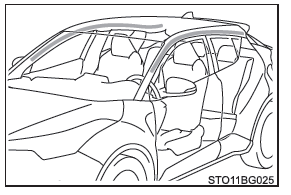
SRS airbags
The SRS airbags deploy when the vehicle is subjected to a severe impact that could seriously injure the occupants. They work together with the seat belts to help reduce the risk of serious or fatal injuries.
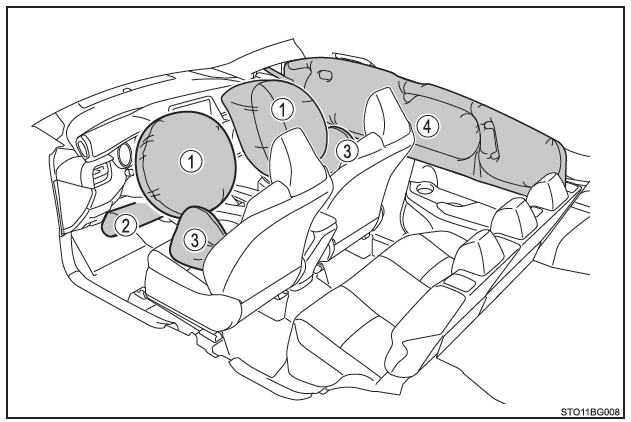
Front SRS airbags
- Driver and front passenger SRS airbags
Help protect the driver's and front passenger's head and chest from contact with interior components - Driver's SRS knee airbag (on equipped models)
Helps protect the driver
Side and curtain SRS airbags
- Front side SRS airbags
Help protect the upper body of occupants seated in the front seats - Curtain SRS airbags
Mainly help protect the heads of occupants seated in the side seats
SRS airbag system components
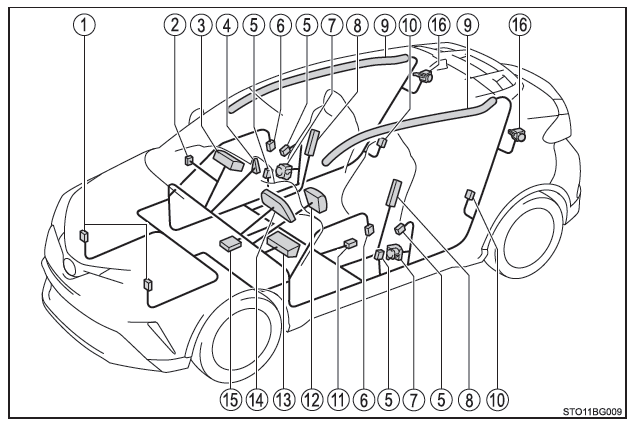
- Front impact sensors
- Manual airbag cutoff switch (on equipped models)
- Front passenger airbag
- "PASSENGER AIR BAG" indicator light (on equipped models)
- Side impact sensors (front)
- Side impact sensors (front)
- Seat belt pretensioners and force limiters (front)
- Side airbags
- Curtain airbags
- Side impact sensors (rear)
- Driver's seat position sensor (on equipped models)
- Driver airbag
- Driver's knee airbag (on equipped models)
- SRS warning light
- SRS airbag ECU
- Seat belt pretensioners and force limiters (rear side seats) (on equipped models)
The main components of the SRS airbag system are shown above.
The SRS airbag system is controlled by an electronic control unit. The airbags are inflated rapidly by a chemical reaction in the pyrotechnic devices, which produces a harmless gas to cushion the occupants' movement.
WARNING■ SRS airbag precautions Observe the following precautions regarding the SRS airbags.
Failure to do so could result in serious or fatal injury.
- The driver and all passengers in the vehicle must wear their seat belts correctly.
SRS airbags are supplemental restraint devices that work together with the seat belts.
- The SRS driver airbag deploys with considerable force, which can be very dangerous or even fatal if the driver is positioned very close to the airbag.
The danger zone for the driver airbag is within the first 50 to 75 mm (2 to 3 in.) of deployment. To ensure a sufficient safety margin, position yourself at least 250 mm (10 in.) from the driver airbag. This distance is measured between the hub of the steering wheel and your breastbone. If you are currently seated less than 250 mm (10 in.) away, you can change your driving position in the following ways:
- Move the seat back as far as possible while still being able to comfortably reach the pedals.
- Recline the seatback slightly.
Although vehicles differ, most drivers can sit at a distance of 250 mm (10 in.), even with the driver's seat fully forward, by simply reclining the seatback slightly. If you have difficulty seeing the road after reclining the seat, use a firm, non-slip cushion to raise your position or, if your vehicle has seat height adjustment, raise the seat.
- If your steering wheel is adjustable, tilt it downward. This directs the airbag toward your chest rather than your head and neck.
■ SRS airbag precautions
- The SRS front passenger airbag also deploys with considerable force, which can be very dangerous or even fatal if the front passenger is positioned very close to the airbag. Move the front passenger seat as far back from the airbag as possible, and adjust the seatback so that you sit upright in the seat.
- Infants and children who are not properly seated and/or restrained can be seriously injured or killed by airbag deployment. Place children who are too young to use the seat belt in a child safety seat. Toyota strongly recommends that all infants and children be placed in the rear seats of the vehicle and properly secured. Rear seats are safer for infants and children than the front passenger seat.
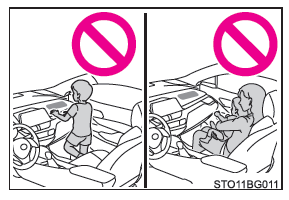
- Do not sit on the edge of the seat and do not lean against the instrument panel.
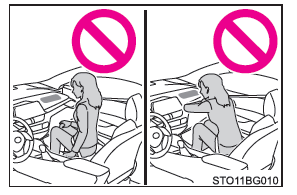
- Do not allow a child to stand in front of the SRS front passenger airbag or sit on the front passenger's lap.
- Do not allow occupants of the front seats to travel with objects on their laps.
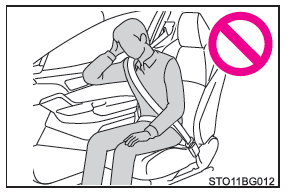
- Do not lean against the door, roof side rail, or the front, side and rear pillars.
■ SRS airbag precautions
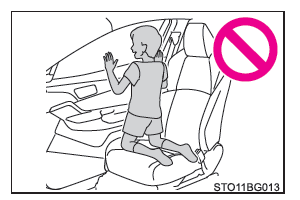
- Do not allow anyone to kneel on the passenger seat while leaning against the door, or to put their head or hands outside the vehicle.
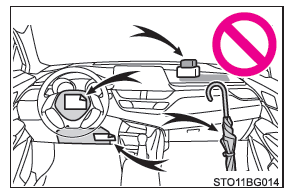
- Vehicles without an SRS driver knee airbag: Do not attach or place anything on parts such as the instrument panel or the center pad of the steering wheel.
When the SRS driver and front passenger airbags deploy, any object may become a projectile.
- Do not attach anything to parts such as a door, the windshield, a side window, a front or rear pillar, a roof side rail, or a grab handle. (Except the speed limit label)
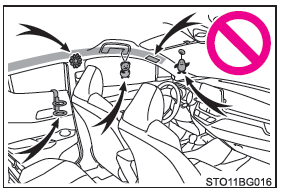
■ SRS airbag precautions
- Vehicles without a smart entry and start system but equipped with an SRS driver knee airbag: Do not attach heavy, sharp, or very hard objects, such as other keys, to the key. These objects may interfere with the deployment of the SRS driver knee airbag or be propelled toward the driver's seat by the deployment force, creating a potential hazard.
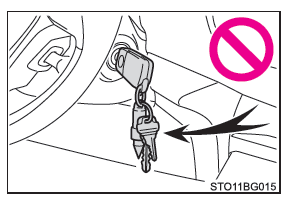
Vehicles equipped with an SRS driver knee airbag: If a vinyl cover covers the area where the SRS driver knee airbag deploys, be sure to remove it.
Do not use any seat accessories that cover the deployment areas of the SRS side airbags, as they may interfere with deployment. Such accessories may prevent the side airbags from functioning properly, disable the system, or cause the side airbags to deploy accidentally, resulting in serious or fatal injury.
Do not subject the parts housing the SRS airbag components, or the front doors, to severe impacts or excessive pressure.
Doing so could cause the SRS airbags to malfunction.
Do not touch any system component immediately after the SRS airbags have been triggered (deployed), as they are still very hot.
If you have difficulty breathing after the SRS airbags deploy, open a door or window to let in fresh air, or get out of the vehicle if it is safe to do so. Clean off any residue as soon as possible to avoid possible skin irritation.
If the parts in which the SRS airbags are installed, such as the steering wheel center pad and the front and rear pillar trims, are damaged or cracked, have them replaced by a Toyota dealer, a Toyota-approved repairer, or any reliable repairer.
■ Modification and end-of-life disposal of SRS airbag system components Do not scrap your vehicle or make any of the following modifications without consulting a Toyota dealer, an authorized Toyota repairer, or any reliable repairer. SRS airbags may not function properly or may deploy (inflate) accidentally, resulting in serious or fatal injury.
- Installation, removal, disassembly and repair of SRS airbags
- Repairs, modifications, disassembly or replacement of the steering wheel, instrument panel, dashboard, seats or their trim, front, side and rear pillars or roof side rails, front door panels, front door trim or front door speakers
- Modifications to the front door panel (such as drilling a hole in it)
- Repairs or modifications to the front fender, front bumper, or the passenger compartment side
- Installation of a grille guard (bull bar or kangaroo bar, etc.), snow plow or winch
- Modifications to the vehicle suspension
- Installation of electronic equipment, such as a mobile radio transmitter/receiver (RF transmitter) or CD player
■ If the SRS airbags deploy (inflate)
- The SRS airbags may cause minor injuries (abrasions, burns, bruises, etc.) when they deploy (inflate) extremely rapidly due to hot gases.
- Deployment is accompanied by a loud bang and white dust.
- Some parts of the airbag module (steering wheel hub, airbag cover and gas generator), as well as the front seats, certain parts of the front and rear pillars and roof side rails may remain very hot for several minutes. The airbag itself may also be very hot.
- The windshield may crack.
■ Deployment conditions for SRS airbags (front)
- The SRS front airbags deploy when the severity of the impact exceeds the specified threshold, equivalent to a frontal collision at approximately 20 to 30 km/h against a fixed, non-deformable barrier.
However, this threshold speed is much higher in the following situations:
- If the vehicle strikes a deformable or moving object on impact, such as a parked vehicle or a road sign
- If the vehicle is involved in an underride collision, i.e., a collision in which the front of the vehicle passes under the platform of a heavy truck
- Depending on the type of collision, only the seat belt pretensioners may activate.
■ Deployment conditions for SRS airbags (side and curtain)
- The SRS side and curtain airbags deploy when the severity of the impact exceeds the specified threshold, equivalent to an impact from a vehicle of approximately 1500 kg (3300 lb.) traveling at a speed of approximately 20 to 30 km/h and striking the passenger compartment at a right angle to its direction of travel.
- The SRS curtain airbags also deploy in the event of a severe frontal collision.
■ Deployment conditions for SRS airbags (inflate), other than in a collision The SRS front and curtain airbags may also deploy in the event of a severe impact from underneath the vehicle. The illustration shows some examples.
- Striking a curb or a hard obstacle
- Falling or jumping into a deep hole
- Severe impact or falling of the vehicle
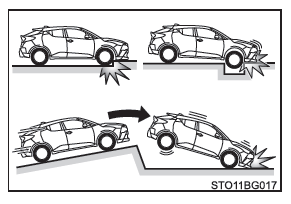
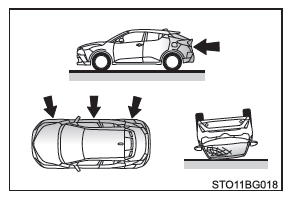
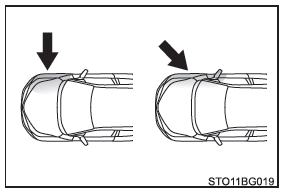
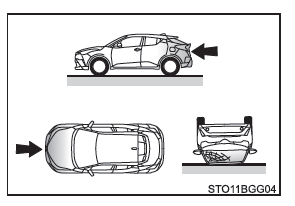
■ Types of collisions in which the SRS front airbags may not deploy As a general rule, the SRS front airbags do not deploy when the vehicle is struck from the rear or side, rolls over, or sustains a frontal impact at low speed. However, if any collision causes sufficient longitudinal deceleration of the vehicle, the SRS front airbags may deploy.
- Side impact
- Rear impact
- Vehicle rollover
■ Types of collisions in which the SRS side and curtain airbags may not deploy The SRS side and curtain airbags may not deploy if the vehicle is struck from the side at certain angles, or at points other than the passenger compartment.
- Side impact outside the passenger compartment of the vehicle
- Three-quarter impact
As a general rule, the SRS side airbags do not deploy when the vehicle is struck from the front or rear, rolls over, or sustains a side impact at low speed.
- Frontal impact
- Rear impact
- Vehicle rollover
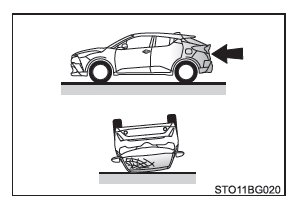
As a general rule, the SRS curtain airbags do not deploy when the vehicle is struck from the rear, rolls over, or sustains a side or frontal impact at low speed.
- Rear impact
- Vehicle rollover
■ When to contact a Toyota dealer, an authorized Toyota repairer, or any reliable repairer In the following cases, the vehicle must be inspected and/or repaired. Contact a Toyota dealer, an authorized Toyota repairer, or any reliable repairer as soon as possible.
- Any SRS airbag has deployed.
- The vehicle has sustained damage or is deformed at the front, or has been involved in a collision not severe enough to cause the SRS front airbags to deploy.
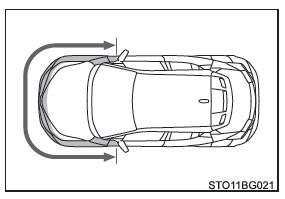
- The vehicle is partially dented or deformed at a door (or the door has been punctured), or has been involved in a collision not severe enough to cause the SRS side and curtain airbags to deploy.
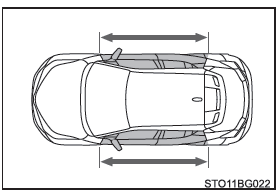
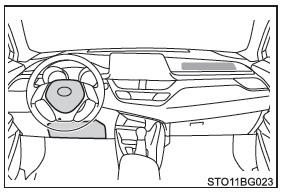
- Vehicles without a driver's SRS knee airbag: The steering wheel trim or the instrument panel area containing the front passenger airbag shows signs of scratches, cracks or any other deterioration.
Vehicles equipped with a driver's SRS knee airbag: The steering wheel pad, the instrument panel in the area containing the front passenger airbag, or the lower part of the dashboard shows any signs of scratches, cracks or other damage.
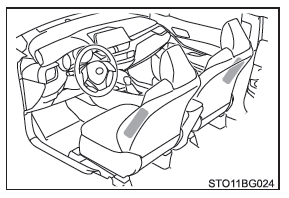
- The area of the seats containing the side airbag shows any signs of scratches, cracks or other damage.
- The area of the front pillars, rear pillars or roof side rail trim where the curtain airbags are housed shows any signs of scratches, cracks or other damage.