Seat belts
Make sure all occupants have fastened their seat belts before driving.
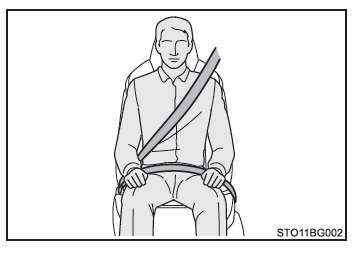
Correct use of seat belts
- Pull out the shoulder belt so that it lies across the shoulder, without touching the neck or slipping off the shoulder.
- Position the lap belt as low as possible across the hips.
- Adjust the seatback position. Sit as upright as possible and sit firmly against the seat.
- Do not twist the seat belt.
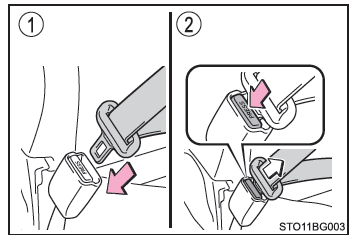
Fastening and unfastening the seat belt
- To fasten the seat belt, insert the tongue into the buckle until you hear a click.
- To unfasten the seat belt, press the release button.
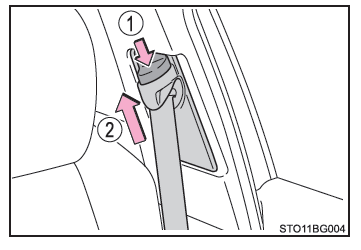
Adjusting the height of the seat belt anchor (front seats)
- Push the shoulder belt anchor down while pressing the release button.
- Push the shoulder belt anchor up.
Move the height adjuster up or down until you hear a click.
Seat belt pretensioners
Vehicles without knee airbag

Vehicles with knee airbag
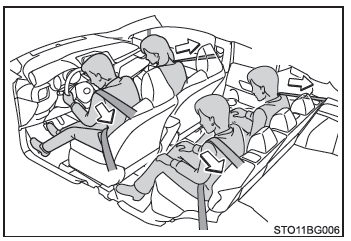
The pretensioners retract the seat belts to pull occupants very quickly back against their seats in the event of a severe frontal or side impact (in certain cases).
It is normal for the pretensioners not to activate in a minor frontal or side impact, a rear impact, or if the vehicle rolls over.
■ Emergency locking retractor (ELR) In the event of a collision or sudden stop, the retractor locks the belt. It may also lock if you lean forward too quickly. Moving slowly and smoothly allows the belt to extend and does not restrict your movements.
■ Using seat belts with child seats The seat belts fitted to your vehicle were designed mainly for adult-sized occupants.
- Use a child seat suitable for your child until they are big enough to wear the vehicle's seat belt properly.
- When the child is large enough to wear the vehicle's seat belt properly, follow the instructions for seat belt use.
■ Replacing the belt after pretensioner activation In the event of multiple collisions, the pretensioner will activate only during the first collision and not during subsequent ones.
■ Seat belt regulations If special regulations concerning seat belts apply in the country where you live, please contact a Toyota dealer, a Toyota authorized repairer, or any reliable repairer for seat belt replacement or installation.
WARNING Observe the following precautions to reduce the risk of injury in the event of sudden braking, swerving or an accident.Failure to do so could result in serious or fatal injury.
■ Wearing the seat belt
- Make sure all passengers wear their seat belts.
- Always fasten your seat belt correctly.
- Each seat belt must be used by only one person. Do not use one seat belt to restrain more than one person at a time, even if they are children.
- Toyota recommends that children sit in the rear seats and that they always wear a seat belt and/or sit in an appropriate child safety seat.
- Do not recline the seat more than necessary to find a comfortable sitting position. Seat belts provide maximum protection when occupants sit upright with their backs fully against the seatbacks.
- Do not route the shoulder belt under your arm.
- Always position the lap belt as low as possible across your hips and make sure it is properly centered.
■ Pregnant women Consult a medical professional and wear the seat belt as instructed.
Pregnant women should position the lap belt as low as possible on the hips, like any other passenger, fully extend the shoulder belt over the shoulder, and avoid routing the belt over the abdomen.
If the seat belt is not worn correctly, any sudden braking or collision may cause serious or fatal injuries, not only to the pregnant woman but also to the fetus.
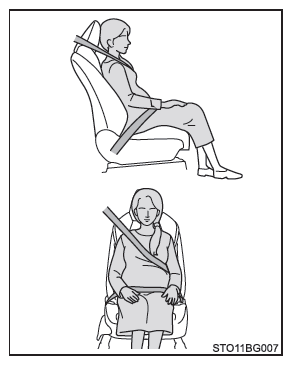
■ Ill persons Consult a medical professional and wear the seat belt as instructed.
■ Children on board
■ Seat belt pretensioners If the pretensioner has deployed, the SRS warning light comes on. In this case, the seat belt can no longer be used and must be replaced by a Toyota dealer, a Toyota-approved repairer, or any reliable repairer.
■ Adjustable upper anchor (front seats) Make sure the shoulder belt passes squarely across the center of your shoulder. It must never press against the neck or slip off the shoulder. Otherwise, the level of protection in an accident may be insufficient, and serious or fatal injuries may result in a sudden stop, swerve, or collision.
■ Seat belt condition and wear
- Avoid damaging the seat belts by pinching the belt, latch, or buckle in the door.
- Inspect the seat belts periodically. Check that they are not cut or frayed and that their anchors are not loose. Do not use a defective seat belt until it has been replaced. A defective seat belt does not guarantee occupant protection in an accident.
- Make sure the latch is securely locked in the buckle and that the belts are not twisted.
If the seat belt does not operate properly, contact a Toyota dealer, a Toyota-approved repairer, or any reliable repairer immediately.
- Replace the seat belt in all cases where your vehicle is involved in a severe accident, even if no damage is visible.
- Do not attempt to install, disassemble, modify, or dispose of the seat belts. Have any necessary repairs performed by a Toyota dealer, a Toyota-approved repairer, or any reliable repairer. Improper handling may cause incorrect operation.