Circuit description
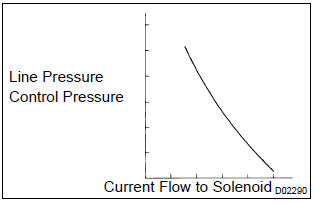
The throttle pressure that is applied to the primary regulator valve (which modulates the line pressure) causes the solenoid valve slt, under electronic control, to precisely and minutely modulate and generate the line pressure according the extent of the accelerator pedal depressed or the output of engine power.
This controls the line pressure and provides smooth shifting.
Upon receiving a signal of the throttle valve opening angle, the ecm controls the line pressure by sending a predetermined (*) duty ratio to the solenoid valve, modulating the line pressure and generating throttle pressure.
(*): Duty ratio the duty ratio is the ratio of the period of continuity in one cycle.
For example, if a is the period of continuity in one cycle, and b is the period of non–continuity, then duty ratio=a/(a+b) x 100 (%)
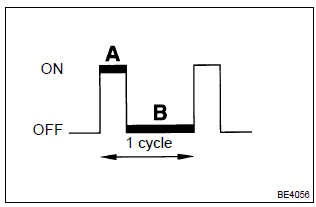

The linear solenoid valve (slt) controls the transmission line pressure for smooth transmission operation based on signals from the throttle position sensor and the vehicle speed sensor. The ecm adjusts the duty cycle of the slt solenoid valve to control hydraulic line pressure coming from the primary regulator valve.
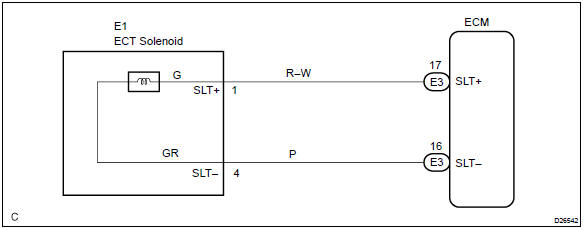
Appropriate line pressure assures smooth shifting with varying engine outputs. When an open or short in the linear solenoid valve (slt) circuit is detected, the ecm interprets this as a fault. The ecm will turn on the mil.
Monitor strategy



Test yourself
A quick Toyota Corolla quiz: every answer comes with an explanation and a link to the manual page.