Ignition system
ON-VEHICLE INSPECTION
NOTICE: "Cold" and "Hot" in these sentences express the temperature of the coils themselves. "Cold" is from -10C (14F) to 50C (122F) and "Hot" is from 50C (122F) to 100C (212F).
1. INSPECT IGNITION COIL (WITH IGNITER) AND SPARK TEST
Check that the spark occurs.
- Remove the ignition coils (with igniter) ( IG-6 ).
- Remove the spark plugs.
- Install the spark plugs to each ignition coil (with igniter), and connect the ignition coil (with igniter) connector.
- Disconnect the 8 injector connectors.
- Ground the spark plug.
- Check if spark occurs while engine is being cranked.
NOTICE: To prevent gasoline from being injected from injectors during this test, crank the engine for no more than 5 - 10 seconds at time.
If the spark does not occur, do the test as follows:

- Using a 16 mm plug wrench, install the spark plugs.
Torque: 17,5 N·m
- Reinstall the ignition coils (with igniter) ( IG-6 ).
2. INSPECT SPARK PLUG
NOTICE:
- Never use a wire brush for cleaning.
- Never attempt to adjust the electrode gap on used spark plug.
- Spark plug should be replaced every 100,000 km (60,000 miles).
(a) Remove the ignition coils (with igniter) ( IG-6 ).
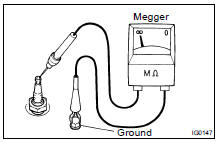
(b) Check the electrode.
- Using a megger (insulation resistance meter), measure the insulation resistance.
Correct insulation resistance: 10 MW or more
If the resistance is less than specified, proceed to step (d).
HINT: If a megger is not available, the following simple method of inspection provides fairly accurate results.

- Simple Method:
- Quickly race the engine to 4,000 rpm 5 times.
- Remove the spark plug. (See step (c))
- Visually check the spark plug. If the electrode is dry ... OK.
If the electrode is wet ... Proceed to step (d).
- Reinstall the spark plug. (See step (g))
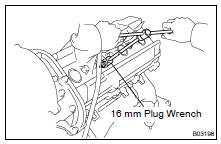
(c) Using a 16 mm plug wrench, remove the spark plugs.
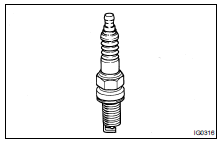
(d) Check the spark plug for thread damage and insulator damage.
If abnormal, replace the spark plug.
Recommended spark plug:


(e) Check the spark plug electrode gap.
Maximum electrode gap for used spark plug: 1.3 mm (0.051 in.)
If the gap is greater than maximum, replace the spark plug.
Correct electrode gap for new spark plug: 1.1 mm (0.043 in.)
NOTICE: If adjusting the gap of a new spark plug, bend only the base of the ground electrode. Do not touch the tip. Never attempt to adjust the gap on a used plug.
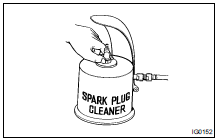
(f) Clean the spark plugs.
If the electrode has traces of wet carbon, allow it to dry and then clean with a spark plug cleaner.
Air pressure: Below 588 kPa (6 kgf/cm2, 85 psi)
Duration: 20 seconds or less
HINT: If there are traces of oil, remove it with gasoline before using the spark plug cleaner.
(g) Using a 16 mm plug wrench, install the spark plugs.
Torque: 17,5 N·m
(h) Reinstall the ignition coils (with igniter) ( IG-6 ).
3. INSPECT CAMSHAFT POSITION SENSOR
(a) Remove the V-bank cover.(b) Disconnect the camshaft position sensor connector.
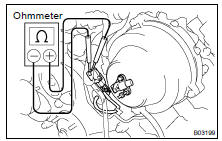
(c) Using an ohmmeter, measure the resistance between terminals.
Resistance:

If the resistance is not as specified, replace the camshaft position sensor.
(d) Reconnect the camshaft position sensor connector.(e) Reinstall the V-bank cover.
4. INSPECT CRANKSHAFT POSITION SENSOR
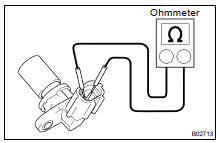
(b) Using an ohmmeter, measure the resistance between the terminals.
Resistance:

If the resistance is not as specified, replace the crankshaft position sensor.
(c) Reinstall the crankshaft position sensor.
Test yourself
A quick Toyota Land Cruiser quiz: every answer comes with an explanation and a link to the manual page.