Running gear, axles, steering
Balancing wheel, balancing wheel on stationary wheel balancer
In this manual: Running gear, axles, steering
~3min read
Road test has been carried out → Chapter.Clamp wheel into wheel balancing machine Note When balancing tyres, please remember that cleanliness is absolutely essential, as is the case in any other repair work you carry out. Only then can you attain a flawless result! Dirt and rust in the area of the contact surfaces and centre of the wheel distort the result.
Note It is very important that the correct tools for centring and clamping the wheels are used on the wheel balancing system. Before commencing any work, find out about the respective centring system for wheel balancing machines → Volkswagen ServiceNet; Workshop Equipment, Catalogue. |
Note |
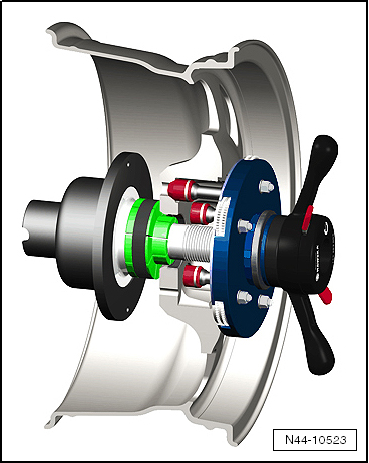 |
To clamp the wheel in place, use centring system for wheel balancing machines -VAS 5271-, for example. This ensures that the wheel is 100% centred and that the wheel will be clamped without damage! The wheel cannot be centralised 100% with conical clamping elements on the wheel balancing machine. A deviation of 0.1 mm from the centre results in an imbalance of 10 grams at the wheel/rim. Procedure for balancing wheels and tyres
Note If one-sided wear, flat spots from braking or severely washed out spots are apparent, balancing cannot achieve smooth running. In this case, the tyre must be renewed.
Note
More than 60 grams of weight per tyre should not be used.If more weight is required, you may be able to achieve smoother running by "matching" the tyre and rim. Matching tyres → Chapter.The wheel balancer display should indicate 0 gram.As an alternative to match mounting, you could use the vibration control system -VAS 6230 A- → Chapter.
Carry out road test
|
 |
Test yourself
A quick Volkswagen Golf quiz: every answer comes with an explanation and a link to the manual page.
Was this page helpful?