Auxiliary heater
Bleeding fuel line to metering pump -V54- (filling with fuel)
In this manual: Auxiliary heater
~3min read
 Note Air/fuel vapour in the fuel supply to the auxiliary heater can lead to malfunction when the auxiliary heater is in the sparking mode. To prevent air/fuel vapour from being drawn in by the metering pump -V54- and conveyed to the auxiliary heater when the auxiliary heater is first switched on after performing repairs on the fuel tank or the fuel delivery unit, the fuel take-off pipe must be filled with fuel (bled) after performing repairs in this area. The fuel line must be bled, for example if the fuel line was removed and the entire fuel line is filled with air. For example, if only the fuel delivery unit was removed and there is only a small amount of air in the fuel line; it is sufficient to switch on the auxiliary heater and let it run for some time in full load mode (at least 10 minutes) to check its operation after completing work on the fuel system. After completing work on the fuel system, switch on the auxiliary heater, and let it run for some time in full load mode (at least 10 minutes). On vehicles with high-voltage system, it may not be possible to switch on the auxiliary heater via the control panel, depending on the charge level of the hybrid battery unit -AX1- and the ambient temperature. If the -J255- gets the information that the hybrid battery unit -AX1- is sufficiently charged, that there is sufficient power available to operate the high-voltage heater (PTC) -Z115- and that the ambient temperature is above -10°C, the -J255- activates the -Z115- (the auxiliary heater is not activated). In this case, the auxiliary heater can be switched on using e.g. the “Basic setting” function. For additional information refer to vehicle diagnostic tester in “Guided fault finding” mode. Note |
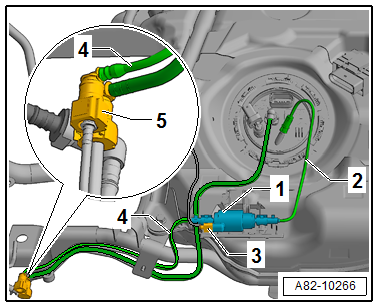
On vehicles with high-voltage system, the metering pump -V54--1- cannot be accessed if the fuel tank is installed. Therefore, bleed fuel line -2- (and corresponding riser tube) leading to metering pump -V54- after completing work on the fuel system of the auxiliary heater (e.g. upon repair work on the fuel delivery unit or the -V54--1-).
Note
Observe safety precautions when working on the fuel supply system → Rep. gr.20.
Note If after 30 seconds fuel escapes continuously from connection -5-, the fuel line is filled completely with fuel.
Note On vehicles with high-voltage system, it may not be possible to switch on the auxiliary heater via the control panel, depending on the charge level of the hybrid battery unit -AX1- and the ambient temperature. If the -J255- gets the information that the hybrid battery unit -AX1- is sufficiently charged, that there is sufficient power available to operate the high-voltage heater (PTC) -Z115- and that the ambient temperature is above -10°C, the -J255- activates the -Z115- (the auxiliary heater is not activated). In this case, the auxiliary heater can be switched on using e.g. the “Basic setting” function. For additional information refer to vehicle diagnostic tester in “Guided fault finding” mode. |
 |
Test yourself
A quick Volkswagen Golf quiz: every answer comes with an explanation and a link to the manual page.
Was this page helpful?