Overview - Radial Ply Tire
Cross-Section of a Radial Ply Tire
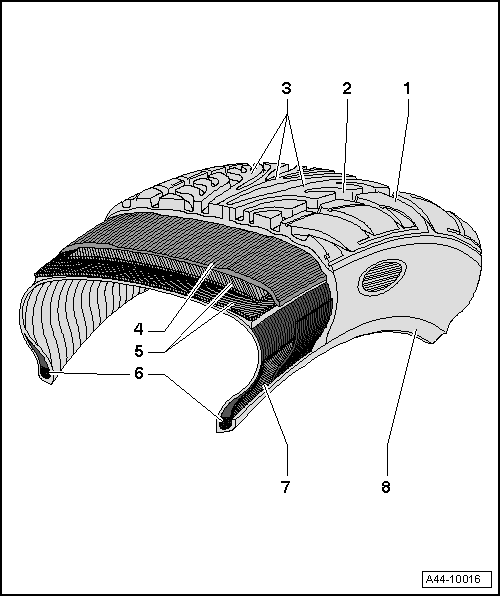
- Tread Block
- Tread Groove
- Tread
- Nylon Ply
- Belt Layers
- Consists mostly of steel
- Bead Bundle
- Consists of steel wires vulcanized into rubber
- Make sure secure seating of the tire on the rim
- Bead Filler
- Wheel Flange Protection
- Protects the rim and tire from abrasion due to, for example, contact with the curb.
- Tires with flange protection are designated by the abbreviation MFS.
The nylon ply -4-, belts -5-, bead cores -6- and bead reinforcements -7- make up the carcass. The carcass is the "load-bearing structure" of the tire.
Run-Flat Tire, Structure and Identification, SST Tire
Run-Flat Tires, Dismounting and Mounting. A Tire Pressure Monitoring Display is Necessary When Using Run-Flat Tires.
Tire Damage and the Pressure Loss Resulting From it is Not Always Recognizable.
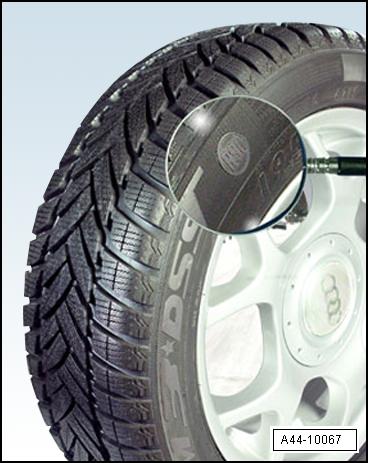
SST tires are identified with a special code (RSC = Run-flat System Component) on the side wall.
The Identification on the Side Wall of Run-Flat Tires can Differ Depending on the Manufacturer.
Self-Supporting Tire stands for a tire system with emergency running characteristics in the event of a loss of pressure. In the event of a flat tire, the driver can continue driving to a limited extent to the next workshop Owner's Manual.
Advantage
SST tires make it possible to drive up to 50 km at a maximum of 80 km/h even with a complete loss of pressure.
Driving style, speed, road surface, weather conditions, tire condition and tire load influence the distance.
With SST tires, it is not necessary to immediately change a tire when it suffers from a complete loss of pressure (e.g. no tire changing in an area with low visibility or in dangerous conditions).
Braking, steering and driving performance remain for the most part after the tire looses pressure.
A spare wheel is no longer necessary when using SST tires. From the view of the customer, this means: saving space and weight.
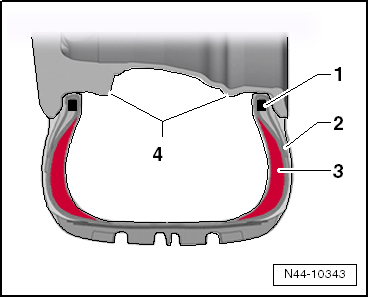
Assembly
- Bead with bead bundle
- Sidewall
- Sidewall reinforcement
- Rim with extended hump (EH2) on both sides - required when using run-flat tires
Technology In Detail
Standard Tires Without Emergency Running Characteristics
- -I- standard tires with air.
- -II- standard tires without air.
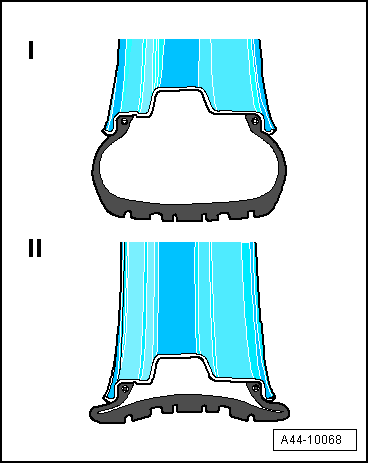
- If the standard tire loses air, the rim presses the side wall together. The rubber in a flat tire is heated strongly and quickly loses its properties.
SST Tires with Reinforced Side Wall
The self-supporting, reinforced side walls form the basis of SST technology.
- -I- SST tires with air.
- -II- SST tires without air.
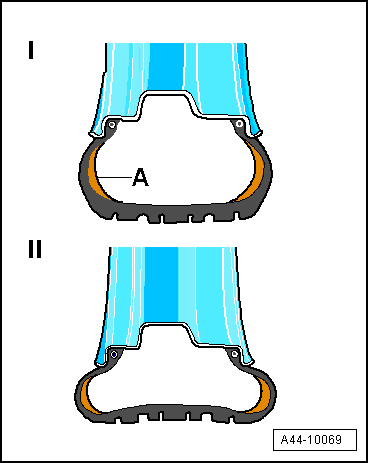
- Especially thick side walls -A- support the empty tires on a standard rim and the vehicle remains maneuverable. A special rubber mixture reinforces the tires and supports the vehicle in an emergency.
The reinforced side walls, unlike a standard tire, prevent the tire flanks from pinching between the road and rim when flat.
Difference in Version H2 and EJ2 Extended Hump Rim
- The increased hump on the EH2 Extended Hump Rim prevents the SST tire from springing off when pressure is lost.
- EH2 builds up toward the center of the wheel.
WARNING
The clearance to the brake is reduced.
Run-Flat Tire, Seal Inside-Technology
- The vehicle can be equipped with run-flat tires as an option.
- The Seal Inside technology is a system that allows the vehicle to continue driving even if the tire has been punctured by a nail or screw: a protective coating on the inside of the tire automatically seals any holes caused by a screw or a nail.
- This way no air can escape. The sealant can work on almost all types of leaks, that result from objects with a diameter of up to 5 millimeters.
Note
It is not recommended to use a mix of different tire types i.e. run-flat and "normal" tires.
Mobility Tires
- The seal inside technology has already been incorporated by the tire manufacturer into the tire manufacturing process.
- The seal inside technology is a self-adhering, viscous sealant, which is evenly applied to the inner side of the running surface from shoulder to shoulder.
- The sealant is an integral component of mobility tires.
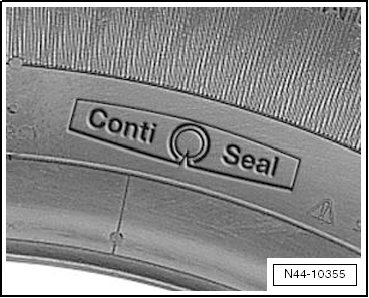
- There is a special logo on the side wall of the tire which identifies it as a mobility tire.
- Example: the sidewall of a Continental tire
Caution
The sealant is not intended to be a permanent tire repair after a puncture has happened.
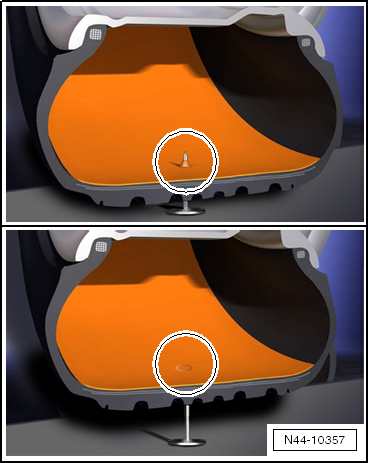
- If a foreign object with a diameter up to 5 mm punctures the running surface of a mobility tire, the sealant immediately closes the puncture and seals it to prevent air leakage.
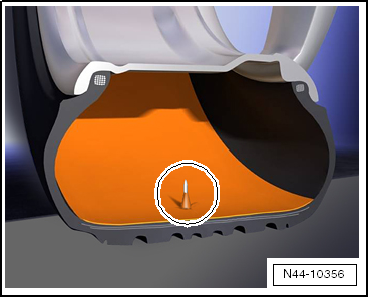
- The sealant is designed to seal most punctures caused by a foreign object, which has a diameter up to 5 mm.
- The Seal Inside technology reduces the frequency of flat tires, but it is not intended to make is possible to drive on a tire which has minimum tire pressure or is completely flat.
- Mobility tires have all the same characteristics as tires without the Seal Inside technology.
Mobility Tires, Handling
- When working with mobility tires it is especially important to pay attention to cleanliness and to how the tires are stored.
- The sealant in the inner side of the tire running surface is not protected and therefore is subject to any type of dirt.
- It is recommended to store the tires in large bags or something similar.
- As with other tires, the mobility tires should be checked regularly for signs of cuts, punctures and air pressure loss.
- The tires should be inspected at least one or twice a month and/or always after a long trip.
- If punctures or damage are not taken care of in a timely manner, the result may be a loss of pressure and/or the tire could fail.
- Mobility tires with cuts or punctures must be immediately inspected.
- It must be decided if the tire should be removed and scrapped.
- Mounting and dismounting a mobility tire is identical to that of a standard tire.
Run-Flat Tire, Overview of a PAX Tire
PAX tires involve specially developed system that exhibits the following differences in comparison to conventional tires:
Pax Tires with Supporting Ring
- -I- PAX tires with air
- -II- PAX tires without air
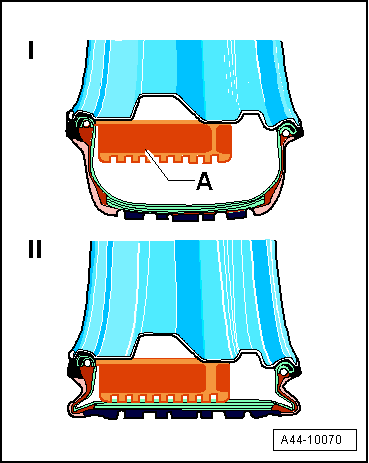
- The tire is anchored to a special rim that prevents it from sliding off when pressure is lost. The rubber supporting ring ensures stability in emergency operation.
- The inner and outer bead diameter are different sizes. This makes it possible to place the tire in a supporting ring.
- The tire is anchored to the rim differently.
- In this way, the tire height could be reduced considerably. That was possible because the area near the bead could be considerably smaller due to the special connection between the tire and rim.
- The tire bead is formed so that it can engage in the rim seat. Therefore, it remains firmly in the seat when pressure is lost.
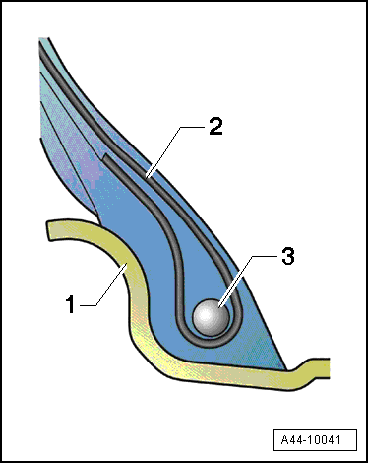
Standard Tire, Beat Area Construction
- Rim flange
- Fabric carcass
- Bead bundle
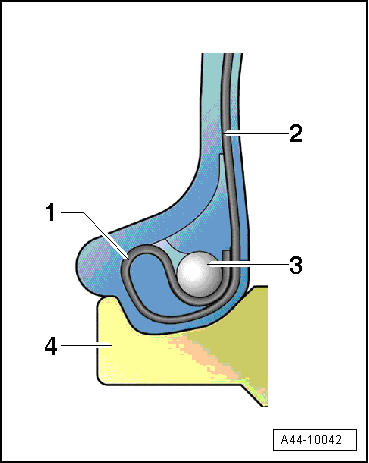
PAX Tire, Bead Area Construction
- Loop
- Fabric carcass
- Bead bundle
- Rim flange
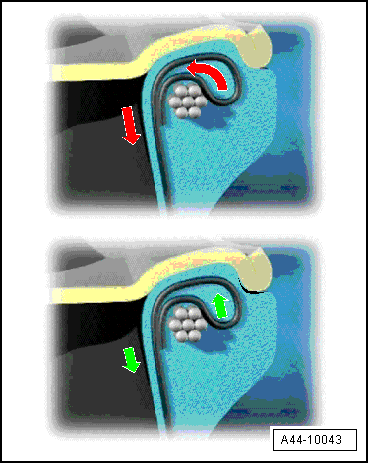
PAX Tires, Anchoring
The secure seating of the tire in the rim is ensured in all driving situations due to the type of construction.
A wedge-shaped component of the tire is pressed between the bead bundle and rim when loaded. This happens independently of the pressure in the tire.
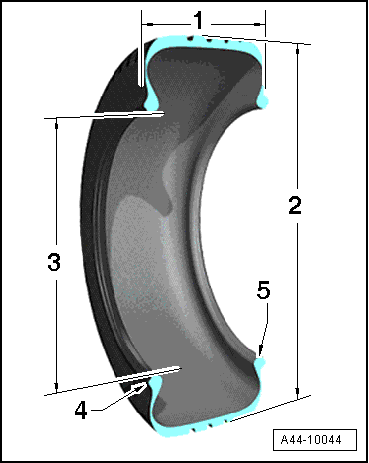
PAX Tires, Dimensions
In contract to conventional tires, tires with emergency running characteristics (PAX) exhibit differences in regard to dimensions and designations.
Therefore, PAX tires can only be mounted on special rims (PAX).
- Width in mm: the tire width from flank to flank on standard rim (corresponds to width specification on standard tire).
- Outer circumference in mm: maximum diameter of a new tire-
- Designated diameter in millimeters on standard rim seat
- Smaller bead diameter in millimeters: rim seat on outer side
- Larger bead diameter in millimeters: rim seat on inner side
Test yourself
A quick Volkswagen Tiguan quiz: every answer comes with an explanation and a link to the manual page.