Hydraulic system
Leak test
Required special tools, testers and equipment, and auxiliary items
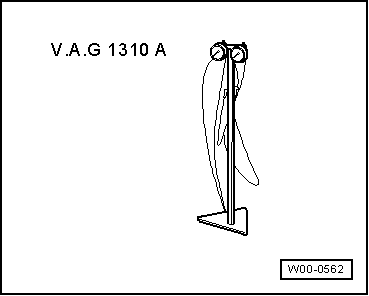
- Brake system tester -V.A.G 1310 A-
- Adapter M 10 -V.A.G 1310/6-
Test requirements:
Function and tightness of brake system (ABS hydraulic unit -N55-, brake hoses, brake lines and brake calipers) OK
Carry out the following work:
- Unscrew the bleed screw on one of the front brake calipers. Connect brake system tester -V.A.G 1310A- and bleed.
- Press the brake pedal until the pressure gauge shows 50 bar overpressure. During the test period of 45 s, the pressure drop must not exceed 4 bar. If the pressure drop is greater, replace brake master cylinder.
Check wheel brake cylinder for leaks
Required special tools, testers and equipment, and auxiliary items
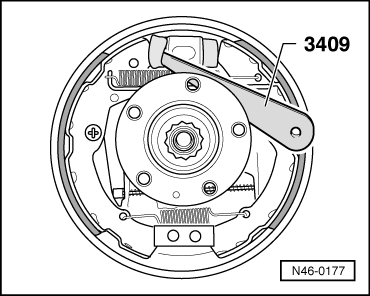
- Release Wedge -3409-
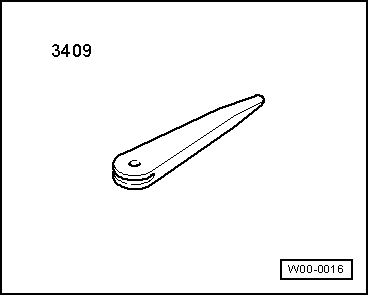
- Lift off dust boot with removal wedge 3409.
- If there is brake fluid in the dust boot, replace wheel brake cylinder.
When lifting off the dust boot, take care not to damage the dust boot.
Subsequent bleeding of hydraulic system
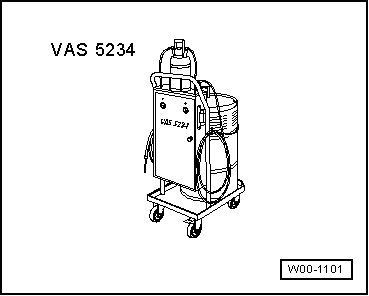
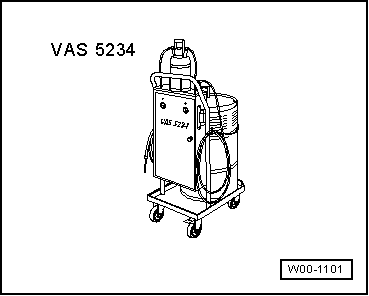
Bleeding the brake system is described with brake filling and bleeding unit -VAS 5234-.
A pre-pressure of 2 bar is required to bleed the hydraulic unit.
Required special tools, testers and equipment, and auxiliary items
- Brake filling and bleeding unit -VAS 5234-
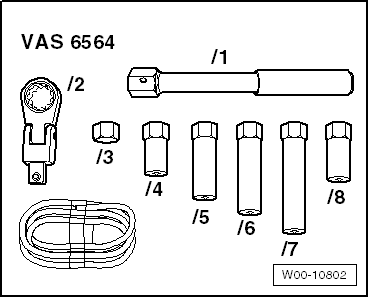
- Brake bleeding tool set -VAS 6564-
Carry out subsequent bleeding when:
- the brake pedal travel is too long or there is a so-called "soft brake pedal"
Subsequent bleeding requires a second technician.
- Apply and hold the brake pedal with high foot force.
- Open the bleed screw on the wheel brake cylinder/brake caliper.
- Depress the brake pedal fully to the stop.
- Close the bleed screw while the pedal is depressed.
- Release the brake pedal slowly.
This bleeding procedure must be carried out 5 times per brake caliper.
Bleeding sequence:
- Wheel brake cylinder, rear right
- Wheel brake cylinder, rear left
- Brake caliper, front right
- Brake caliper, front left
After bleeding, a road test must be carried out. At least one ABS control cycle must occur!
Normal bleeding of hydraulic system
Bleeding the brake system is described with brake filling and bleeding unit -VAS 5234-.
A pre-pressure of 2 bar is required to bleed the hydraulic unit.
Required special tools, testers and equipment, and auxiliary items
- Brake filling and bleeding unit -VAS 5234-
- Brake bleeding tool set -VAS 6564-
Follow the bleeding procedure for the brake system exactly.
- Connect brake filling and bleeding unit -VAS 5234- or -V.A.G 1869-.
- Open the bleed screws in the prescribed sequence and bleed the wheel brake cylinders/brake calipers.
- Wheel brake cylinder, rear right
- Wheel brake cylinder, rear left
- Brake caliper, front right
- Brake caliper, front left
Use a suitable bleed hose. It must fit tightly on the bleed screw so that no air can enter the brake system.
- With the hose of the bleed bottle attached, keep the bleed screw of a brake caliper open until bubble-free brake fluid flows out.

General notes on brake fluid

WARNING!
Use only new brake fluid meeting VW standard (VW 501 14).

Note
- Brake fluid is toxic. In addition, due to its corrosive effect, it must not come into contact with paint.
- Brake fluid is hygroscopic, meaning it absorbs moisture from the surrounding air. It must therefore always be stored in airtight sealed containers.
- Rinse any spilled brake fluid off with plenty of water.
Changing brake fluid
Maintenance, strictly speaking.