Vacuum system
Check vacuum system
If there are complaints about the brake booster or a so-called "hard brake pedal", the following test procedure provides help and guidance for effective and objective fault finding.
This test covers the following components:
- Brake booster
- Sealing ring between brake master cylinder and brake booster
- Check valve
- Vacuum hoses with plug connections
- Vacuum pump (if fitted)
Measurement results are affected by geographic location. The higher the location above sea level, the lower the air pressure.
Observe test requirements:
- Visually inspect all vacuum hoses for damage (e.g. cracks or marten bites) and for correct fit
- Keep everything clean when working on the vacuum system.
- If necessary, clean the engine compartment before starting work.
Required Special Tools, Test and Measuring Equipment and Auxiliary Items
- Vacuum gauge for brake booster -VAS 6721-
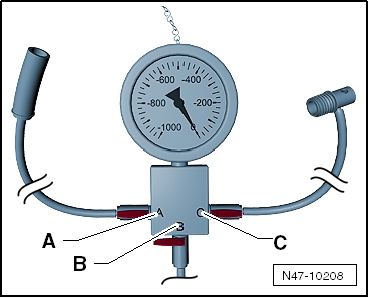
Leak test

Note
- The average air pressure of the atmosphere at sea level (N.N.) is 1013 mbar and decreases sharply with increasing altitude (approx. 100 mbar per 1000 m of altitude). Local and temporal fluctuations also affect vacuum generation.
- A cold engine, air conditioning switched on, and engine idling only all have a negative effect on vacuum generation.
- First check all vacuum hoses for damage (e.g. cracks or marten bites) and for correct fit.
- Connect vacuum gauge for brake booster -VAS 6721-.
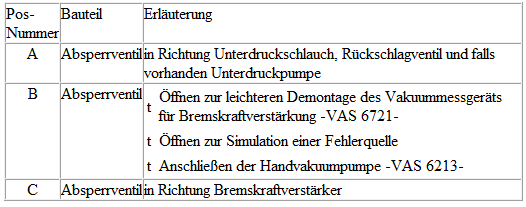
- Open shut-off valve -A-.
- Close shut-off valves -B+C-.
- Start the engine at operating temperature (> 60 °C) and briefly accelerate once (engine speed above 2000 rpm).
Under normal conditions (see notes), the generated vacuum should be between 600 and 950 mbar (depending on engine).

- Open shut-off valve -C- to evacuate the brake booster.
- Switch off the engine.
- Read and note the displayed measured value.
The vacuum must not drop by more than 400 mbar in 12 hours.
If the vacuum drop is greater, check whether the leak is in the area of the...
- Brake booster
or of the
- check valve, vacuum hoses with plug connections and vacuum pump/intake manifold
is located.
With larger leaks, the vacuum drops sharply within a few seconds.
Vacuum test in area of brake booster:
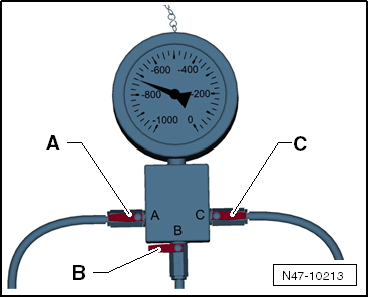
- After generating vacuum, close shut-off valve -A- to test the vacuum system from the brake booster.
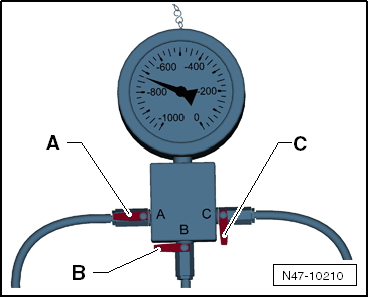
Vacuum test in area of check valve, vacuum hoses with plug connections and vacuum pump/intake manifold:

- After generating vacuum, close shut-off valve -C- to test the vacuum system from the vacuum gauge for brake booster -VAS 6721- up to the intake manifold or vacuum pump.
To make it easier to remove the hose connections and adapters, open shut-off valve -B-.
Testing vacuum generation

Note
- The average air pressure of the atmosphere at sea level (N.N.) is 1013 mbar and decreases sharply with increasing altitude (approx. 100 mbar per 1000 m of altitude). Local and temporal fluctuations also affect vacuum generation.
- A cold engine, air conditioning switched on, and engine idling only all have a negative effect on vacuum generation.
- First check all vacuum hoses for damage (e.g. cracks or marten bites) and for correct fit.
- Connect vacuum gauge for brake booster -VAS 6721-.
- Open shut-off valve -A-.
- Close shut-off valves -B+C-.
- Start the engine at operating temperature (> 60 °C) and briefly accelerate once (engine speed above 2000 rpm).
- Read the displayed measured value.
Under normal conditions (see notes), the generated vacuum should be between 600 and 950 mbar (depending on engine).
If the specified value is not reached although the conditions (see notes) are met, first check the vacuum system for leaks.
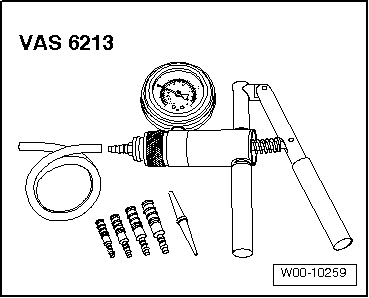
- For comparison, generate the vacuum with the hand vacuum pump -VAS 6213-.
To make it easier to remove the hose connections and adapters, open shut-off valve -B-.

Generating vacuum with hand vacuum pump -VAS 6213-
In certain cases, the vacuum can also be generated with the hand vacuum pump -VAS 6213- instead of the engine or the vacuum pump.
- To do so, connect the hand vacuum pump -VAS 6213- to the vacuum hose from connection -B- on the vacuum gauge for brake booster -VAS 6721-.
- Open the shut-off valve -B-.
- Generate vacuum with the hand vacuum pump -VAS 6213- until the vacuum gauge for brake booster -VAS 6721- indicates between 600 and 950 mbar.
- Then carry out the relevant tests.
Connecting vacuum gauge for brake booster -VAS 6721-
- Pull the vacuum hose off the brake booster.
To make it easier to remove the vacuum hose, first press the brake pedal several times.
- Insert the vacuum gauge for brake booster -VAS 6721- between the components -see illustrations below-.
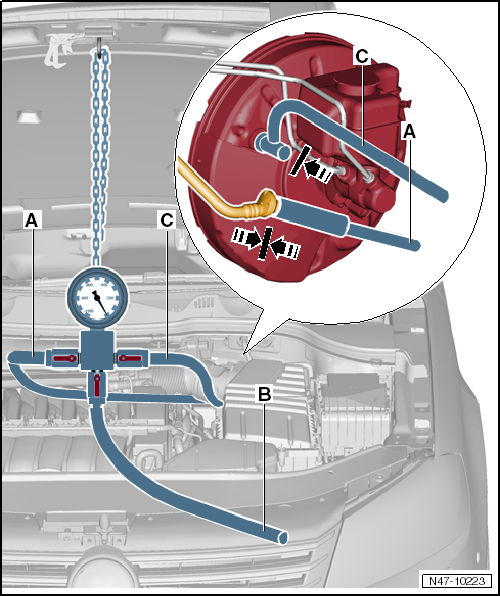
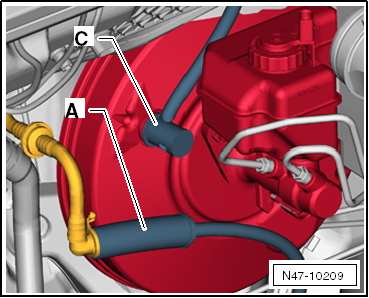
- Push hose -A- of the vacuum gauge for brake booster -VAS 6721- onto the vacuum hose and press adapter -C- into the brake booster.
Checking check valve
- In the direction of the arrow, check valve -A- must allow air to pass.
- In the opposite direction, the check valve must remain closed.
Observe correct installation position!
