Loading guidelines
There are a number of things that are important to consider when carrying loads in or on the vehicle.
The load carrying capacity is determined by the curb weight of the vehicle. The total weight of all passengers and any installed accessories reduces the vehicle's load carrying capacity by the corresponding amount.
Loading the cargo compartment/trunk
Observe the following when loading:
- Position objects so that they are pressed against the back of the rear seat.
- Heavy objects should be positioned as low as possible. Avoid placing heavy objects on folded-down seat backrests.
- Cover sharp corners with a soft cloth or similar to help prevent damage to the upholstery.
- Use the load anchoring eyelets and tensioning straps or similar to secure all objects.
Additional cargo space
The rear seat backrests can be folded down to increase cargo space in the cargo compartment/ trunk and simplify loading. If the rear seat backrests are folded down, make sure that no objects loaded into the vehicle prevent the WHIPS system for the front seats from functioning correctly.
Raising/lowering the rear of the vehicle*
The rear end of the vehicle can be lowered or raised for easier loading into the cargo compartment/ trunk or to facilitate attaching a trailer*.
The controls for raising/lowering are located at the rear edge of the right side panel in the cargo compartment/trunk.
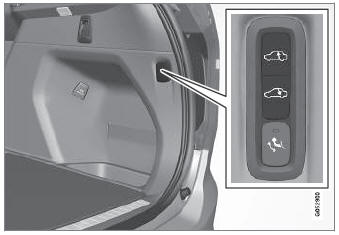
Controls for raising/lowering the rear of the vehicle.
The controls consist of two buttons ‒ one button for lowering and one button for raising the rear end. Press and hold the relevant button until the desired height is reached.
The rear of the vehicle cannot be raised above its normal height.
The rear of the vehicle will return to normal height when the vehicle is driven.
* Option/accessory.
Test yourself
A quick Volvo XC90 quiz: every answer comes with an explanation and a link to the manual page.