Front Wheel Alignment Angles
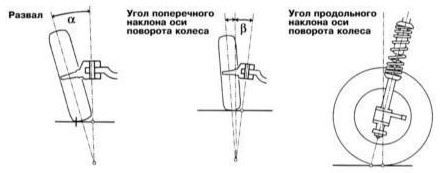 Wheel Alignment Angles
Wheel alignment angles have a significant effect on vehicle stability, tire wear and fuel consumption. The following wheel alignment angles are distinguished:
Camber is the inclination of the wheel in the vertical plane relative to the vehicle centerline. It can be positive if the wheels are tilted outward or negative if the wheels are tilted inward. Camber mainly affects the evenness of tire wear on the front wheels. If the camber of one wheel is positive and the other is negative, the vehicle will pull to one side when driving straight.
Toe is the lateral distance between the wheels. Toe-in means the front of the wheels is closer together than the rear, measured at the height of the wheel center. Toe-out means the front of the wheels is farther apart than the rear.
Steering axis inclination is the angle between the steering knuckle pivot axis and the vertical line through the wheel mounting point, viewed in the longitudinal direction of the vehicle.
Due to camber and steering axis inclination, the wheel contact points with the road are located closer to the steering knuckle axis. This maintains the so-called "scrub radius", which makes the vehicle easier to steer. Also, shocks from road surface irregularities are transmitted less to the steering system.
Caster is the angle of the steering axis in the longitudinal direction. The axis around which the wheel turns is positioned so that its lower end points forward. Such a caster angle is called positive. With a positive caster angle, the wheel's self-centering after turning improves.
Conditions for Checking Wheel Alignment Angles
Checking the wheel alignment angles requires an inspection pit or a special alignment lift. The following conditions must be met when carrying out the measurement:
– Tire air pressure is as specified. – Front wheels are in the straight-ahead position. – Vehicle is unloaded, fuel tank is full. – Vehicle suspension is fully settled (bounced). – Steering is adjusted. – Play in the steering linkage joints is within limits. – Play in the suspension joints is within limits. – Tread depth of tires on the same axle is the same.
Wheel alignment angle values are given in the Specifications.
Test yourself
A quick Audi A3 quiz: every answer comes with an explanation and a link to the manual page.