Why seat belts?
Seat belts protect
The widespread belief that you can brace yourself with your hands in a minor accident is completely wrong.
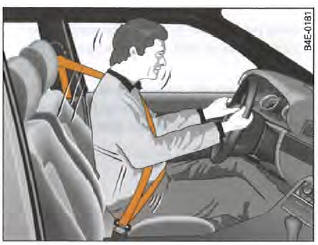
Fig. 168 Driver wearing seat belt (principle)
Seat belts have been proven to provide good protection in the event of an accident. For this reason, wearing seat belts is required by law in most countries.
When correctly positioned, seat belts keep vehicle occupants in the correct seated position =>fig. 168. Seat belts considerably reduce kinetic energy. They also prevent uncontrolled movements that could cause serious injuries => “Important safety guidelines for using seat belts”.
Occupants whose seat belt is correctly positioned benefit to the greatest extent from the belt's ability to absorb kinetic energy. The front structure of the vehicle as well as
other passive safety features of your vehicle, such as the airbag system, also reduce kinetic energy. The energy generated is then lower and the risk of injury is reduced.
Our examples describe frontal collisions. These physical principles naturally also apply to other types of accidents and to vehicles equipped with airbags. Therefore, fasten your seat belt before every trip, even if you are only "going around the corner". Also make sure that the people you are transporting have correctly fastened their seat belts. Accident statistics show that correct use of seat belts reduces the risk of injury and increases the chances of survival in a serious accident “Schematic representation of an accident”.
When transporting children, specific safety instructions must be observed “What you should know when transporting children”.
CAUTION!
- Always fasten your seat belt before every departure, even when driving in town. This also applies to rear passengers - risk of injury!
- Pregnant women must also always fasten their seat belt. It is the only way for them to provide the best protection for their unborn child “Three-point belt fastening and belt positioning recommended for pregnant women”.
Important safety guidelines for using seat belts
Correct use of seat belts considerably reduces the risk of injury!
CAUTION!
- Only a correct seated position allows seat belts to provide optimal protection. See page 93, "Seats and storage".
- Correct positioning of the belt webbing is essential for the belt to provide optimal protection => page 184, “How to correctly fasten your seat belt”. Make sure that the seat belts are positioned as described in this chapter. Incorrect positioning of the seat belt considerably increases the risk of injury in an accident.
- The belt webbing must not be trapped or twisted, nor rub against sharp edges.
- Never fasten two people (or even children) with a single belt. It is especially dangerous to secure your child when they are sitting on your lap.
- The belt webbing must not pass over rigid or breakable objects (glasses, pens, etc.) that could cause injuries.
- Very loose, unfitted clothing (e.g. a coat worn over a jacket) prevents correct positioning and operation of the seat belt.
- The belt webbing must always be clean, as heavy soiling can impair the operation of the automatic retractor “Seat belts”.
- The opening of the buckle receiver intended to accept the latch plate must not be blocked by paper, etc., otherwise the latch plate may not engage correctly.
- The latch plate must only be inserted into the buckle of the seat or position for which it is intended, otherwise the protective effect is compromised.
- Check the condition of the seat belts regularly. If the belt webbing, belt anchorages, automatic retractors or buckles are damaged, the affected seat belt must be replaced by a specialist workshop.
Test yourself
A quick Audi A4 quiz: every answer comes with an explanation and a link to the manual page.