Schematic representation of an accident
Physical principle of a frontal collision
In an accident, enormous forces are generated, which must be absorbed.
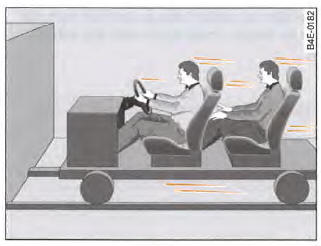
Fig. 169 Vehicle approaching a wall with passengers not wearing the seat belt
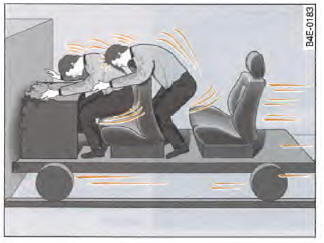
Fig. 170 The vehicle strikes the wall
The physical principle of a frontal collision is simple to explain:
As soon as the vehicle is moving, energy is generated by the movement of the vehicle and its occupants; this is "kinetic energy" => fig. 169. The amount of kinetic energy released depends mainly on the speed of the vehicle and on the weight of the vehicle and its occupants. The higher the weight and speed of the vehicle, the greater the energy that must be absorbed in an accident.
However, vehicle speed is the decisive factor.
If the speed doubles from 25 km/h to 50 km/h, the kinetic energy released is multiplied by four. Because the passengers in our example are not wearing their seat belts, in a collision the wall alone will absorb all of the passengers' kinetic energy => fig. 170. This would result in serious or even fatal injuries.
*Even if you are only travelling at a speed of 30 km/h to 50 km/h, the forces exerted on your body in an accident can easily exceed 10,000 newtons, equivalent to a weight of one tonne (1,000 kg).
These forces increase further with vehicle speed.
In other words: when speed doubles, the forces released are multiplied by four! Occupants who have not fastened their seat belt are therefore not "secured" to the vehicle. In a frontal collision, these persons continue to move at the speed the vehicle was travelling before the collision.
What happens to passengers who are not wearing their seat belt?
Passengers who have not fastened their seat belt risk being fatally injured!

Fig. 171 The unbelted driver is thrown forward
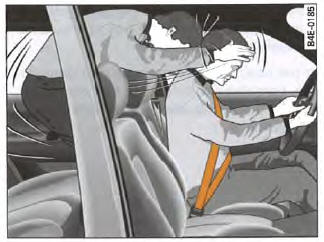
Fig. 172 The unbelted rear passenger is thrown forward
In a frontal collision, passengers who are not wearing their seat belt are thrown forward and strike parts of the interior such as the steering wheel, the dashboard and the windscreen
=> fig. 171. Unbelted passengers may even be thrown out of the vehicle. They may suffer fatal injuries.
The widespread belief that you can brace yourself with your hands in a minor accident is wrong. Even in collisions at very low speed, the forces acting on the body cannot be contained.
It is important that rear seat passengers fasten their seat belt, because they too are thrown around the interior in an accident. A rear passenger who is not wearing a seat belt endangers not only their own life but also the lives of the other occupants => fig. 172.
Test yourself
A quick Audi A4 quiz: every answer comes with an explanation and a link to the manual page.