Cooling System Inspection
Leaks in the cooling system and the operation of the pressure relief valve in the expansion tank cap can be checked with conventional tools.
PROCEDURE
1. Warm up the engine to operating temperature. To do this, drive the vehicle until the coolant temperature gauge shows normal operating temperature.
2. Check the coolant level and add coolant if necessary.
3. Open the expansion tank cap.
* When the engine is hot, before opening the radiator cap, place a thick cloth over it to prevent scalding from ejected hot coolant and steam. There is a risk of injury. Open the cap only when the coolant temperature is below +90°C.
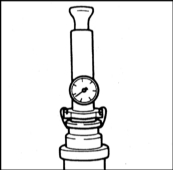
4. Using an adapter, connect the leak tester to the expansion tank coolant filler neck. Use the hand pump of the tester to build up a pressure of approximately 1.0 bar. If the pressure drops by more than 0.1 bar within two minutes, locate and repair the leak. A sign of a defective area is coolant leaking from it. Refer to the accompanying illustration.
5. If the pressure drops without visible coolant leakage, or even rises, the cause may be, for example, a damaged cylinder head gasket or a crack in the housing.
6. To check the pressure relief valve in the radiator cap, install the cap on the tester. Build up pressure with the hand pump. The pressure relief valve should open at 2.0 bar. If not, replace the cap.
7. Create a vacuum in the radiator. At a vacuum of 0.1 bar, the vacuum valve in the radiator cap should open.
Test yourself
A quick BMW 1 quiz: every answer comes with an explanation and a link to the manual page.