Heater
General Information

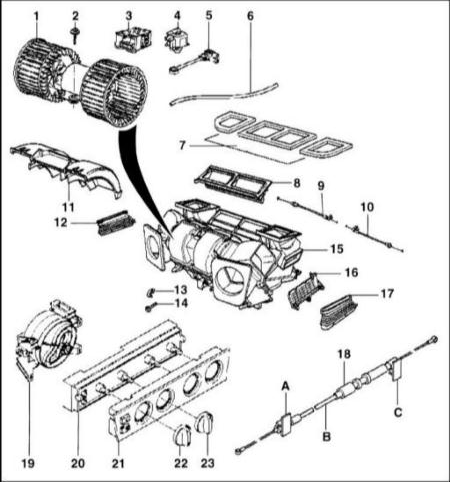
1 — blower motor
2 — bolt
3 — blower motor final stage
4 — cabin air temperature sensor
5 — heater element temperature sensor
6 — vacuum hose, black
7 — fresh air intake seal
8 — ventilation duct
9 — damper control cable
10 — cable
11 — blower cover
12 — heater duct deflector
13 — clamp
14 — bolt
15 — heater blower
16 — heating element cover
17 — heater duct deflector
18 — actuator cable:
footwell: A - green, C - green
defrost: A - red, C - red
ventilation: A - blue, C - blue
19 — damper position actuator
20 — printed circuit board
21 — visor
22 — airflow distribution knob
23 — temperature setting knob
Outside air for heating is drawn in through the air filter housing intake grille located under the windshield and is delivered by the blower into the vehicle cabin. The air passes through the heater housing and then through individual outlets into the cabin.
Airflow is controlled by dampers operated by cables. When the heater is set to “warm”, the airflow is directed through the heater core. The heater core is located in the heater housing and is heated by hot engine coolant.
The air flowing through is heated by contact with the core fins and enters the cabin. Heating output is regulated by coolant flow; the system has two solenoid valves in the cooling system circuit.
Air temperature is adjusted by a rotary knob, separately for the driver and passenger sides. An electronic module in the control unit regulates the opening time of the heater valves depending on the cabin temperature. The temperature sensor is located behind the heater housing. Thanks to electronic control, the air temperature is kept nearly constant regardless of vehicle speed and outside temperature.
A blower with stepless control is used to increase heat flow.
Test yourself
A quick BMW 1 quiz: every answer comes with an explanation and a link to the manual page.