Cooling System
The engine is equipped with a circulating cooling system with thermostatic control. Until the engine has warmed up, the coolant circulates only in the cylinder head and cylinder block, and, when the heater is on, in the heater core. As the coolant temperature rises, the thermostat opens the main cooling circuit and the coolant flows to the radiator, passing through it from top to bottom, and is cooled by the air flowing through it. The coolant pump is driven by the engine V-belt.
A fan is mounted on the coolant pump shaft. The fan provides air cooling of the radiator. The fan includes a viscous coupling. When the air flowing from the radiator reaches 90°C, the bimetallic strip in the viscous coupling engages and connects the fan. After that, the fan rotates at engine speed and provides increased heat transfer until the cooling air temperature drops below +60°C. Then the viscous coupling disengages and reduces the fan speed.
Partial fan engagement increases the useful engine power and reduces fuel consumption.
* When the engine is hot, before opening the radiator cap, place a thick cloth over it to prevent scalding from ejected hot coolant and steam. There is a risk of injury. Open the cap only when the coolant temperature is below +90°C.
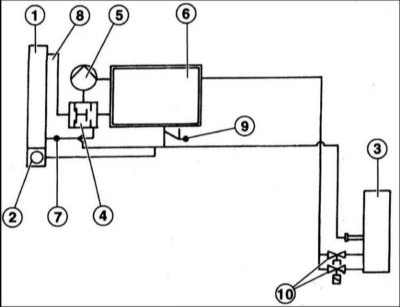
Cooling system circuit diagram
1 — radiator
2 — expansion tank
3 — cabin heater
4 — thermostat
5 — coolant pump
6 — cylinder block
7 — return
8 — supply
9 — throttle valve heating
10 — heater valve
Chemical heat accumulator

Some models may be equipped with a chemical heat accumulator. It stores heat from the coolant and releases it later when a cold engine is started. As a result, cabin heating works faster and heat loss to the atmosphere is reduced. The time required to warm up the cabin and the engine is significantly reduced.
The heat accumulator consists of a well-insulated storage unit connected in parallel to the engine cooling system and located near the front passenger footwell. Depending on need, it takes heat from or releases heat to the coolant. The coolant flow during operation is automatically controlled by various solenoid valves.
Its operation is based on the use of heat released when an environmentally friendly salt mixture changes from liquid to solid state. Similar to the heat of fusion of ice, heat from the warmed-up engine is stored as the salt mixture liquefies.
Thus, the heat accumulator improves driving safety and vehicle comfort without creating additional environmental load.
The accumulator requires no maintenance, as its control is handled by the electronics.
This function can only operate when the outside air temperature is not higher than +15°C, the engine has reached operating temperature, and the battery voltage is sufficient.
Test yourself
A quick BMW 1 quiz: every answer comes with an explanation and a link to the manual page.