Fuel System
General Information
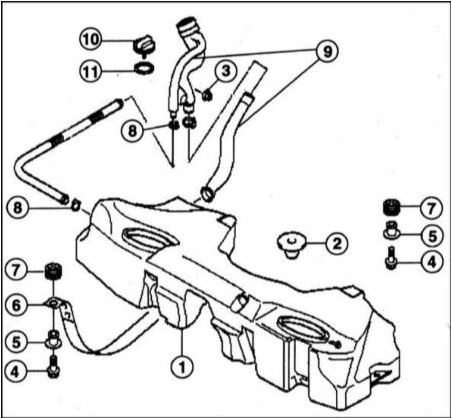
Fuel Tank
1 — fuel tank
2 — shock absorber
3 — nut
4 — bolt
5 — bushing
6 — clamp, right (left is similar)
7 — damper
8 — clamp
9 — filler pipe
10 — cap
11 — gasket
The fuel system consists of the fuel tank, the fuel pump located in the tank, the fuel lines, and the fuel filter and air filter. Gasoline and diesel injection systems are described in separate sections.
The fuel tank is made of plastic, with a capacity of 70 L. It is secured with clamps under the rear seat, in front of the rear suspension. The tank is divided into two compartments.
The tank is vented to the atmosphere through a charcoal canister (adsorber). The canister is located behind the inner rear wheel arch. Fuel reserve is indicated on the instrument panel by a warning lamp. The fuel level is measured separately for each compartment by a lever-type sender. The microprocessor in the instrument panel unit calculates the current fuel volume in the tank based on injection pulses, vehicle speed and sender signals.
Fuel Economy While Driving
Driving style has a significant effect on fuel consumption. Below are some tips on sensible use of the accelerator pedal.
a) After starting the engine, drive off immediately, even in cold weather.
b) If the vehicle will be stopped for more than 40 s, switch off the engine.
c) Always drive in the highest possible gear.
d) On long journeys, maintain a steady speed whenever possible. Avoid high speeds. Drive carefully. Do not brake unnecessarily.
e) Do not carry unnecessary loads. If the roof rack is not in use, remove it.
f) Check tire pressure regularly. Do not allow excessive pressure loss.
g) When using the vehicle, consider local conditions and peak traffic hours in your area.
Cleanliness Rules When Working on the Fuel System
When working on the fuel system, observe the following cleanliness rules:
a) Thoroughly clean connections and surrounding areas before opening.
b) Place removed parts on a clean surface and cover them. Use polyethylene or paper for this. Do not use fibrous cloth!
c) Carefully cover open parts or install blanking plugs if the repair will take some time.
d) Install only clean parts.
e) Remove spare parts from their packaging only immediately before installation.
f) Do not use parts that have no packaging (for example, parts stored in the tool box).
g) With the fuel system open, avoid using compressed air where possible. Avoid moving the vehicle if possible.
h) Do not allow diesel fuel to contact cooling system hoses, as this may damage them. Wipe up fuel immediately with a damp cloth.
Test yourself
A quick BMW 1 quiz: every answer comes with an explanation and a link to the manual page.