Tire Pressure Monitor (RPA)
Operating Principle
The tire damage indicator monitors tire air pressure while the vehicle is in motion. The system gives a signal when the pressure in one of the tires drops significantly compared with the other wheels.
When tire pressure drops, the rolling radius of the wheel changes and, consequently, its rotational speed. The system registers this change and reports tire damage.
Operating Conditions
For the system to operate reliably, it must be initialized when the air pressure in all tires is normal.
 Initialization must be performed each time the tire pressure is adjusted, after a tire or wheel is replaced, and after a trailer has been attached or detached.◄
Physical limits of system operation
The tire damage indicator cannot warn of sudden severe tire damage caused by external influences. It also does not react to a natural, even pressure loss in all four tires.◄
In the following situations, the system may respond late or incorrectly:
► if the system has not been initialized;
► when driving on snowy or slippery roads;
► when driving sporty: with drive wheel spinning, high lateral acceleration;
► when driving with snow chains.
System Initialization
 Initialization is performed while driving. Stops are permitted during this process. Initialization continues automatically during the next driving cycle.
Do not initialize the system with snow chains fitted.◄
1. Start the engine, but do not move off.

2. Press button 1 on the turn signal lever up or down until the corresponding symbol and the message "INIT" appear on the display.
3. Press button 2 to confirm the selection of the tire damage indicator.
4. Press and hold button 2 (approx. 5 seconds) until the following indication appears:
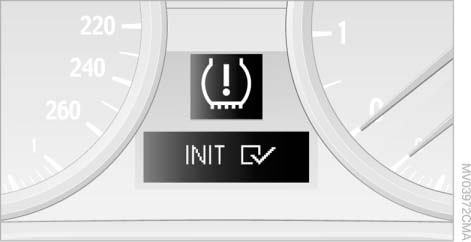
5. Start driving.
Initialization completes while driving without a confirmation message.
Tire Damage Message
 The warning lamp has illuminated in red, and a gong sounds: a puncture or significant pressure loss in one of the tires.
1. Carefully reduce speed to 80 km/h or lower, avoiding sharp steering and braking inputs. Do not exceed a speed of 80 km/h thereafter.
If the vehicle is not fitted with run-flat tires, as provided by the factory equipment, driving on a deflated tire may lead to a serious accident.◄
2. At the first opportunity, check the air pressure in all four tires.
 If the pressure in all tires is normal, the false warning may be caused by the tire damage indicator not having been initialized.
Initialize the system.◄
3. The permissible driving distance with a completely deflated tire can be estimated using the following guide:
► Low load (1–2 persons and empty luggage compartment): approx. 250 km.
► Medium load (2 persons and full luggage compartment, or 4 persons without luggage): approx. 150 km.
► Full load (4 or more persons and full luggage compartment): approx. 50 km.
► Driving with a trailer: approx. 50 km.
Drive without sudden maneuvers and do not exceed a speed of 80 km/h. With deflated tires, the vehicle's dynamic characteristics change. Handling during braking deteriorates, braking distance increases, and the vehicle's inherent steering behavior changes.
Unusual vibrations and loud noise while driving may indicate that the damaged tire is about to fail completely. Such a tire may begin to disintegrate and cause an accident, so reduce speed and stop in a safe place. Further driving is prohibited. Contact a BMW service center.◄
System malfunctions
 The warning lamp has illuminated in yellow: the tire damage indicator is experiencing a malfunction or is faulty. Have the system checked by a BMW service center as soon as possible.
Test yourself
A quick BMW X3 quiz: every answer comes with an explanation and a link to the manual page.