Wheel replacement
Fitting tires of different types to the wheels may cause loss of vehicle control while driving.
All tires must be the same size, of the same brand, and of the same type (radial or bias-belted). Otherwise, the vehicle's handling may deteriorate and an accident may occur. In addition, using tires of a brand, type, or size other than recommended may damage the vehicle. Therefore, all wheels must have tires of the same size, brand, and type.
Depending on the version, the vehicle may be equipped with a tire repair kit instead of a spare wheel.
Before changing a wheel, make the following preparations and read the instructions below:
- Pull off the road to a safe location, away from traffic.
- Park the vehicle on level, hard, dry ground. Set the front wheels straight ahead.
- Apply the parking brake and select 1st or reverse gear.
For an automatic transmission, select position P.
- Switch off the engine and remove the key from the ignition.
- Turn on the hazard warning lights.
- Chock the wheel diagonally opposite the one being changed by placing wedges, wooden blocks, or stones in front of and behind it.
- All passengers must leave the vehicle.
- Remove the spare wheel.
- Do not change more than one wheel at a time.
- Use the jack only for changing a wheel after a puncture; do not use it for seasonal changing of winter and summer tires.
- If the ground is soft, place a rigid support plate up to 1 cm thick under the jack.
- No people or animals may be inside the vehicle while it is supported by the jack.
- Never lie under a vehicle that is raised on a jack.
- Do not start the engine while the vehicle is supported by the jack.
- Clean the wheel nuts and threads before fitting the wheel.
Using the jack to repair another vehicle may damage the jack or the vehicle and may cause personal injury.
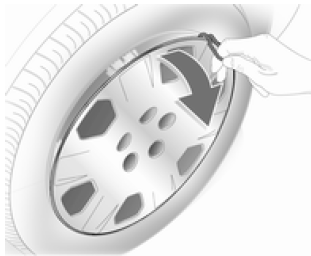
- Pry off the wheel trim with a flat-blade screwdriver.
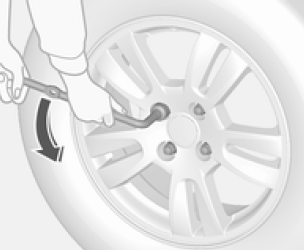
- Position the wrench accurately on each wheel nut and loosen it by half a turn, working in sequence.
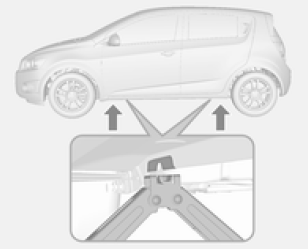
- Turn the jack handle to raise the lifting head slightly, then position the jack vertically at the point marked by the half-circle.
- Attach the handle to the jack and fit the wrench to the jack handle.
Then raise the jack so that the lifting head engages firmly with the opening.
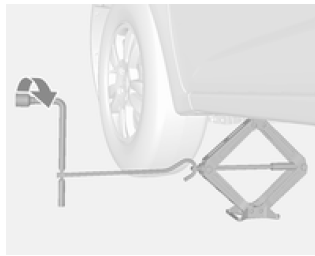
- Turn the wrench while controlling the jack position until the wheel lifts off the ground.
- Remove the wheel nuts.
- Replace the wheel.
- Install the wheel nuts.
- Lower the vehicle.
- Position the wrench accurately on each wheel nut and tighten it. Tighten the nuts in a crisscross (star) pattern.
- Before installing the wheel trim, align the valve hole with the tire valve.
Install the wheel nut caps.
- Stow the removed wheel and vehicle tools. To prevent rattling during travel, turn the bolt head so that the upper and lower parts of the jack fully press against the tool case after the jack is returned to its original position. At this point, make sure the jack has some clearance from the other vehicle tools.
- Check the tire pressure of the installed wheel and the wheel nut torque as soon as possible.
Replace the damaged tire with a new one or have it repaired.
Test yourself
A quick Chevrolet Aveo quiz: every answer comes with an explanation and a link to the manual page.